
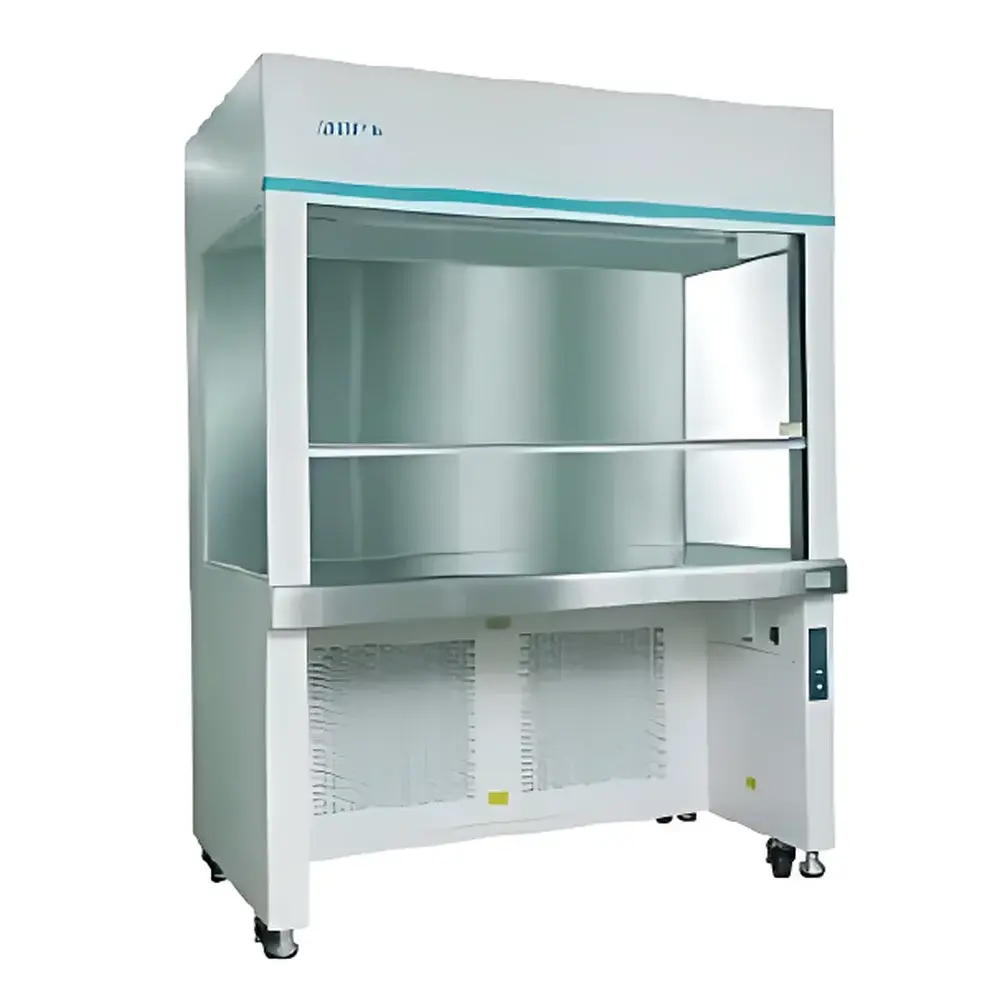
SuJing Antai VS-1300L-U Vertical Laminar Flow Clean Bench
| Brand | SuJing Antai |
|---|---|
| Origin | Jiangsu, China |
| Model | VS-1300L-U |
| Instrument Type | Vertical Laminar Flow Clean Bench |
| Cleanliness Class | ISO Class 5 (equivalent to Fed. Std. 209E Class 100) |
| Noise Level | ≤62 dB(A) |
| Operating Configuration | Dual-Operator, Single-Face |
| Average Air Velocity | 0.3–0.6 m/s (adjustable) |
| Vibration (Half-Peak) | ≤4 µm |
| Illuminance | ≥300 lx |
| Power Supply | AC 220 V, 50 Hz |
| Max. Power Consumption | 0.4 kW |
| Net Weight | 230 kg |
| Work Area Dimensions (W×D×H) | 1120 × 650 × 720 mm |
| Overall Dimensions (W×D×H) | 1300 × 825 × 1760 mm |
| HEPA Filter Specification | 610 × 610 × 50 mm × 2 units |
| Lighting | 30 W Fluorescent Lamp × 1, 30 W UV Lamp × 1 |
| Microbial Contamination | ≤0.5 CFU/plate·hour |
Overview
The SuJing Antai VS-1300L-U is a vertically oriented laminar flow clean bench engineered for ISO Class 5 (Fed. Std. 209E Class 100) particulate control in non-sterile but contamination-sensitive laboratory environments. It operates on the principle of unidirectional vertical airflow: ambient air is drawn through a prefilter, conditioned, and then passed through dual high-efficiency particulate air (HEPA) filters (EN 1822 H14 rated) before being delivered downward across the work surface at a uniform, adjustable velocity of 0.3–0.6 m/s. This laminar flow profile minimizes turbulence-induced particle resuspension and ensures consistent protection of samples from airborne contaminants—including dust, aerosols, and viable microorganisms—during routine handling, assembly, or inspection tasks. Designed for dual-operator use with a single-face configuration, the unit meets fundamental requirements for aseptic technique support in electronics prototyping, precision instrumentation calibration, pharmaceutical raw material weighing, and chemical reagent dispensing—where sterility is not mandated but particulate integrity is critical.
Key Features
- Vertically oriented laminar airflow architecture with dual 610 × 610 × 50 mm HEPA filters (H14 grade), providing ≥99.995% efficiency at 0.3 µm particle size
- Adjustable air velocity via touch-sensitive voltage controller, enabling precise optimization of flow dynamics for varying procedural demands
- Stainless steel work surface and rear panel (imported grade 304), paired with tempered glass side panels for optical clarity, corrosion resistance, and ease of decontamination
- Spring-assisted vertical sash with smooth, tool-free positioning—ensuring ergonomic access while maintaining aerodynamic seal integrity
- Aluminum multi-blade pre-filter damper for fine-tuned regulation of intake airflow volume and pressure balance
- Dual lighting system: 30 W daylight-balanced fluorescent lamp for general illumination (≥300 lx at work surface) and 30 W germicidal UV-C lamp (254 nm) for post-use surface decontamination
- Structural modularity allows disassembly into transportable subassemblies without compromising airflow calibration or filter sealing integrity
Sample Compatibility & Compliance
The VS-1300L-U is intended for applications where sample integrity depends on low particulate exposure—not microbial sterility. It complies with ISO 14644-1:2015 for cleanroom classification verification protocols and supports adherence to ISO 14698-1 (biocontamination control) when integrated into broader environmental monitoring programs. While not certified for sterile compounding under USP or , it satisfies baseline requirements for non-sterile pharmaceutical manufacturing (e.g., excipient handling per ICH Q5C), electronics cleanroom staging (JEDEC J-STD-001), and GLP-compliant analytical sample preparation. The ≤0.5 CFU/plate·hour microbial performance metric was validated per ISO 14698-2 using settle plate methodology under controlled room conditions (ISO Class 8 background environment).
Software & Data Management
This clean bench operates as a standalone mechanical system with no embedded firmware or digital interface. All operational parameters—including fan speed, sash position, and lamp activation—are managed manually via tactile controls. For laboratories implementing electronic recordkeeping under FDA 21 CFR Part 11 or EU Annex 11, external validation documentation (IQ/OQ/PQ protocols), maintenance logs, and periodic HEPA filter integrity test reports (e.g., DOP/PAO scanning per ISO 14644-3) must be maintained separately. The unit’s design facilitates integration into facility-wide HVAC monitoring systems via optional analog output modules (0–10 V or 4–20 mA) for real-time airflow and vibration status feedback.
Applications
- Electronics: PCB assembly, semiconductor component handling, and optical lens cleaning in Class 100–1000 environments
- Pharmaceuticals: Weighing of non-sterile active pharmaceutical ingredients (APIs), packaging line sampling, and stability study sample preparation
- Chemistry: Solvent transfer, titration setup, and reference standard handling where particulate interference affects analytical reproducibility
- Materials Science: Thin-film deposition staging, nanomaterial dispersion, and metrology fixture setup requiring micron-level cleanliness
- Education & R&D: Undergraduate and graduate teaching labs requiring reliable, low-maintenance laminar flow infrastructure
FAQ
Is the VS-1300L-U suitable for sterile microbiological work?
No. It is a clean bench—not a biological safety cabinet—and provides personnel and product protection only from environmental particulates, not aerosolized pathogens or operator-generated biohazards.
What HEPA filter standards does it meet?
Dual EN 1822 H14 filters are installed, delivering ≥99.995% particle removal efficiency at the most penetrating particle size (MPPS) of 0.3 µm.
Can the unit be validated for GMP compliance?
Yes—when accompanied by documented IQ/OQ/PQ protocols, annual filter integrity testing, and preventive maintenance records aligned with ISO 14644-2:2015 surveillance requirements.
Does it include alarm or monitoring outputs?
Not by default; however, analog signal interfaces can be added during installation to feed airflow and vibration status into building management systems.
What is the recommended service interval for prefilter and HEPA replacement?
Prefilters should be inspected monthly and replaced every 3–6 months depending on ambient particulate load; HEPA filters require integrity testing semiannually and replacement every 5–7 years under typical lab usage.



