
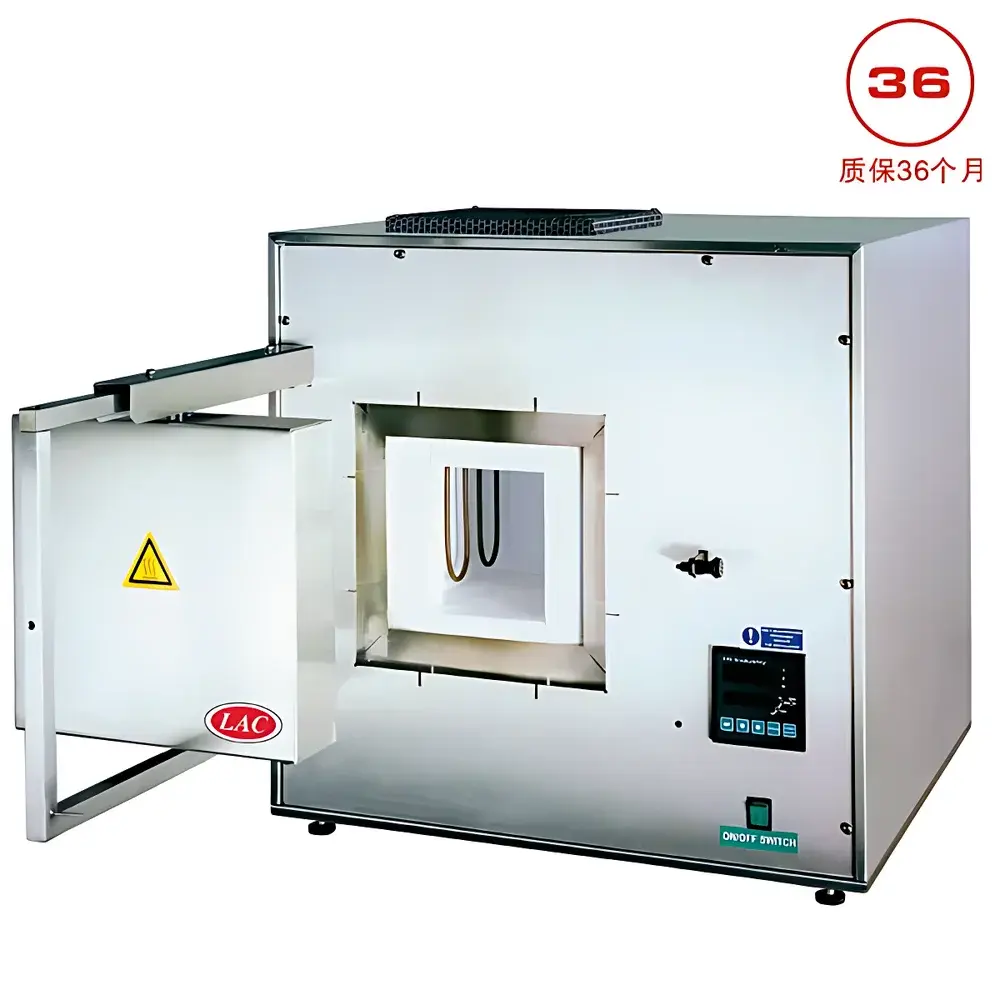
LAC VP02/17 High-Temperature Box Furnace (1700 °C)
| Brand | LAC |
|---|---|
| Origin | Czech Republic |
| Model | VP02/17 |
| Max Temperature | 1700 °C |
| Temperature Uniformity | ±1 °C |
| Max Power | 3 kW |
| Ramp Time to 1700 °C | 135 min |
| Heating Element | Silicon Molybdenum (MoSi₂) Rods |
| Internal Chamber Dimensions | 130 × 150 × 135 mm (W × H × D) |
| Controller | HT205 (30 programs, 15 segments each, LAN interface) |
| Thermocouple Type | Type B |
| Door Operation | Manual side-opening with safety limit switch |
| Cooling | Integrated fan for electronic components |
| Exhaust Port | Standard |
| Configuration | Benchtop design |
Overview
The LAC VP02/17 is a precision-engineered high-temperature box furnace designed for demanding laboratory and R&D applications requiring stable thermal environments up to 1700 °C. Built on a robust refractory architecture with dual-layer insulation and MoSi₂ heating elements, it operates on the principle of resistive radiant heating—optimized for uniform temperature distribution in small-volume chambers. Unlike general-purpose muffle furnaces, the VP02/17 is specifically calibrated and thermally validated for sustained operation above 1200 °C; prolonged use below this threshold is strongly discouraged due to irreversible degradation of MoSi₂ element microstructure and compromised thermal homogeneity across the chamber. Its benchtop footprint and rigid mechanical construction make it suitable for integration into controlled-atmosphere workflows, materials synthesis labs, and ceramic sintering protocols where reproducibility at extreme temperatures is critical.
Key Features
- High-stability MoSi₂ heating elements rated for continuous operation at 1700 °C, with optimized geometry for minimized thermal gradient across the chamber
- Advanced HT205 programmable controller featuring 30 user-defined thermal profiles, each supporting up to 15 ramp-hold segments, and integrated LAN connectivity for remote monitoring and script-based control
- Precision Type B thermocouple (PtRh30–PtRh6) with cold-junction compensation, certified for accuracy within ±1 °C across the full operating range
- Benchtop configuration with manual side-hinged door incorporating a mechanical limit switch for interlocked power cutoff during door opening
- Dual-zone insulation system combining high-purity alumina fiberboard and low-conductivity ceramic wool, minimizing external surface temperature rise and energy consumption
- Integrated cooling fan dedicated to thermal management of solid-state relays and controller electronics, ensuring long-term reliability under repeated thermal cycling
- Standard exhaust port (M12 thread) compatible with flexible ducting or vacuum manifold integration for off-gas evacuation or inert gas purging
Sample Compatibility & Compliance
The VP02/17 accommodates crucibles and sample holders up to 130 mm wide × 150 mm high × 135 mm deep, supporting standard alumina, zirconia, and graphite containers. It is not intended for organic or volatile-laden samples without auxiliary gas handling. The furnace complies with IEC 61000-6-3 (EMC emission standards) and IEC 61000-6-2 (immunity), and its electrical safety design conforms to IEC 61010-1 for laboratory equipment. While not intrinsically safe, optional inert atmosphere ports (N₂, Ar) enable operation under controlled gas flow per ASTM E1112 and ISO 8501-1 requirements. For GLP/GMP environments, optional HTMonit software provides audit-trail-capable data logging compliant with FDA 21 CFR Part 11 when paired with HT200 controller upgrades.
Software & Data Management
The HT205 controller supports local program execution and real-time temperature logging via LAN interface (TCP/IP). Optional HT200 controller upgrade adds USB 2.0, RS-232, and EIA-485 serial interfaces, enabling direct integration with LabVIEW, MATLAB, or custom SCADA systems. HTMonit suite—comprising Windows-based acquisition software and USB-to-LAN bridge—enables synchronized multi-furnace monitoring, automated report generation (PDF/CSV), and timestamped calibration event tracking. All logged data include metadata such as operator ID, program name, segment index, and thermocouple voltage raw values—essential for traceability in ISO/IEC 17025-accredited testing laboratories.
Applications
- Sintering of advanced ceramics (e.g., SiC, AlN, YSZ) and ultra-high-temperature composites
- Heat treatment of refractory metals (Mo, W, Nb) and intermetallic alloys
- Thermal gravimetric analysis (TGA) pre-conditioning and ashing protocols per ASTM E1131
- Calibration of high-temperature reference standards and fixed-point cells (e.g., Co–C, Pd–C)
- Crystallization studies of oxide glasses and rare-earth-doped phosphors
- Pre-oxidation of silicon carbide fibers and matrix infiltration in CMC processing
FAQ
Why is operation below 1200 °C not recommended?
MoSi₂ heating elements undergo phase transition and oxidation kinetics that accelerate significantly below 1200 °C, leading to embrittlement, non-uniform resistance growth, and permanent loss of temperature uniformity.
Can the furnace be used under vacuum or reducing atmospheres?
No—MoSi₂ elements are incompatible with vacuum or H₂/CO-rich environments; optional inert gas inlet kits support only N₂ or Ar purging at atmospheric or slightly positive pressure.
Is the HT205 controller compliant with FDA 21 CFR Part 11?
Standalone HT205 does not provide electronic signatures or audit trails; full Part 11 compliance requires HT200 + HTMonit with user access controls and encrypted database logging.
What maintenance intervals are recommended for MoSi₂ elements?
Under nominal 1600–1700 °C cycling (≤5 cycles/week), elements typically retain specification performance for 12–18 months; visual inspection for chalking or cracking is advised every 200 h of operation.
Does the furnace include overtemperature protection?
Yes—a redundant independent overtemperature cut-off circuit (OTC) triggers at 1750 °C, de-energizing all heating zones and latching until manually reset via front-panel key switch.



