
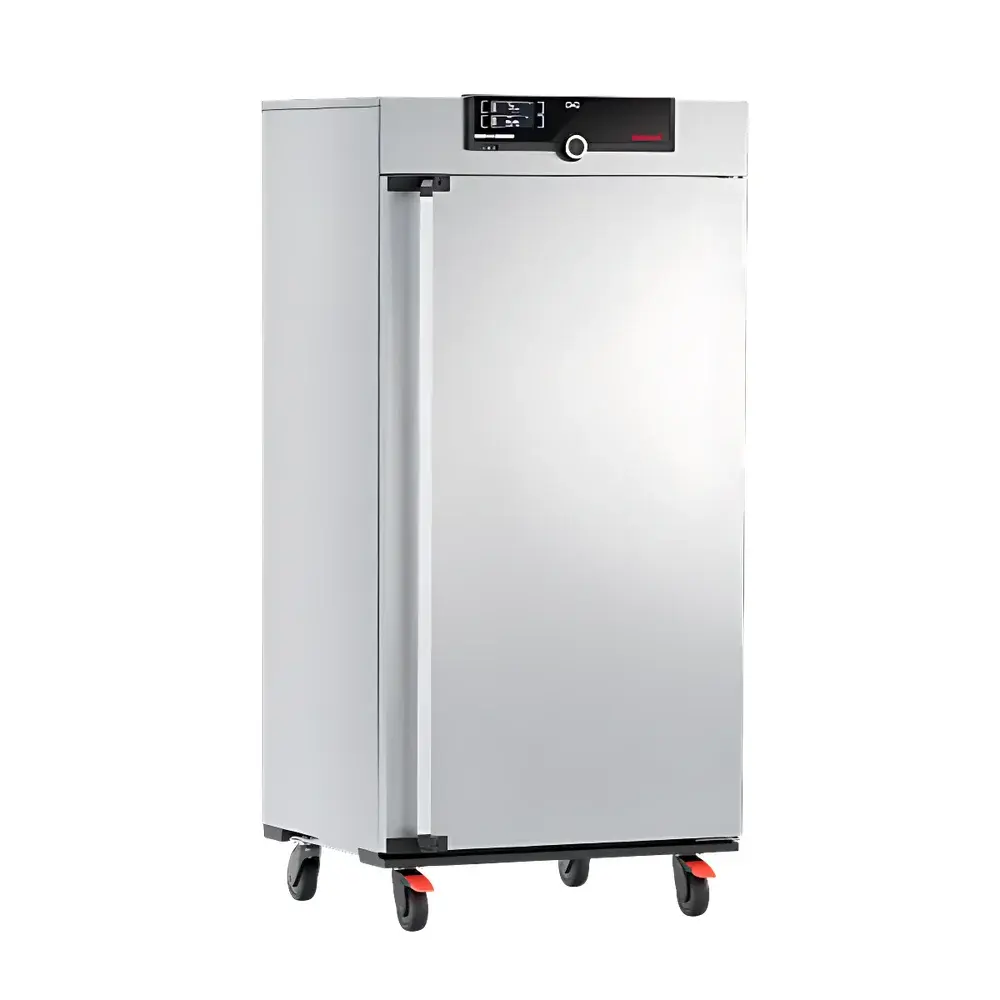
Memmert IPPeco Low Temperature Incubator (Single-Display Model)
| Brand | Memmert |
|---|---|
| Origin | Jiangsu, China |
| Manufacturer Type | Original Equipment Manufacturer (OEM) |
| Country of Manufacture | China |
| Model Variants | IPP110eco / IPP260eco / IPP410eco / IPP750eco |
| Cooling Method | Peltier Thermoelectric Module |
| Temperature Range | 0 °C to 70 °C |
| Energy Efficiency | ~90% lower power consumption vs. compressor-based incubators |
| Internal Humidity Control | Not integrated (requires separate HPPeco model) |
| Vibration Level | <0.5 µm RMS |
| Noise Level | ≤38 dB(A) |
| Air Circulation | Forced convection with tangential fan |
| Compliance | Designed per IEC 61010-1, EN 60335-1, and ISO 14644-1 Class 5 cleanroom-compatible airflow architecture |
Overview
The Memmert IPPeco Low Temperature Incubator (Single-Display Model) is an engineered solution for precise, energy-efficient temperature control in life science laboratories. Unlike conventional compressor-driven incubators, the IPPeco employs solid-state Peltier thermoelectric modules for bidirectional thermal regulation—enabling both heating and active cooling within a single, compact chassis. This technology operates on the principle of the Peltier effect: direct current applied across dissimilar semiconductor junctions induces heat transfer from one side to the other, allowing sub-ambient operation down to 0 °C without refrigerants or mechanical compression cycles. The system’s closed-loop thermal architecture eliminates internal condensation by confining moisture-sensitive condensation exclusively to external heat-sink surfaces—ensuring sample integrity in sensitive microbiological, entomological, and cell culture applications where humidity-induced contamination or thermal stratification must be avoided.
Key Features
- Peltier-based dual-mode thermal control (heating + cooling) with no CFCs, HFCs, or moving refrigerant components
- Energy-optimized operation: consumes up to 90% less electricity than equivalent compressor-based units during typical lab-use cycles (per Memmert internal validation under ISO 17025-accredited conditions)
- Ultra-low mechanical vibration (<0.5 µm RMS) and acoustic noise (≤38 dB[A])—validated for vibration-sensitive assays including insect behavioral studies and microplate-based kinetic assays
- Forced-air convection using a brushless tangential fan ensures uniform temperature distribution (±0.3 °C at 37 °C, per DIN 12880-1 test protocol)
- Compact footprint with front-accessible chamber design; stainless steel interior (AISI 304), seamless corners, and smooth-welded seams compliant with ISO 14644-1 Class 5 cleanroom maintenance standards
- Single high-resolution LCD display with intuitive menu navigation, real-time temperature graphing, and configurable alarm thresholds (deviation, door open, sensor fault)
Sample Compatibility & Compliance
The IPPeco accommodates standard laboratory vessels—including Petri dishes, multiwell plates, flasks, and vials—without compromising thermal homogeneity or introducing mechanical disturbance. Its absence of internal condensation supports long-term incubation of hygroscopic or desiccation-sensitive samples (e.g., fungal spore cultures, cryopreserved cells post-thaw, and low-moisture insect rearing media). While the IPPeco does not provide active humidity control, its sealed thermal envelope maintains ambient RH stability better than open-loop compressor systems. Regulatory alignment includes design conformity to IEC 61010-1 (Safety Requirements for Electrical Equipment for Measurement, Control, and Laboratory Use), EN 60335-1 (Household and Similar Electrical Appliances Safety), and electromagnetic compatibility per EN 61326-1. For GLP/GMP environments, optional audit-trail logging and password-protected parameter locking are available via firmware upgrade.
Software & Data Management
The single-display interface supports local data logging (up to 30 days of 1-minute interval temperature records) with USB export capability (CSV format). Optional PC connectivity via RS232 or Ethernet enables integration into centralized lab monitoring systems (e.g., LabVantage, Thermo Fisher SampleManager). All logged data include timestamp, setpoint, actual chamber temperature, and operational status flags—fully traceable for FDA 21 CFR Part 11 compliance when paired with validated electronic signature modules and role-based access controls. Firmware updates are delivered via encrypted .bin files with SHA-256 checksum verification.
Applications
- Low-temperature microbial growth studies (e.g., psychrotrophic bacteria, cold-adapted yeasts)
- Insect rearing and developmental biology experiments requiring vibration-free environments
- Enzyme activity assays conducted below ambient temperature to modulate reaction kinetics
- Post-thaw viability assessment of cryopreserved primary cells and stem cell lines
- Stability testing of biologics and diagnostics under controlled sub-ambient conditions per ICH Q5C guidelines
- Environmental simulation for ecological and agricultural research (e.g., overwintering physiology, seed germination thresholds)
FAQ
Does the IPPeco support humidity control?
No—the IPPeco is a temperature-only incubator. For combined temperature and humidity regulation, Memmert offers the HPPeco series, which uses complementary Peltier-based humidification and dehumidification modules.
Can the IPPeco operate continuously at 0 °C in a 30 °C ambient environment?
Yes—its Peltier system is rated for continuous operation across the full 0–70 °C range under standard laboratory ambient conditions (15–30 °C, ≤70% RH), verified per DIN 12880-1 Annex B thermal load testing.
Is the unit suitable for GMP-regulated environments?
It meets core hardware safety and EMC requirements; full 21 CFR Part 11 compliance requires configuration with optional audit-trail firmware, electronic signatures, and documented IQ/OQ protocols provided by authorized Memmert service partners.
What maintenance is required?
No routine refrigerant servicing or compressor oil changes. Recommended annual calibration of the PT100 sensor and visual inspection of fan intake filters per ISO/IEC 17025 maintenance schedules.
How does the Peltier system achieve higher energy efficiency than compressor-based units?
By eliminating parasitic losses associated with compressors (e.g., start-up surge, oil circulation, refrigerant phase-change hysteresis), and delivering power only during active heating or cooling phases—unlike compressors that cycle on/off with inherent thermal lag and overshoot.



