
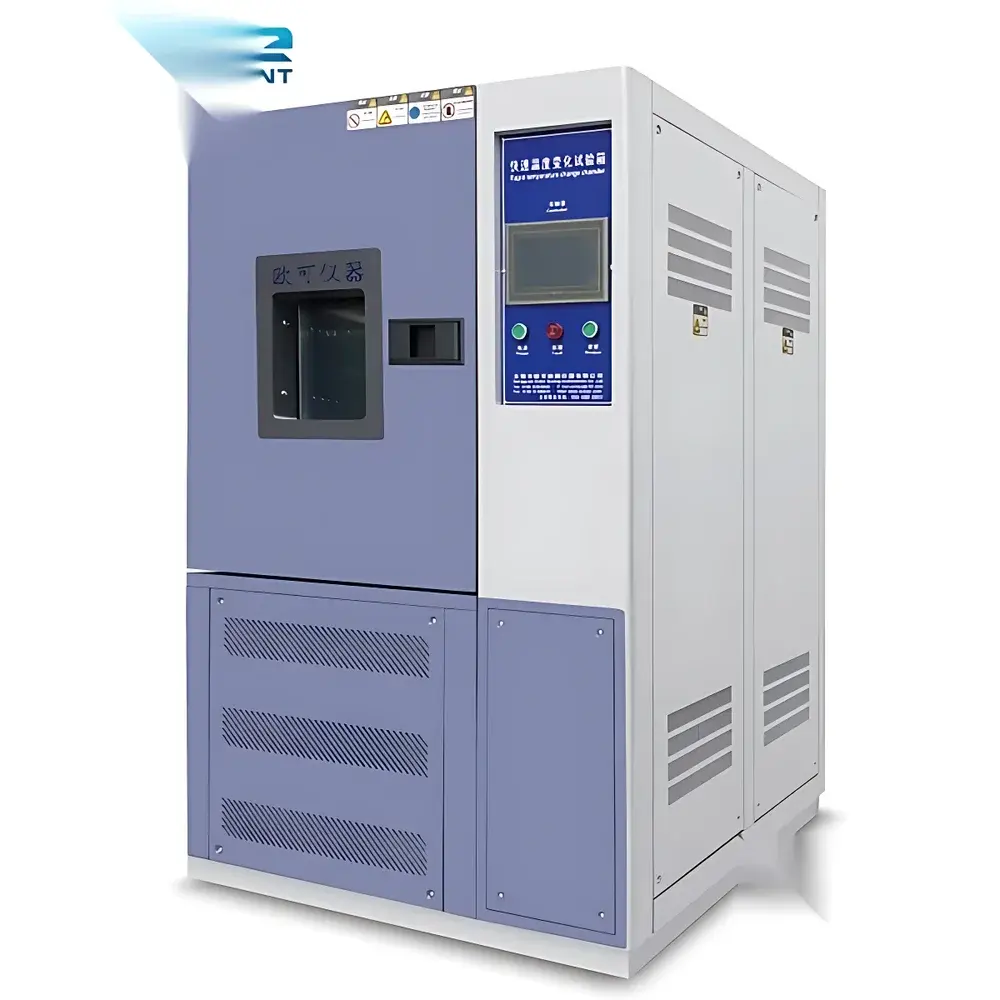
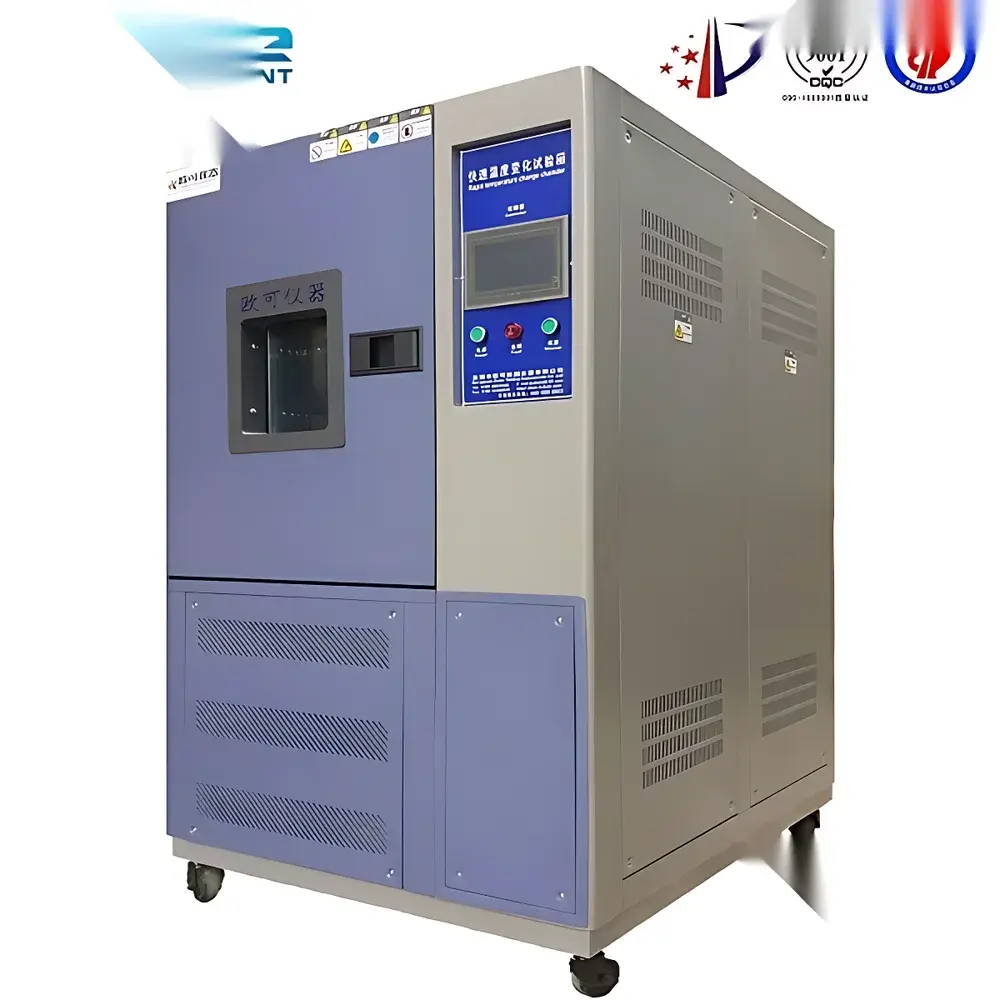
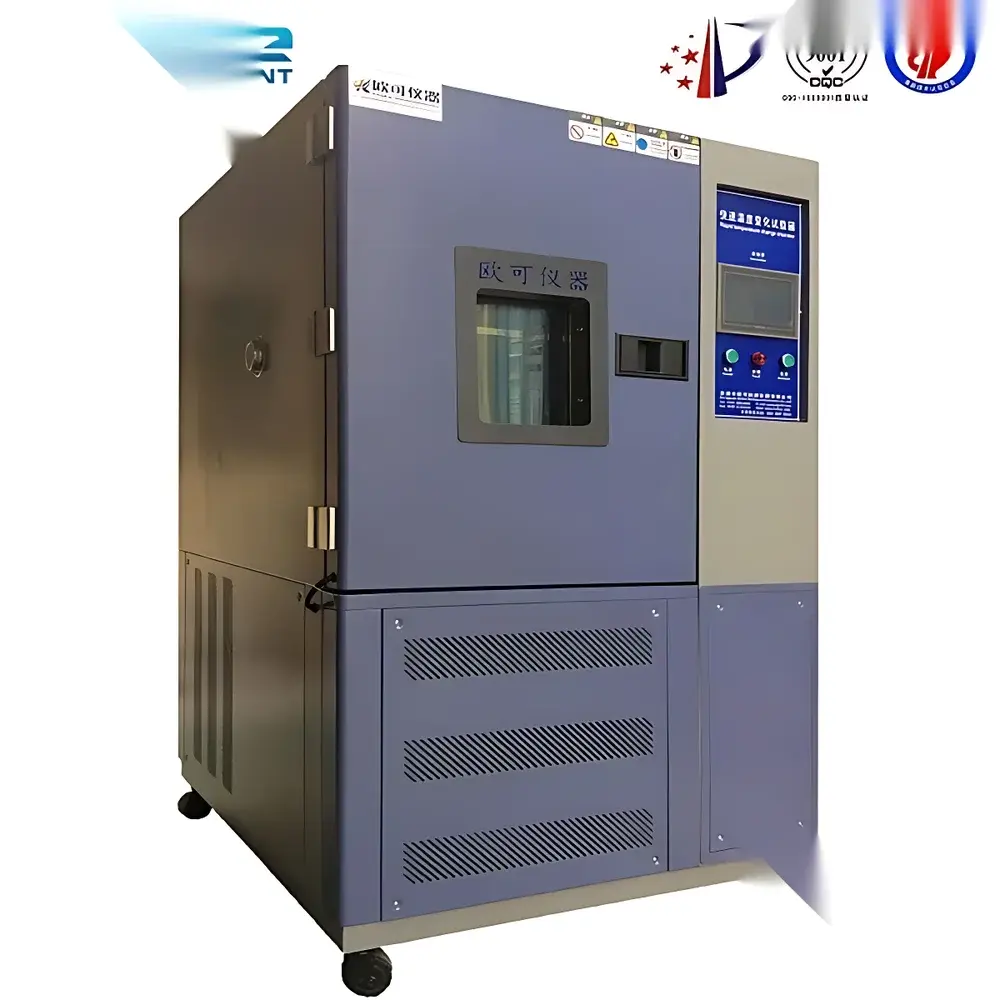
English Product Name
| KS-TH Series Rapid Temperature Transition Chamber (Model Range | KS-TH-80 to KS-TH-1000, Configurable Low-Temperature Options A–F) |
|---|---|
| Brand | Other Brands |
| Origin | Imported |
| Manufacturer Type | Authorized Distributor |
| Price | USD 13,500–18,500 (FOB) |
| Internal Dimensions (W×H×D) | 40×50×40 cm to 100×100×100 cm |
| External Dimensions (W×H×D) | 120×165×115 cm to 190×210×185 cm |
| Temperature Range | Low Temp Options: +25°C (A), 0°C (B), −20°C (C), −40°C (D), −60°C (E), −70°C (F) |
| High Temp | 100°C standard / 150°C optional |
| Humidity Range | 20–98% RH (standard), 10–98% RH (optional), 5–98% RH (custom configuration) |
| Temperature Resolution/Accuracy | 0.1°C / ±2.0°C |
| Humidity Resolution/Accuracy | 0.1% RH / ±3.0% RH |
| Thermal Transition Mode | Airflow-switched dual-zone or tri-zone chamber architecture |
| Max Cycle Count | 9999 cycles |
| Max Dwell Time per Zone | 9999 minutes |
| Cooling System | Dual-stage refrigeration (air-cooled or water-cooled variants available) |
| Control Interface | Full-color LCD touchscreen with bilingual (English/Chinese) GUI |
Overview
The KS-TH Series Rapid Temperature Transition Chamber is an engineered environmental test system designed for accelerated thermal stress evaluation of electronic components, automotive modules, aerospace assemblies, and packaging materials. It implements a three-zone physical architecture—comprising independent high-temperature, low-temperature, and test chambers—connected via pneumatically actuated airflow ducts. Unlike single-chamber thermal cycling systems, this design eliminates thermal mass interference during transitions, enabling repeatable, high-fidelity temperature ramping rates up to 15°C/min (typical, dependent on selected low-temp option and load conditions). The chamber operates on the principle of rapid air transfer rather than direct heating/cooling of the test volume, thereby minimizing thermal overshoot, reducing stabilization time, and improving test repeatability across IEC 60068-2-14, MIL-STD-810H Method 503.7, and JESD22-A104 compliant protocols.
Key Features
- Modular three-zone configuration with thermally isolated compartments, each equipped with independent PID-controlled heating and dual-stage refrigeration circuits.
- Configurable low-temperature capability spanning from ambient (+25°C) down to −70°C (Option F), supporting qualification testing per ISO 16750-4 and AEC-Q200 requirements.
- High-resolution environmental control: 0.1°C temperature resolution and 0.1% RH resolution, with uniformity maintained within ±2.0°C and ±3.0% RH across the working volume (per ASTM E744 verification).
- Intuitive full-color 7-inch TFT-LCD touchscreen interface with English/Chinese language toggle, real-time trend logging, and programmable multi-step profiles including dwell, ramp, and transition phases.
- Dual cooling options: air-cooled condensers for standard lab deployment; water-cooled variants for high-ambient or continuous-duty applications requiring stable sub-zero performance.
- Comprehensive safety architecture including over-temperature cutoff, refrigerant pressure monitoring, door interlock, and independent mechanical thermostat backup.
Sample Compatibility & Compliance
The KS-TH series accommodates samples ranging from PCB subassemblies and semiconductor packages (e.g., QFN, BGA) to larger enclosures such as ECUs, battery modules, and medical device housings. Internal dimensions—from 40×50×40 cm (KS-TH-80) to 100×100×100 cm (KS-TH-1000)—support standardized test fixtures and custom mounting solutions. All models are constructed with SUS304 stainless steel interior walls, non-outgassing insulation, and sealed electrical penetrations compliant with IP54 ingress protection. The system meets electromagnetic compatibility requirements per EN 61326-1 and is compatible with GLP/GMP documentation workflows through optional audit-trail-enabled firmware (21 CFR Part 11 ready when paired with validated software suite).
Software & Data Management
Standard operation includes embedded profile programming with up to 100 user-defined sequences, each supporting up to 999 segments. Optional PC-based software (KS-Control Suite v4.x) enables remote monitoring, automated report generation (PDF/CSV), real-time data streaming via Ethernet, and integration with LIMS platforms via Modbus TCP or OPC UA. All logged environmental data—including chamber setpoints, actual sensor readings, cycle counters, and alarm events—are timestamped and stored internally (≥30 days at 1-second sampling) with optional SD card backup. Calibration certificates traceable to NIST or national metrology institutes are provided with initial commissioning.
Applications
This chamber is routinely deployed in reliability engineering labs for thermal shock validation of solder joints (IPC-J-STD-020), plastic housing integrity (ASTM D695), conformal coating adhesion (IPC-CC-830), and hermetic seal performance (MIL-STD-883 Method 1014). Automotive Tier-1 suppliers use it for ECU cold-start simulation and power module lifetime projection under cyclic thermal loads. In R&D environments, it supports material selection studies involving polymer crystallinity shifts, elastomer compression set behavior, and MEMS package warpage quantification. Its precise humidity control also permits combined temperature-humidity stress testing aligned with JEDEC JESD22-A110 and IEC 60068-2-30.
FAQ
What is the difference between thermal shock and temperature cycling?
Thermal shock involves rapid transfer of test specimens between extreme temperature zones (typically >15°C/min ramp rate), inducing transient mechanical stress. Temperature cycling uses slower, controlled ramps within a single chamber and emphasizes cumulative fatigue effects.
Can the KS-TH chamber perform humidity-controlled thermal shock?
Yes—models configured with humidity capability support combined temperature/humidity shock testing within the 5–98% RH range, subject to low-temperature dew point limitations (e.g., humidity not feasible below −40°C without specialized dehumidification).
Is calibration and validation support included?
Factory calibration is performed pre-shipment using traceable reference sensors. IQ/OQ documentation templates and third-party validation services (per ISO/IEC 17025) are available upon request.
What maintenance intervals are recommended?
Refrigeration oil and filter replacement every 24 months; door gasket inspection quarterly; sensor verification annually or per internal quality protocol.
Does the system support remote diagnostics?
Yes—Ethernet connectivity enables secure remote access for firmware updates, log retrieval, and diagnostic mode activation by authorized service engineers.



