
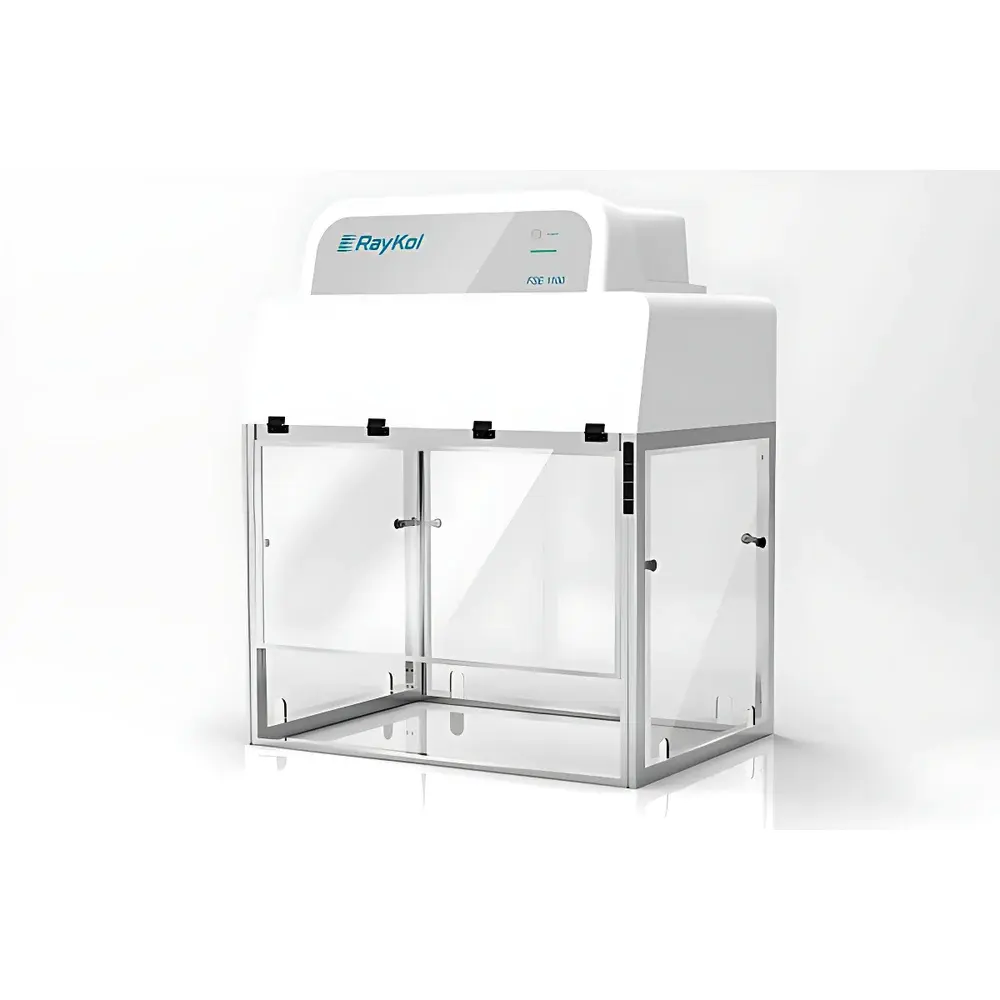
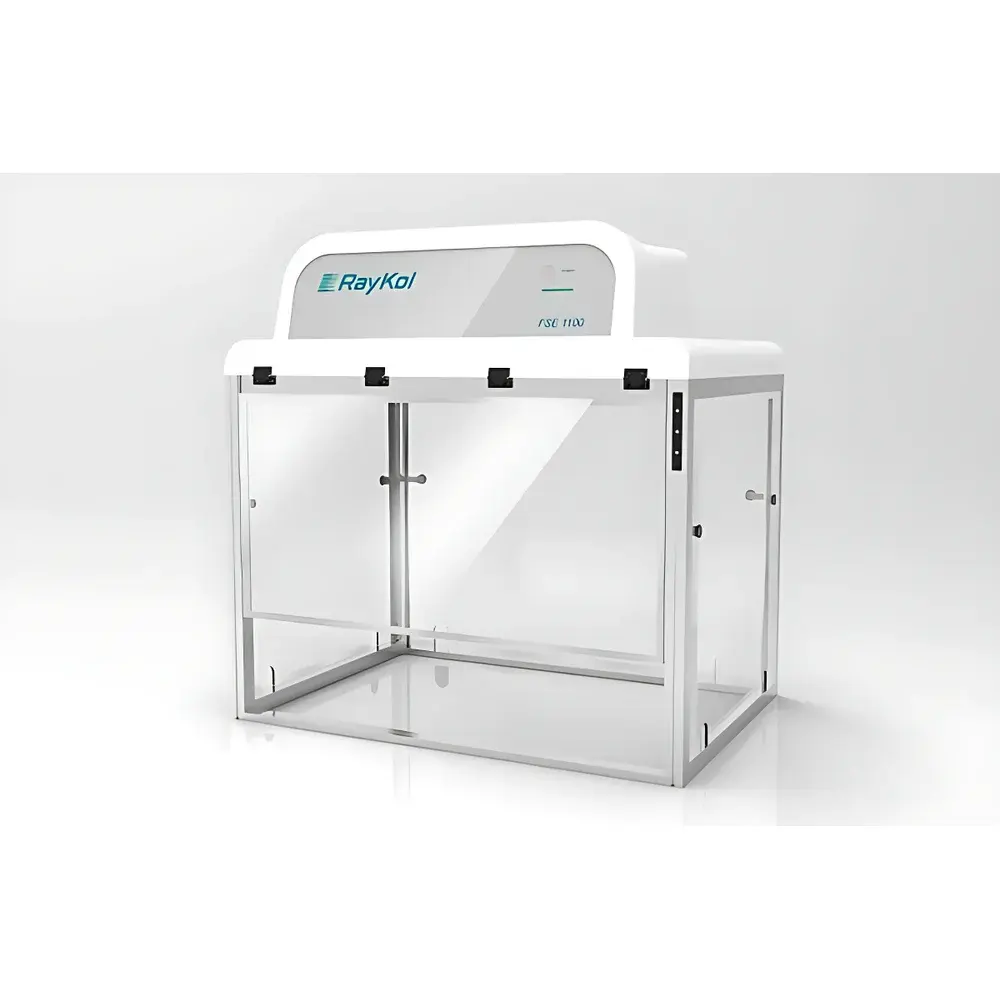
Raykol FSE 1100 Ductless Instrument Safety Cabinet
| Brand | Raykol |
|---|---|
| Origin | Fujian, China |
| Manufacturer Type | Direct Manufacturer |
| Country of Origin | China |
| Model | FSE 1100 |
| Price Range | USD 2,800 – 7,000 (estimated) |
| Cabinet Material | Polypropylene (PP) |
| Configuration | Single-Face Ductless Fume Hood |
| Optional Interior Heights | 800 mm / 1100 mm |
| Pre-Filter Type | Electrostatically Charged Primary Filter |
| Main Filtration Media | Imported Activated Carbon (10 kg capacity) |
| Viewing Panel Material | Polycarbonate (PC), Fully Transparent & Modular |
| Power Requirement | Standard 220 V AC, 50 Hz |
| Fan System | Low-Noise, Energy-Efficient Centrifugal Blower |
| Airflow Mode | Recirculating (Ductless) with Dual-Stage Filtration |
Overview
The Raykol FSE 1100 Ductless Instrument Safety Cabinet is an engineered solution for localized chemical vapor containment in analytical and preparative laboratories. Designed around a closed-loop recirculation principle, it employs dual-stage filtration—comprising an electrostatically charged primary particulate filter followed by a high-capacity activated carbon bed—to capture volatile organic compounds (VOCs), acid vapors, and fine particulates generated during instrument operation. Unlike conventional ducted fume hoods that exhaust conditioned air outdoors, the FSE 1100 filters and returns >95% of airflow into the lab environment, significantly reducing HVAC load and associated energy costs. Its structural integrity, chemical resistance, and modular enclosure meet ISO 14644-1 Class 8 cleanroom-compatible handling standards for low-emission instrumentation. The cabinet operates under stable negative pressure (–20 to –30 Pa at sash opening), verified per EN 14175-3 test protocols, ensuring consistent operator protection without reliance on building exhaust infrastructure.
Key Features
- Chemical-resistant polypropylene (PP) chassis with seamless welded joints, providing long-term stability against solvents including acetone, methanol, dichloromethane, and dilute acids.
- Modular polycarbonate (PC) transparent enclosure—fully removable and reconfigurable—enables unobstructed access for instrument maintenance, calibration, or hardware upgrades without disassembly tools.
- Electrostatic pre-filter allows safe, hot-swap replacement while the unit remains operational and maintains negative pressure integrity—eliminating workflow interruption during routine filter servicing.
- 10 kg imported granular activated carbon bed with iodine number ≥1,000 mg/g and BET surface area >1,100 m²/g, delivering extended service life (typically 6–12 months depending on VOC load profile).
- Low-power centrifugal blower (≤220 W nominal), compliant with IEC 60335-1 safety standards, optimized for continuous 24/7 operation with noise emission <58 dB(A) at 1 m distance.
- Single-face configuration with ergonomic sash height adjustment (300–600 mm working aperture), supporting integration with HPLC systems, rotary evaporators, ASE extractors, and SPE workstations.
Sample Compatibility & Compliance
The FSE 1100 is validated for use with instruments generating low-to-moderate VOC emissions (<50 ppm total hydrocarbon equivalent) under controlled operational conditions. It complies with key international safety and performance benchmarks, including EN 14175-3 (fume hood performance testing), DIN 12924-1 (ductless cabinet classification), and OSHA 29 CFR 1910.1200 (Hazard Communication Standard). While not certified for high-hazard applications such as perchloric acid digestion or hydrogen sulfide generation, its filtration architecture supports GLP-compliant documentation of filter usage cycles, airflow verification logs, and maintenance records—facilitating internal audit readiness and alignment with ISO/IEC 17025 clause 5.4.3 (equipment management).
Software & Data Management
The FSE 1100 operates as a standalone mechanical system with no embedded microprocessor or digital interface. However, optional analog airflow monitoring kits (sold separately) provide real-time static pressure differential readouts via calibrated manometers, enabling manual logging for QA/QC traceability. All filter change events, airflow verifications, and visual inspections are documented using Raykol’s standardized Lab Equipment Maintenance Log Template—a paper-based or Excel-compatible format compatible with FDA 21 CFR Part 11–aligned electronic record systems when integrated with institutional LIMS platforms.
Applications
- Enclosure for HPLC, UHPLC, and LC-MS sample introduction modules where solvent venting occurs at ambient temperature and pressure.
- Containment housing for automated solid-phase extraction (SPE) workstations and accelerated solvent extraction (ASE) systems operating below 150 °C.
- Local vapor control for rotary evaporators handling low-boiling-point solvents (e.g., ethyl acetate, hexane, diethyl ether) under vacuum.
- Operator-proximate shielding during repetitive liquid handling tasks—including pipetting, reagent addition, and vortex mixing—in analytical QC labs where full-room ventilation is impractical.
- Temporary deployment in mobile or modular laboratory units where duct installation is structurally prohibited or cost-prohibitive.
FAQ
Does the FSE 1100 require external ductwork or roof penetration?
No. It is a fully self-contained ductless system relying solely on internal filtration and recirculation.
Can the activated carbon filter be regenerated onsite?
No. Raykol specifies single-use, non-regenerable carbon media to ensure consistent adsorption kinetics and avoid desorption risks.
Is the cabinet suitable for use with nitric acid or hydrochloric acid fumes?
Not recommended. The standard carbon/PP configuration lacks impregnated carbon or alkali-treated media required for acidic gas capture.
What verification procedures are recommended prior to first use?
Perform a smoke tracer test per EN 14175-3 Annex C, confirm sash face velocity ≥0.5 m/s, and verify negative pressure differential across all panel seams using a digital micromanometer.
How often should the electrostatic pre-filter be replaced?
Typically every 3–6 months under normal lab usage; frequency increases with high particulate load (e.g., powder handling or centrifugation support).



