
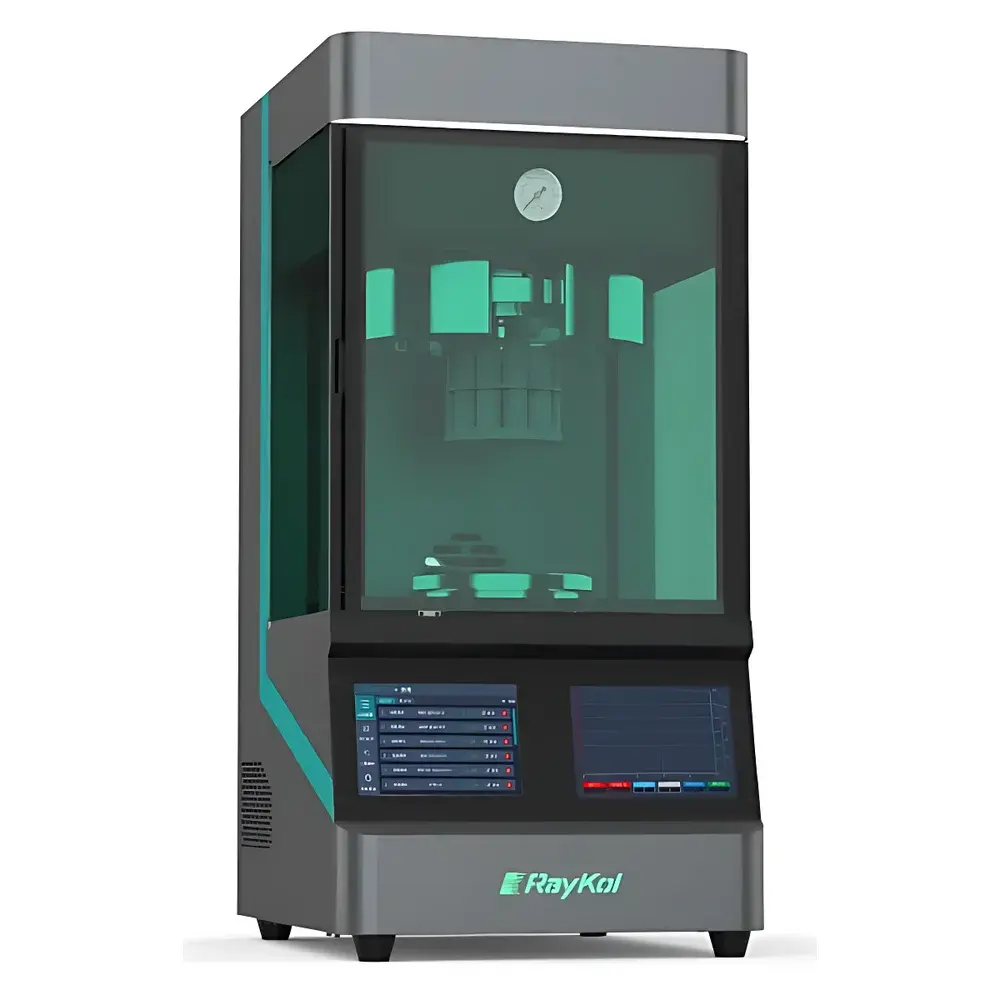
Raykol UM260 High-Throughput Super Microwave Digestion System
| Brand | Raykol |
|---|---|
| Origin | Fujian, China |
| Manufacturer Type | Original Equipment Manufacturer (OEM) |
| Country of Origin | China |
| Model | UM260 |
| Price Range | USD 77,000 – 168,000 (based on configuration) |
| Cavity Class | Industrial-Grade |
| Sample Capacity | 6 / 9 / 22 / 28 / 39 / 83 positions (customizable) |
| Max Temperature | 300 °C |
| Max Pressure | 200 bar |
Overview
The Raykol UM260 High-Throughput Super Microwave Digestion System is an industrial-grade sample preparation platform engineered for precision, reproducibility, and regulatory compliance in trace-element analysis workflows. Unlike conventional microwave digestion instruments relying on multimode cavity resonance and individual sealed vessels, the UM260 implements a patented single-chamber, water-bath-isothermal super microwave digestion architecture. It operates on the principle of controlled, high-power microwave energy delivery via bottom-directed irradiation—enabling uniform volumetric heating across all sample tubes simultaneously. This eliminates inter-vial thermal gradients and pressure differentials commonly observed in rotor-based systems. The integrated nitrogen pre-pressurization system allows rapid pressurization to 200 bar prior to microwave initiation, while the monolithic reaction chamber maintains structural integrity under sustained 300 °C/200 bar conditions—meeting ASTM D5511, ISO 11885, and USP requirements for complete matrix decomposition of refractory samples.
Key Features
- Single-isothermal reaction chamber with precision water-bath temperature control (±0.5 °C), ensuring identical thermal history for all samples within a batch
- Bottom-fed directional microwave coupling delivering >92% energy transfer efficiency—significantly higher than traditional multimode cavity reflection systems
- Industrial-grade stainless-steel cavity rated for continuous operation at 300 °C and 200 bar, validated per ASME BPVC Section VIII Division 1
- Modular sample capacity configurations: 6, 9, 22, 28, 39, or 83 positions; fully customizable layouts for specialized throughput demands
- Integrated active cooling system with dual-stage heat exchange—reducing post-digestion cycle time by up to 40% without thermal stress on magnetron or cavity walls
- Redundant safety architecture: triple-redundant pressure transducers, real-time cavity temperature mapping via four PT100 sensors, automatic overpressure venting, and fail-safe nitrogen purge interlock
- Consumables-free operation: compatible with standard 15 mL borosilicate glass test tubes for routine digestion; optional quartz or PFA liners available for ultra-trace applications
Sample Compatibility & Compliance
The UM260 accommodates diverse solid and semi-solid matrices—including silicates, polymers, biological tissues, metal alloys, and carbon-rich organics—without requiring external pressure-rated vessels or disposable liners. Its ability to sustain 200 bar enables complete dissolution of highly resistant materials such as titanium dioxide, tungsten carbide, and borosilicate glass. Method validation data demonstrate full compliance with EPA Method 3052, ISO/IEC 17025–2017 accreditation criteria, and GLP/GMP documentation requirements. All system logs—including temperature, pressure, microwave power, and gas pressure—are timestamped and stored with audit trail functionality compliant with FDA 21 CFR Part 11 for electronic records and signatures.
Software & Data Management
The UM260 is operated via Raykol’s Digilab™ Control Suite—a Windows-based application supporting method library management, multi-step ramp/hold programming, real-time parameter visualization, and automated report generation in PDF or CSV format. The software includes built-in calibration verification routines for pressure and temperature sensors, configurable user access levels (admin/operator/auditor), and encrypted local database storage. Data export supports LIMS integration through ASTM E1384-compliant XML schema. All method parameters, run logs, and error events are retained for ≥10 years per internal archive policy, satisfying long-term traceability mandates in environmental and pharmaceutical QA/QC laboratories.
Applications
- Environmental testing: total recoverable metals in soils, sediments, and fly ash per EPA SW-846 Methods 3050B and 3052
- Pharmaceutical quality control: residual catalyst quantification in API intermediates and excipient screening per ICH Q2(R2)
- Food and feed safety: Pb, Cd, As, Hg determination in fortified cereals, infant formula, and animal feedstuffs (AOAC 999.10, EN 13805)
- Geochemical analysis: rare earth element (REE) extraction from monazite and bastnäsite ores under closed-vessel high-pressure conditions
- Materials science: dissolution of Ni-based superalloys and ceramic composites prior to ICP-MS or ICP-OES analysis
- Plastics and polymers: Cr, Co, Sb quantification in PET bottles and flame-retardant additives per ISO 11339
FAQ
Does the UM260 require proprietary consumables or disposable vessels?
No—the system is designed for open-tube digestion using standard 15 mL borosilicate glass test tubes. Optional quartz or PFA liners are available for ultra-low background applications.
Can the UM260 be integrated into an automated sample prep line?
Yes—RS-232 and Ethernet interfaces support third-party robotic arm synchronization and LIMS-triggered method execution.
Is validation documentation provided for regulatory submissions?
Yes—each unit ships with Factory Acceptance Test (FAT) reports, IQ/OQ protocols, and a comprehensive User Requirement Specification (URS) alignment document.
What maintenance intervals are recommended for industrial continuous-use environments?
Magnetron output calibration and pressure sensor verification are recommended every 500 operating hours; cavity interior inspection every 2,000 hours.
How does the UM260 compare to rotor-based microwave digesters in terms of method transferability?
Method parameters (acid volume, ramp rate, hold time) translate directly from established rotor-based protocols—no re-optimization is required due to identical kinetic profiles and thermal homogeneity.



