
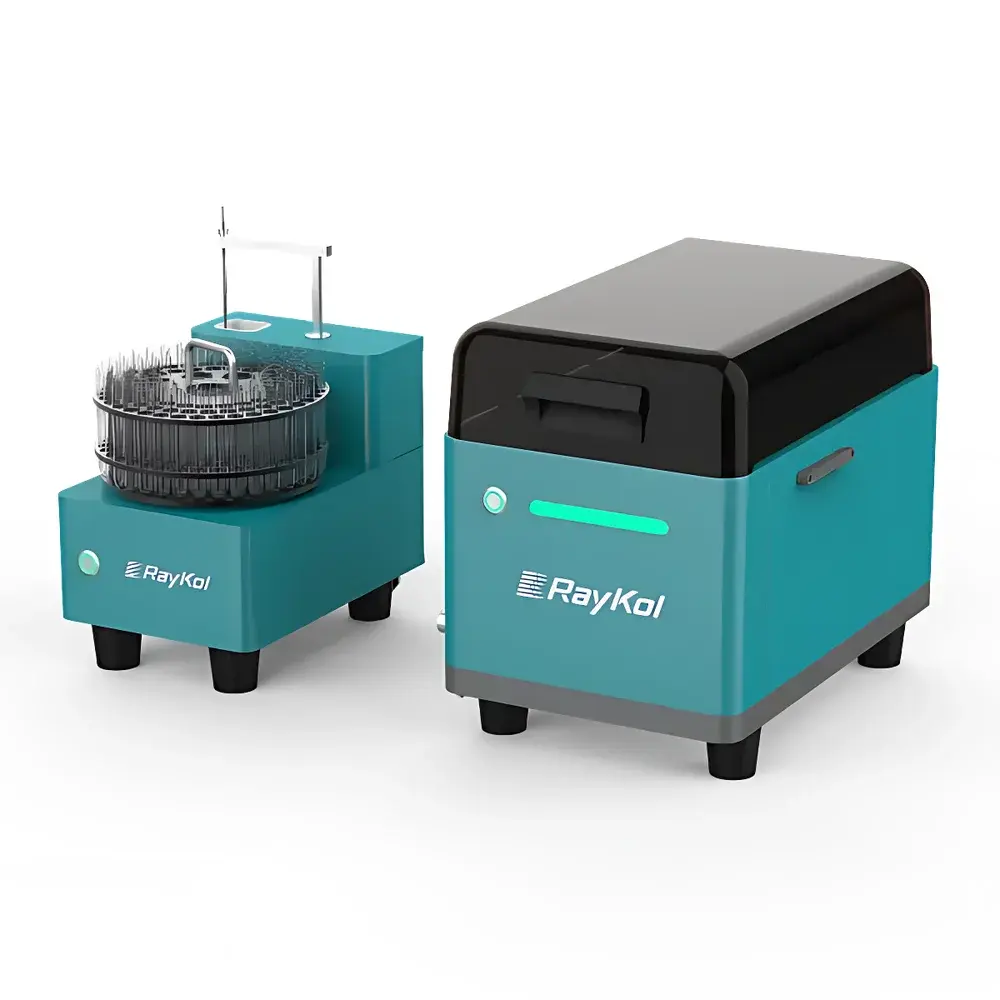
Raykol RKCF-200 Automated Continuous Flow Analyzer
| Brand | Raykol |
|---|---|
| Origin | Fujian, China |
| Manufacturer Type | Original Equipment Manufacturer (OEM) |
| Product Category | Domestic |
| Model | RKCF-200 |
| Product Type | Continuous Flow Analyzer |
| Wavelength Range | 340–1100 nm |
| Sample Capacity | 81 positions |
| Flow Cell Path Length | 1–5 cm |
| Light Source | LED |
Overview
The Raykol RKCF-200 Automated Continuous Flow Analyzer is an engineered solution for high-throughput, multi-parameter water quality analysis based on the gas-segmented continuous flow analysis (CFA) principle. This technique relies on discrete air bubbles introduced between successive sample and reagent segments to physically separate reaction zones within a single capillary manifold, eliminating carryover and cross-contamination while ensuring consistent reaction time, mixing efficiency, and thermal equilibrium. The system is optimized for spectrophotometric detection of nitrogen- and phosphorus-containing analytes—including total nitrogen (TN), total phosphorus (TP), phosphate (PO₄³⁻), nitrate-nitrogen (NO₃⁻-N), nitrite-nitrogen (NO₂⁻-N), and ammonia-nitrogen (NH₃-N)—in environmental, regulatory, and food safety laboratories. Its modular architecture supports standardized, repeatable method execution aligned with internationally recognized analytical protocols.
Key Features
- Gas-segmented CFA architecture ensures robust physical separation of sample zones, minimizing memory effects and enabling high reproducibility across extended run times.
- Modular optical detection module equipped with a stable, low-drift dual-beam LED photometer operating across 340–1100 nm—optimized for common colorimetric reactions used in environmental chemistry (e.g., indophenol blue, molybdenum blue, diazotization).
- Interchangeable flow cells with selectable path lengths (1–5 cm) allow sensitivity tuning per analyte: shorter paths for high-concentration applications; longer paths for trace-level detection without dilution.
- Quartz-based reaction coils provide superior chemical inertness, mechanical durability, and resistance to clogging—eliminating the need for pre-filtration or degassing of samples or reagents.
- Independent parallel channels support concurrent analysis of up to six parameters without hardware modification, reducing per-sample turnaround time and improving laboratory throughput.
- Fully integrated control software enables synchronized operation of peristaltic pumps, valve sequencing, detector acquisition, and data logging—all from a single interface with configurable method templates.
Sample Compatibility & Compliance
The RKCF-200 is validated for use with aqueous matrices including surface water, groundwater, wastewater effluent, seawater (per HJ 442.3–2020), soil extracts (NY/T 1121.25–2012), tobacco digests (YC/T 296–2009, YC/T 343–2010), and food extracts (GB 5009.33). It meets performance criteria outlined in multiple Chinese national and industry standards, including HJ 665–2013 (ammonia-N), HJ 670–2013 (phosphate/TP), T/NAIA 0247–2023 (nitrate-N), GB/T 5750.5–2023 (drinking water), and YC/T 245–2008 (tobacco ammonia). While not certified to ISO/IEC 17025 or FDA 21 CFR Part 11 out-of-the-box, its audit-ready data structure—including timestamped raw absorbance values, method versioning, and user-action logs—supports laboratory implementation of GLP/GMP-compliant workflows when paired with appropriate procedural controls.
Software & Data Management
The proprietary CFA Control Suite provides method-driven automation with intuitive drag-and-drop protocol building. Each analytical channel operates independently with dedicated calibration curves, blank subtraction routines, and real-time QC flagging (e.g., drift alerts, peak shape validation). All spectral data are stored in vendor-neutral CSV and XML formats compliant with LIMS integration requirements. Audit trails record operator ID, method name, injection time, calibration status, and instrument configuration changes—facilitating traceability and internal review. Software updates are delivered via secure HTTPS, and local backup scheduling is configurable to meet institutional IT policies.
Applications
- Regulatory environmental monitoring programs requiring adherence to HJ-series standards for coastal, riverine, and wastewater discharge compliance.
- Drinking water utilities performing routine TP/TN screening per GB/T 5750.5–2023.
- Food safety labs quantifying nitrate/nitrite in processed meats and vegetables per GB 5009.33.
- Agricultural research facilities analyzing soil-available phosphorus and leachate nitrogen species.
- Tobacco quality control laboratories implementing YC/T-series methods for inorganic nitrogen and phosphate profiling.
- Educational institutions teaching core principles of segmented flow chemistry, reaction kinetics, and automated spectrophotometry.
FAQ
What detection principle does the RKCF-200 employ?
It utilizes gas-segmented continuous flow analysis coupled with LED-based dual-beam absorbance detection at user-selectable wavelengths between 340 nm and 1100 nm.
Can the system be validated for ISO/IEC 17025 accreditation?
Yes—when operated under documented SOPs with calibrated reference materials, traceable standards, and full audit trail activation, it supports method validation per ISO/IEC 17025 clause 7.2 and 7.7.
Is the quartz reaction coil compatible with strong acid or alkaline reagents?
Quartz exhibits excellent resistance to hydrochloric, nitric, and sulfuric acids below 200 °C and to sodium hydroxide solutions up to 1 mol/L at ambient temperature; prolonged exposure to concentrated alkalis above pH 13 is not recommended.
How is carryover minimized during high-concentration sample runs?
Air segmentation, combined with programmable wash cycles between injections and optional post-reaction rinse loops, reduces carryover to <0.05% for typical environmental analytes.
Does the software support electronic signatures per 21 CFR Part 11?
The base software does not include electronic signature functionality; however, it exports structured data suitable for ingestion into Part 11–compliant LIMS or ELN platforms that manage user authentication and signature workflows.
Related Products





