
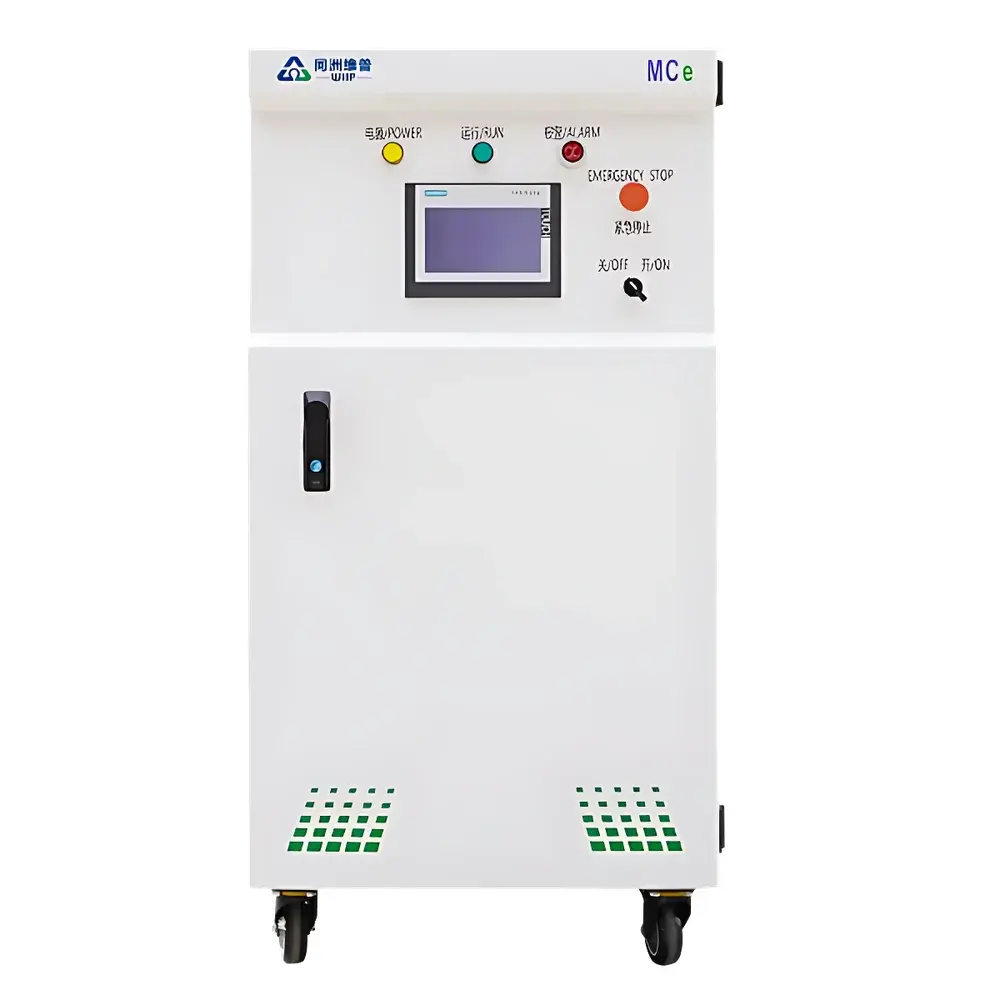
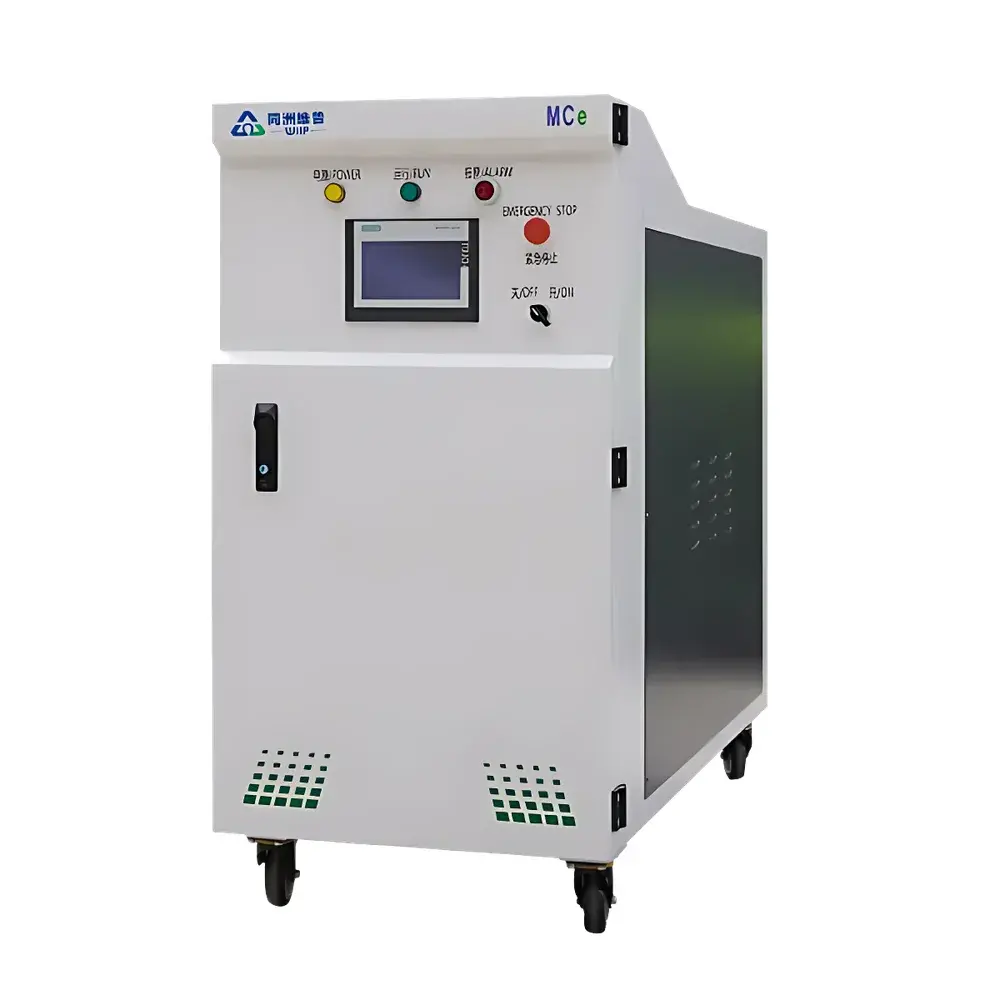
Tongzhou Weipu MCe Integrated Circulating Chiller for Motor Fatigue Testing
| Brand | Tongzhou Weipu |
|---|---|
| Origin | Beijing, China |
| Manufacturer Type | Direct Manufacturer |
| Product Category | Domestic |
| Model | MCe Integrated Circulating Chiller for Motor Fatigue Testing |
| Instrument Type | Integrated Unit |
| Temperature Control Range | +10 °C to 95 °C |
| Temperature Stability | ±1 °C |
| Cooling Capacity | 20 kW to 300 kW |
| Circulating Pump Flow Rates | 2–20 L/min |
Overview
The Tongzhou Weipu MCe Integrated Circulating Chiller is an engineered thermal management solution specifically designed for high-duty-cycle, long-duration motor fatigue testing and EV powertrain component validation. Unlike conventional vapor-compression chillers, the MCe operates via direct heat exchange between process coolant (typically deionized water or water-glycol mixture) and facility-supplied chilled water or cooling tower water — eliminating onboard refrigerant circuits, compressors, and associated energy losses. This design enables stable, precise temperature control across a wide operational range (+10 °C to 95 °C) while maintaining low acoustic emissions (<65 dB(A) at 1 m) and significantly reducing total cost of ownership. The system is built for continuous operation under dynamic thermal loads typical of electric motor endurance testing, where rapid heat dissipation and thermal inertia minimization are critical to test fidelity and repeatability.
Key Features
- Direct primary-secondary heat exchange architecture — no refrigerant loop, compressor, or expansion valve; eliminates refrigerant charge, oil management, and associated maintenance intervals.
- Multi-range, high-head magnetic-drive circulation pumps with variable-frequency drive (VFD) control — five standard flow configurations (2–20, 4–40, 6–60, 9–90, and 10–150 L/min) support diverse DUT interface requirements, from small stator windings to full-size traction motor test rigs.
- Precision PID-controlled temperature regulation with ±1 °C stability over full load and ambient conditions (15–35 °C), verified per ISO 17025-accredited calibration procedures.
- Stainless steel 316L fluid path and corrosion-resistant heat exchanger core — compatible with conductivity-controlled coolants used in high-voltage EV component testing (e.g., IEC 60601-1, UL 2580 compliant media).
- Integrated safety interlocks including flow monitoring, overtemperature cutoff, low-level tank protection, and dry-run prevention — aligned with functional safety requirements per ISO 13849-1 PL e / Category 4.
Sample Compatibility & Compliance
The MCe chiller is routinely deployed in laboratories conducting thermal stress validation of electric motors, inverters, on-board chargers, and battery modules under IEC 60034-1, ISO 19453-3, and GB/T 18488.1 test protocols. Its non-refrigerant architecture avoids volatile organic compound (VOC) emissions and complies with EU F-Gas Regulation (EU) No 517/2014 Annex III restrictions. All electrical components meet CE/UKCA marking requirements (EN 61000-6-2, EN 61000-6-4). The system supports GLP/GMP-aligned audit trails when integrated with external SCADA or LIMS platforms via Modbus TCP or EtherNet/IP.
Software & Data Management
The MCe includes a local HMI touchscreen interface (7″ resistive LCD) with real-time display of setpoint, actual temperature, flow rate, inlet/outlet ΔT, and pump speed. Logged data (1-second resolution, 30-day buffer) is exportable via USB or Ethernet to CSV format. Optional OPC UA server integration enables seamless connectivity to LabVIEW, MATLAB, or Siemens Desigo CC for synchronized thermal control within automated test sequences. Audit trail functionality — including user login events, parameter changes, and alarm acknowledgments — satisfies FDA 21 CFR Part 11 requirements when paired with validated identity management systems.
Applications
- Continuous thermal cycling of permanent magnet synchronous motors (PMSM) during endurance testing per SAE J2908.
- Coolant temperature stabilization for inverter junction temperature mapping under transient load profiles.
- Thermal soak conditioning of battery packs prior to mechanical shock or vibration fatigue tests (e.g., UN 38.3, GB/T 31467.3).
- Controlled heating/cooling of electronic control units (ECUs) during environmental stress screening (ESS) and HALT protocols.
- Supporting ISO 8573-1 Class 2 compressed air drying loops where chiller-cooled condensate traps require stable sub-ambient dew point control.
FAQ
Does the MCe chiller require refrigerant handling certification for installation or maintenance?
No — the MCe uses facility-supplied chilled water as its sole heat sink and contains no refrigerant circuitry, eliminating the need for EPA Section 608 or F-Gas handling certification.
Can the MCe maintain 95 °C outlet temperature while rejecting heat to a 35 °C cooling tower loop?
Yes — its counterflow plate heat exchanger achieves up to 12 K minimum approach temperature, enabling stable high-temperature output even with elevated facility water temperatures.
Is the system suitable for use with dielectric coolants in high-voltage motor testing?
Yes — all wetted materials are rated for compatibility with ASTM D1500-class dielectric fluids; optional conductivity monitoring and grounding kits are available upon request.
What is the maximum allowable backpressure at the chiller’s return port?
The unit is rated for continuous operation at ≤3.5 bar(g) return pressure; higher backpressures require upstream pressure-reducing valve integration.
How is flow accuracy validated across the full 10–150 L/min range?
Each pump configuration undergoes factory calibration against traceable Coriolis mass flow standards (NIST-traceable, uncertainty <±0.8% of reading), with certificate provided per unit.



