
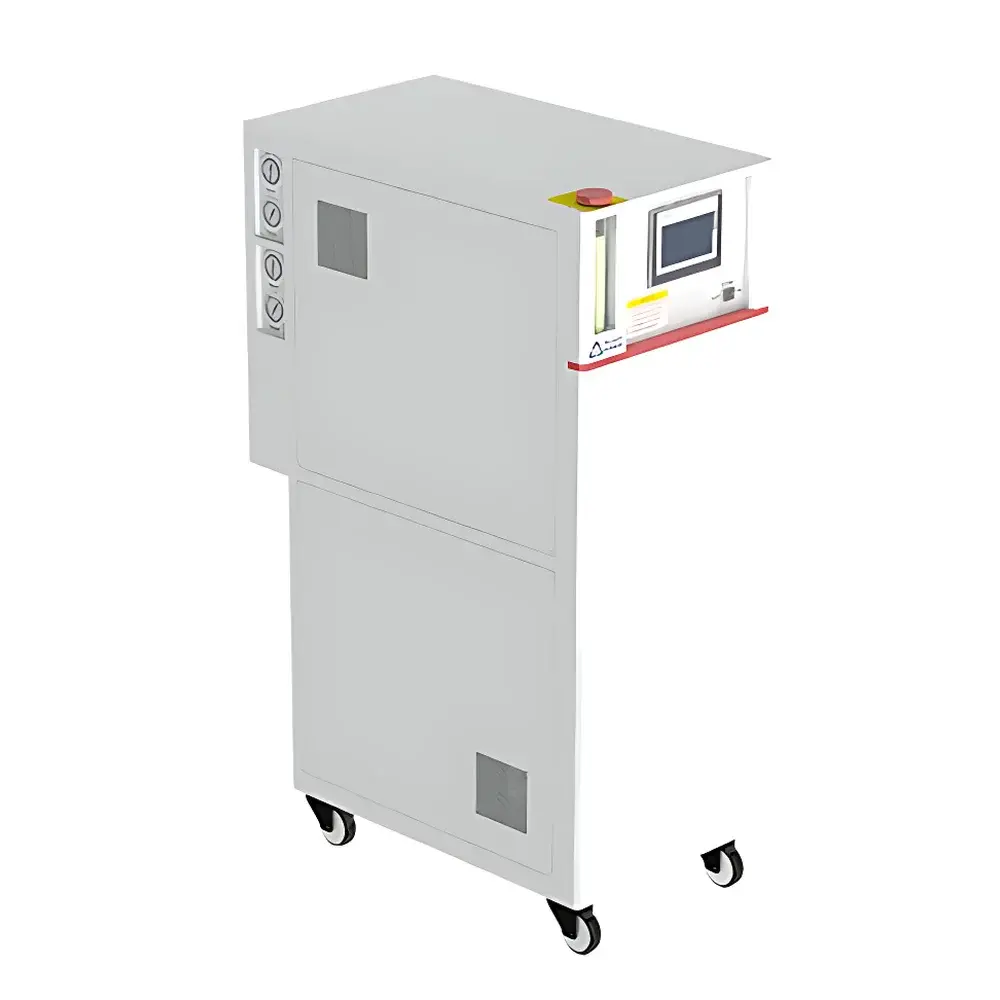
Tongzhou Weipu TL7000 Series Low-Temperature Circulating Chiller
| Brand | Tongzhou Weipu |
|---|---|
| Origin | Tianjin, China |
| Manufacturer Type | Direct Manufacturer |
| Product Category | Domestic |
| Model | TL7000 |
| Temperature Range | −70 °C to −20 °C |
| Refrigeration Capacity | Up to 14.0 kW @ −20 °C |
| Pump Flow Rate | Up to 75 L/min @ 2.5 bar |
| Control Interface | 7″ TFT LCD Touchscreen with PLC-based Controller |
| Communication Protocols | Modbus TCP (Ethernet), RS485 Modbus, External PT100 Input |
| Data Logging | USB Storage Support |
| Programmable Steps | 100-step Ramp-Soak Profile |
| Cooling Options | Air-Cooled (F) or Water-Cooled (W) Configurations |
| Optional Configurations | Explosion-Proof, Split-System, OEM Integration, Stainless Steel Enclosure |
| Compliance | Designed for GLP-compliant laboratory environments |
Overview
The Tongzhou Weipu TL7000 Series Low-Temperature Circulating Chiller is an engineered thermal management system designed for precise, stable, and reproducible temperature control in demanding laboratory and pilot-scale applications. Operating within a sustained range of −70 °C to −20 °C, the series employs a cascade refrigeration architecture with dual-stage compressors and environmentally compliant refrigerants (R23/R508B or R507A, depending on configuration) to achieve deep-cold performance without cryogenic consumables. Unlike single-stage chillers limited by thermodynamic constraints below −40 °C, the TL7000’s cascade design ensures consistent cooling capacity, low superheat, and minimal temperature drift—critical for applications requiring long-duration thermal stability at sub-zero conditions. Its primary function is closed-loop circulation of heat-transfer fluid (HTF) through external process equipment—including bioreactors, condensers, reaction jackets, material test chambers, and analytical instrumentation—enabling accurate simulation of low-temperature operational environments.
Key Features
- PLC-integrated 7″ high-resolution TFT touchscreen interface with real-time graphical display of setpoint, actual temperature, pump pressure, refrigerant discharge/suction temperatures, and alarm status.
- Multi-dimensional PID control algorithm with adaptive tuning parameters optimized for varying thermal loads and HTF viscosities across the operating range.
- Dual cooling configurations: air-cooled (TL70xxF) and water-cooled (TL70xxW) variants, each engineered for optimal heat rejection under specified ambient or facility cooling water conditions (e.g., 30 °C max inlet for water-cooled units).
- Robust stainless-steel fluid circuitry with electropolished internal surfaces; compatible with synthetic heat-transfer fluids including AU-280 (−90 °C to 150 °C), AUSI-05 (−80 °C to 220 °C), and AUSI-10 (−60 °C to 250 °C).
- Modular mechanical design supporting field-installable options: explosion-proof electrical enclosures (ATEX/IECEx Zone 1 certified upon request), split-system configurations (remote condenser placement), and custom stainless steel chassis for cleanroom or corrosive environments.
- Comprehensive I/O interface suite: isolated dry-contact alarm outputs, analog 4–20 mA temperature feedback, RS485 Modbus RTU, Ethernet-based Modbus TCP, and dedicated external PT100 input for master-slave cascaded control or external bath monitoring.
Sample Compatibility & Compliance
The TL7000 Series is compatible with standard laboratory and industrial heat-transfer media meeting ASTM D6792 and ISO 6743-12 specifications for synthetic organic heat-transfer fluids. Fluid selection must be validated against minimum pour point, flash point, and thermal stability requirements of the target application. The system complies with IEC 61000-6-2 (immunity) and IEC 61000-6-4 (emissions) for electromagnetic compatibility. When deployed in regulated environments—such as pharmaceutical development labs conducting stability studies per ICH Q1 or QC testing per USP —the chiller supports GLP documentation workflows. With third-party validated software integration, it meets traceability and electronic record requirements outlined in FDA 21 CFR Part 11, including user access control, audit trail generation, and electronic signature capability.
Software & Data Management
While the onboard controller provides standalone operation, the TL7000 supports seamless integration into centralized laboratory infrastructure via industry-standard protocols. Modbus TCP enables direct connection to SCADA, LIMS, or MES platforms for remote monitoring, predictive maintenance alerts, and automated batch reporting. USB data export captures timestamped temperature, flow, pressure, and alarm logs in CSV format for post-processing in MATLAB, Python, or Excel. Optional firmware upgrades include enhanced logging intervals (down to 1-second resolution), configurable alarm hysteresis, and password-protected parameter lockdown for SOP enforcement. All firmware revisions undergo rigorous validation per GAMP 5 guidelines to ensure consistency in regulated use cases.
Applications
- Biopharmaceutical processing: low-temperature jacketed reactor control during monoclonal antibody purification, viral vector manufacturing, and cryopreservation buffer preparation.
- Cold trap and condenser cooling in rotary evaporation, short-path distillation, and freeze-drying (lyophilization) systems.
- Material science testing: thermal cycling of polymers, composites, and battery electrolytes under controlled sub-zero stress conditions per ASTM D696 and ISO 11359.
- Analytical instrumentation support: maintaining detector and column oven temperatures in GC, HPLC, and LC-MS systems requiring stable cold-zone operation.
- Environmental simulation: calibration and verification of low-temperature sensors, thermocouples, and IR cameras in metrology labs.
FAQ
What is the lowest achievable temperature with the TL7000 Series, and how is it maintained under load?
The TL7000 achieves a guaranteed minimum operating temperature of −70 °C at the fluid outlet under nominal flow and thermal load conditions. Sustained performance relies on proper HTF selection (e.g., AU-280), adequate insulation of external circuits, and adherence to maximum allowable heat load limits specified per model.
Can the TL7000 be integrated into a building management system (BMS)?
Yes—via Modbus TCP over Ethernet or Modbus RTU over RS485, the unit transmits real-time process variables and accepts setpoint commands from BMS or DCS platforms using standard register mapping.
Is validation documentation available for GxP environments?
Factory-installed IQ/OQ documentation packages are available upon request. Full PQ execution requires site-specific installation and operational context; Tongzhou Weipu provides template protocols aligned with ASTM E2500 and Annex 15.
What maintenance intervals are recommended for long-term reliability?
Compressor oil analysis every 2,000 operating hours; refrigerant circuit integrity check annually; filter dryer replacement every 18 months or after any refrigerant service event.
Are custom fluid circuit connections supported?
Yes—standard offerings include M30×1.5 and M38×1.5 male/female ports with optional aerogel-enhanced insulation. Custom flange types (DIN, ANSI), quick-disconnect fittings (Tri-Clamp, VCR), and extended-length insulated hoses are available under OEM engineering support.



