
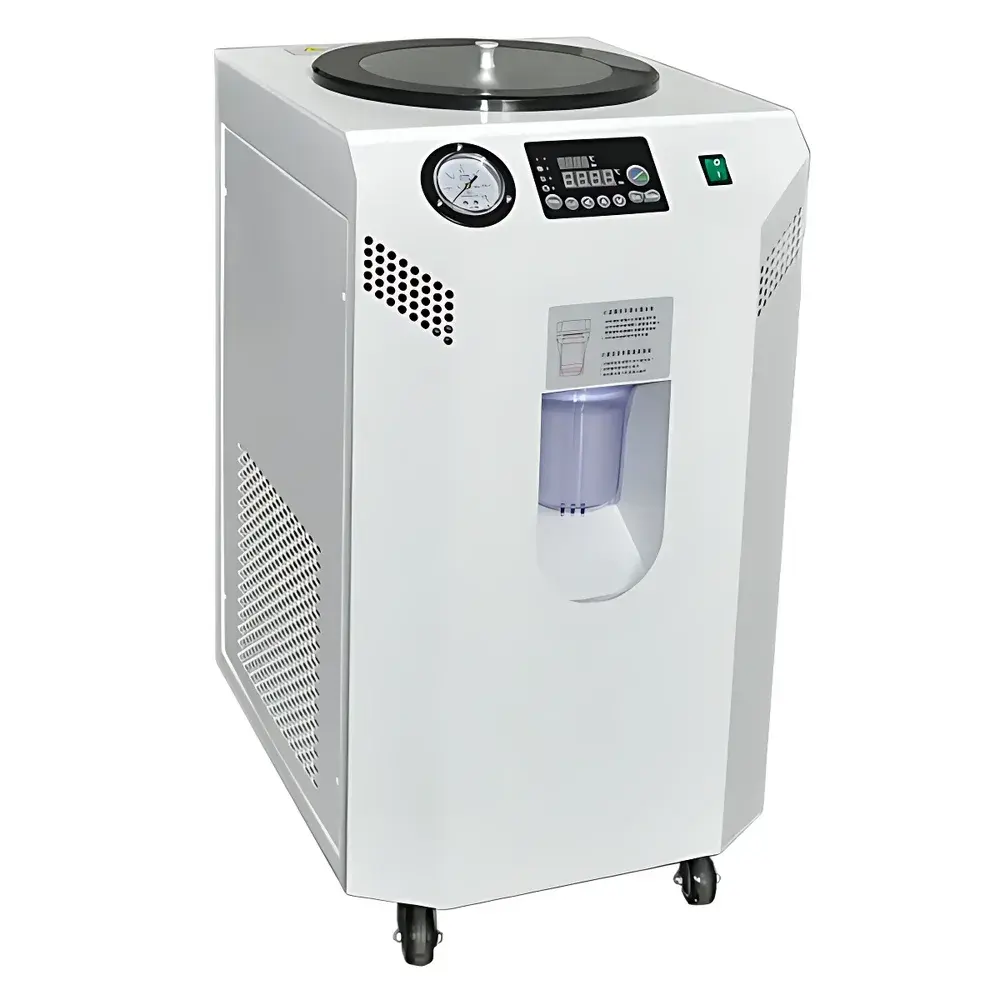
Tongzhou Weipu AC Series Circulating Chiller
| Brand | Tongzhou Weipu |
|---|---|
| Origin | Beijing, China |
| Manufacturer Type | Direct Manufacturer |
| Product Category | Domestic |
| Model | AC Series |
| Instrument Type | Integrated Unit |
| Cooling Method | Air-Cooled |
| Temperature Control Range | 5–35 °C |
| Temperature Stability | ±0.1 °C |
| Refrigeration Capacity | 1000 W |
| Circulating Pump Pressure | 2.0 bar |
| Circulating Pump Flow Rate | 30 L/min |
| Reservoir Volume | 20 L |
| Operating Mode | Continuous |
Overview
The Tongzhou Weipu AC Series Circulating Chiller is an engineered thermal management solution designed specifically for precision laboratory instrumentation requiring stable, continuous coolant delivery. Operating on vapor-compression refrigeration with air-cooled condensation, the system maintains precise temperature control (5–35 °C) with high stability (±0.1 °C) across extended operational cycles. Its integrated architecture—combining refrigeration circuit, stainless-steel reservoir, variable-flow circulation pump, and intelligent monitoring logic—ensures consistent heat extraction from sensitive analytical instruments such as atomic absorption spectrometers (AAS), inductively coupled plasma optical emission spectrometers (ICP-OES), scanning electron microscopes (SEM), and plasma etching systems. Unlike generic chillers, the AC Series incorporates application-specific design elements—including corrosion-resistant wetted materials, flow-sensing interlocks, and multi-stage thermal protection—to meet the reliability and contamination control requirements of regulated laboratory environments.
Key Features
- Stainless-steel open-top reservoir with transparent side panels for real-time visual inspection of coolant clarity and particulate accumulation
- Integrated pre-filter assembly with replaceable cartridge; filter status observable without disassembly
- Standard water-level sensor and optional flow switch sensor for fail-safe detection of low-flow or dry-run conditions
- Full stainless-steel fluid path—including pump housing, tubing, and fittings—to prevent leaching, scaling, or microbial proliferation
- Optional ion-exchange resin filtration module for deionized water recirculation, supporting long-term purity maintenance in ultra-low-conductivity applications
- Rear-mounted axial fans with optimized airflow ducting ensure efficient heat dissipation while minimizing cabinet surface temperature rise and acoustic emissions (<58 dB(A) at 1 m)
- Digital PID temperature controller with programmable ramp-soak profiles and external trigger interface (dry-contact I/O) for synchronized start/stop with host instrumentation
Sample Compatibility & Compliance
The AC Series is compatible with aqueous coolants, 20–50% ethylene glycol/water mixtures, and deionized water when equipped with resin filtration. It meets mechanical safety requirements per IEC 61010-1 (2010) for laboratory electrical equipment and complies with electromagnetic compatibility standards EN 61326-1. While not certified to UL or CSA for North American markets, its control architecture supports integration into GLP/GMP workflows through configurable alarm logging and event timestamping. Optional analog voltage outputs (0–10 V) and RS-485 Modbus RTU communication enable connection to centralized building management systems (BMS) or LIMS platforms for audit-ready thermal history tracking. All models include hardware-based overtemperature cutoff (≥40 °C) and low-water-level shutdown to prevent compressor damage during unattended operation.
Software & Data Management
The chiller operates via a front-panel LCD interface with intuitive menu navigation and real-time display of setpoint, actual temperature, flow rate, and system status codes. No proprietary software is required for basic operation; however, optional Modbus-enabled controllers support remote parameter adjustment and data polling at 1-second intervals. Logged events—including flow interruption, temperature deviation >±0.5 °C, and compressor cycle count—are stored in non-volatile memory for up to 30 days. For laboratories subject to FDA 21 CFR Part 11, third-party SCADA integration (e.g., Ignition, LabVIEW) enables electronic signature enforcement, audit trail generation, and role-based access control when paired with validated drivers.
Applications
- Thermal stabilization of graphite furnace AAS atomizers and ICP torch interfaces
- Cooling of SEM electron column components and detector housings to minimize thermal drift
- Heat rejection from RF generators in plasma etch and deposition tools
- Temperature regulation of Kjeldahl digestion blocks and high-frequency fusion furnaces
- Secondary cooling loop for glovebox inert gas purification systems
- Support of high-resolution X-ray fluorescence (XRF) spectrometers requiring <0.05 °C thermal gradient control
FAQ
What is the nominal refrigeration capacity rating based on?
The stated capacity (e.g., 1000 W for AC1000) is measured under standard test conditions: ambient temperature 25 °C, inlet coolant temperature 25 °C, and full-load operation. Actual capacity decreases linearly with rising ambient temperature or lower setpoint temperatures; derating curves are provided in the technical manual.
Can this chiller operate with deionized water without corrosion risk?
Yes—when configured with the optional resin filtration module and full stainless-steel fluid path, the system maintains resistivity >1 MΩ·cm for >72 hours without measurable metal ion leaching (tested per ASTM D1125).
Is remote monitoring supported out of the box?
Basic dry-contact alarm outputs and start/stop signals are standard. RS-485 Modbus RTU communication and analog process outputs require optional controller firmware and hardware configuration.
How often should the pre-filter cartridge be replaced?
Under typical lab use with tap water pretreatment, replacement is recommended every 3–6 months; frequency increases with higher suspended solids load or use of non-deionized coolants.
Does the unit comply with ISO/IEC 17025 calibration traceability requirements?
While the chiller itself is not a measuring instrument, its embedded Pt100 sensor is factory-calibrated against NIST-traceable references, and calibration certificates (including uncertainty budgets) are available upon request for metrological validation.



