
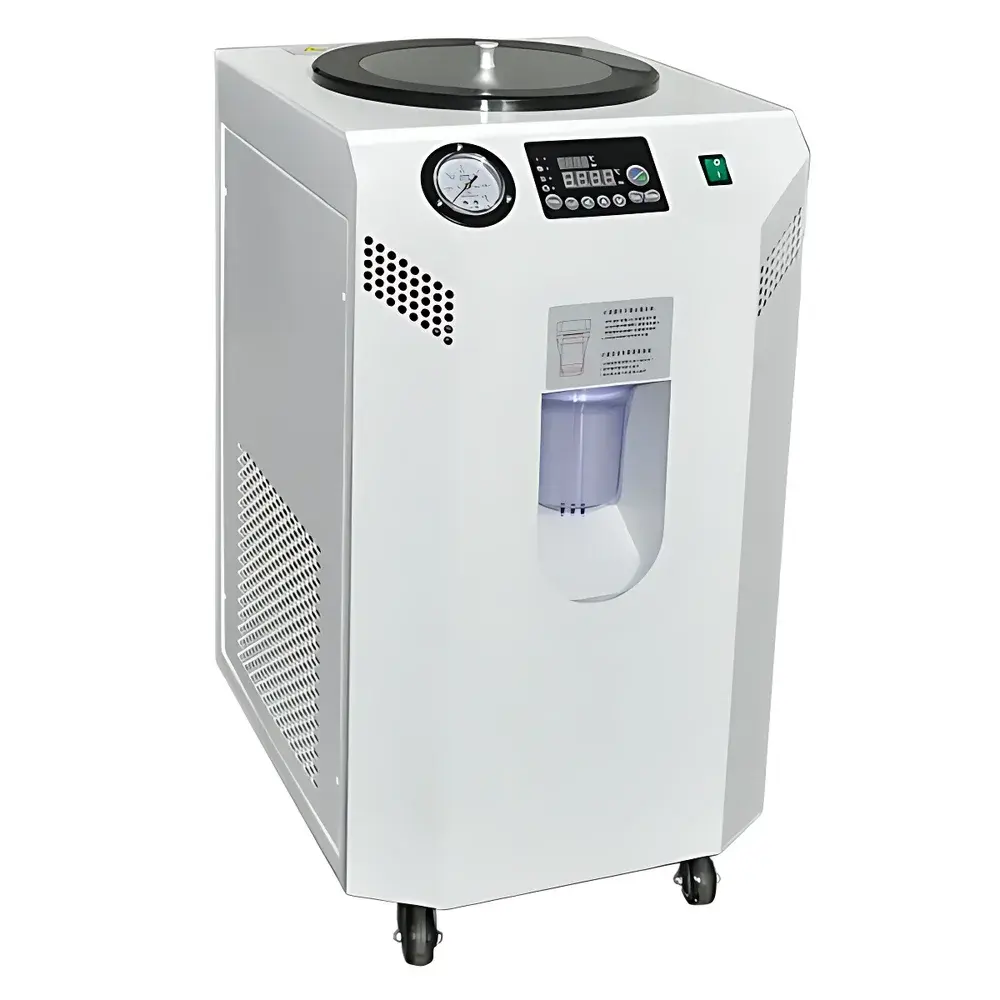
Shanghai Spectrum Atomic Absorption Circulating Chiller (C2 Series)
| Brand | Tongzhou Weipu |
|---|---|
| Origin | Beijing, China |
| Manufacturer Type | Direct Manufacturer |
| Product Origin | Domestic |
| Model | C2 Series |
| Instrument Type | Integrated Circulating Chiller |
| Cooling Method | Water-Cooled |
| Temperature Control Range | 5–35 °C |
| Cooling Capacity | 600–4600 W |
| Temperature Stability | ±0.1 °C |
| Circulation Pump Pressure | 13–19 m H₂O |
| Circulation Flow Rate | 10–58 L/min |
| Reservoir Volume | 8–40 L |
| Operating Principle | Phase-Change Refrigeration |
Overview
The Shanghai Spectrum Atomic Absorption Circulating Chiller (C2 Series), manufactured by Tongzhou Weipu in Beijing, is an integrated, water-cooled refrigeration system engineered for precise thermal management of high-sensitivity analytical instrumentation. Designed specifically to support atomic absorption spectrometers (AAS), the chiller employs phase-change refrigeration technology to maintain stable coolant temperatures within a tightly controlled range of 5–35 °C, with temperature stability of ±0.1 °C—critical for minimizing thermal drift in optical path alignment and detector performance. Its robust architecture ensures continuous, low-noise operation under variable load conditions typical of AAS flame or graphite furnace modules, ICP-OES plasma sources, SEM electron column cooling, and other heat-generating lab systems requiring consistent heat rejection.
Key Features
- Stainless steel open-bath reservoir with transparent side panels for real-time visual inspection of coolant clarity and particulate accumulation—facilitating proactive maintenance and preventing contamination of connected instruments.
- Integrated pre-filter housing with visible filter element, enabling rapid assessment of cartridge saturation and scheduled replacement without disassembly.
- Standard ultrasonic water level sensor; optional flow switch and dual-stage temperature alarm outputs (high/low threshold) compliant with industrial safety interlock protocols.
- All-wetted components—including circulation pump, piping, and fittings—constructed from 316 stainless steel to resist corrosion from deionized water, glycol-water mixtures, or low-conductivity laboratory-grade coolants.
- Rear-mounted axial fans with optimized airflow ducting ensure efficient condenser heat dissipation while maintaining ambient surface temperatures below 35 °C—reducing localized lab heat load and improving energy efficiency.
- Modular control interface supports dry-contact I/O: TTL-compatible start/stop signals and configurable relay outputs for alarm status reporting (e.g., flow loss, overtemperature, low level) compatible with building management systems (BMS) or centralized lab monitoring platforms.
Sample Compatibility & Compliance
The C2 Series is validated for continuous-duty operation with analytical instruments requiring stable coolant supply at regulated flow rates (10–58 L/min) and backpressure tolerance up to 19 m H₂O. It meets general-purpose laboratory equipment requirements per GB/T 20975 (Chinese national standard for circulating chillers) and aligns with ISO/IEC 17025 clause 6.4.3 on environmental condition control for testing laboratories. While not certified to UL/CSA or CE for standalone medical or hazardous-area use, its electrical design conforms to IEC 61010-1:2010 for measurement, control, and laboratory equipment. Optional resin-based water purification kits enable conductivity reduction to <1 µS/cm—supporting GLP-compliant operation where ultra-pure coolant is mandated to prevent scaling or microbial growth in closed-loop systems.
Software & Data Management
The C2 Series operates via embedded microcontroller firmware with no external PC dependency. All operational parameters—including setpoint, actual bath temperature, flow rate (indirectly inferred via pressure differential), runtime hours, and alarm history—are retained in non-volatile memory with timestamped logging capacity for ≥10,000 events. Alarm records include trigger type, duration, and recovery status—enabling root-cause analysis during QA audits. Data export is supported via RS-232 serial port (ASCII protocol) for integration into LIMS or instrument control software. The system supports FDA 21 CFR Part 11–compatible audit trail configuration when paired with validated third-party data acquisition middleware, including electronic signature enforcement and user-level access control (admin/operator roles).
Applications
- Primary cooling for flame and graphite furnace atomic absorption spectrometers (AAS), including PerkinElmer AA, Thermo Scientific iCE, and Shimadzu AA-7000 series.
- Thermal stabilization of ICP-OES plasma torches and RF generators, particularly in multi-element trace metal analysis workflows.
- Coolant supply for scanning electron microscope (SEM) electron columns, cryo-stages, and EDS detector housings.
- Temperature regulation for glovebox antechambers, plasma etching reactors (RIE/ICP), and high-frequency fusion melters used in geochemical sample preparation.
- Support cooling for Kjeldahl nitrogen analyzers, direct-reading optical emission spectrometers (OES), and laser-induced breakdown spectroscopy (LIBS) systems requiring consistent thermal baseline.
FAQ
What is the maximum allowable inlet water temperature for the condenser circuit?
The unit is designed for connection to municipal or facility-supplied chilled water at ≤32 °C inlet temperature. Higher temperatures reduce effective cooling capacity and may trigger high-head pressure alarms.
Can the C2 Series operate with 50% propylene glycol solution?
Yes—provided viscosity remains below 3.5 cP at operating temperature. Flow rate and pressure curves must be recalibrated using manufacturer-provided correction factors; glycol use voids warranty on pump seals unless specified as “glycol-rated” at time of order.
Is remote monitoring via Ethernet or Wi-Fi available?
No native Ethernet/Wi-Fi module is included. Remote supervision requires integration via RS-232-to-Ethernet gateway (e.g., Digi One SP) and custom SCADA or LabVIEW driver development.
How often should the pre-filter cartridge be replaced under normal lab use?
With deionized water and average particulate load, replacement is recommended every 3–6 months; frequency increases in hard-water environments or when used with open-bath accessories generating aerosol contaminants.
Does the chiller meet noise emission requirements for ISO Class 5 cleanroom-adjacent labs?
At 1 m distance, sound pressure level is ≤58 dB(A) across all models—within acceptable limits for ISO 14644-1 Class 5 buffer zones, provided installation includes anti-vibration mounting pads and rigid conduit routing.



