
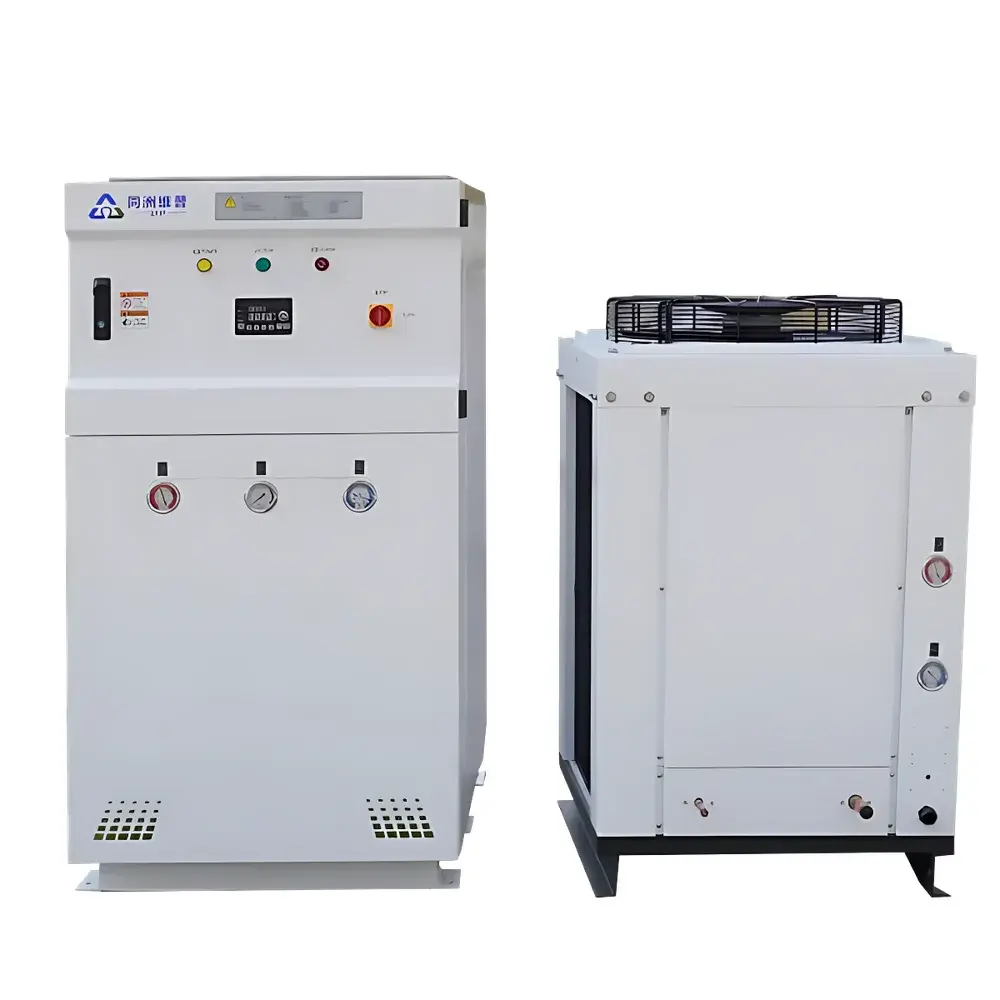
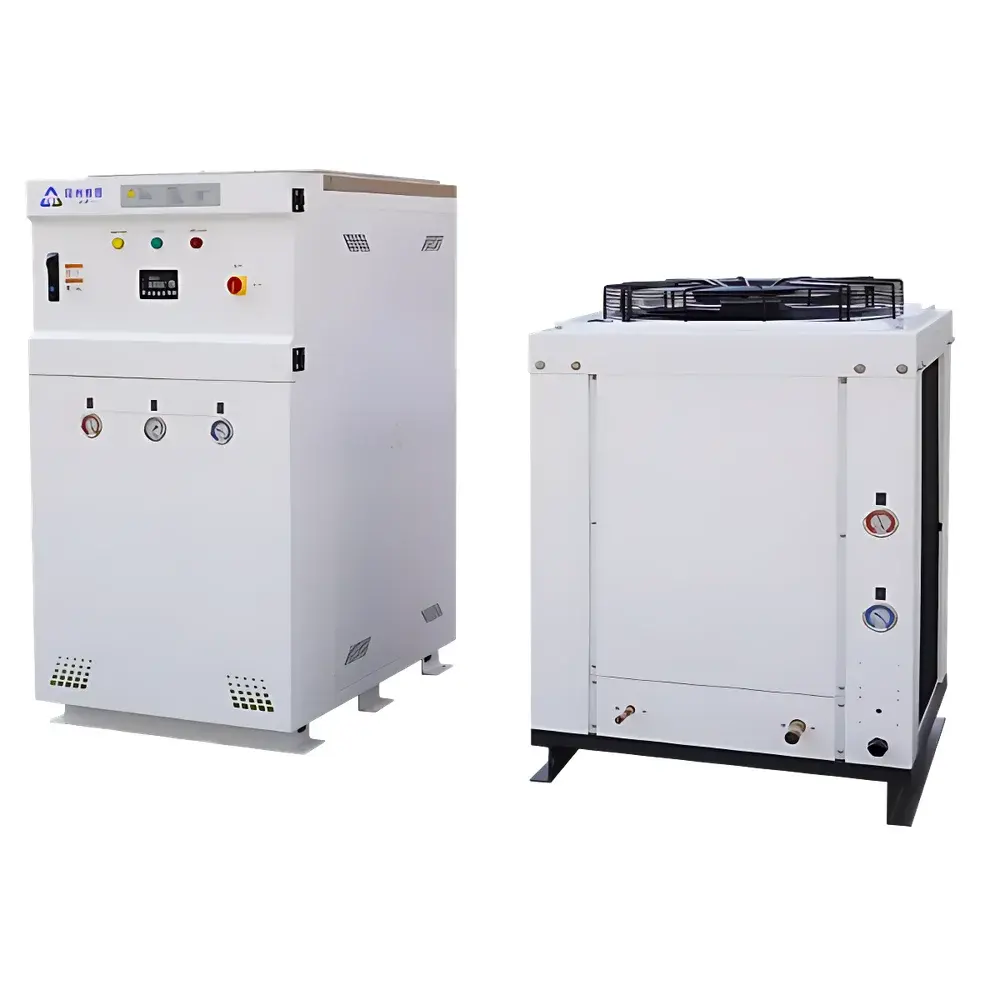
Tongzhou Weipu RG16 Split-System Circulating Chiller
| Brand | Tongzhou Weipu |
|---|---|
| Origin | Beijing, China |
| Manufacturer Type | Direct Manufacturer |
| Regional Classification | Domestic (China) |
| Model | RG16 |
| Instrument Type | Split-System |
| Cooling Method | Water-Cooled |
| Temperature Control Range | 5–35 °C |
| Refrigeration Capacity | 5.6–270 kW |
| Temperature Stability | ±0.1–±2 °C |
| Circulating Pump Pressure | 3.6–5.5 bar |
| Circulating Pump Flow Rate | 40–900 L/min |
Overview
The Tongzhou Weipu RG16 Split-System Circulating Chiller is an engineered thermal management solution designed for continuous, high-stability cooling of laboratory and industrial process equipment. Based on vapor-compression refrigeration cycle architecture, the system separates thermally active components—compressor, condenser, and exhaust fan—into a dedicated outdoor unit, while housing the chilled water circulation loop—including stainless-steel reservoir, centrifugal pump, and evaporator—in a low-noise indoor unit. This physical decoupling eliminates heat dissipation and primary acoustic sources from the operational environment, enabling precise temperature control in sensitive applications such as laser systems, vacuum deposition chambers, and bioreactor jackets where ambient thermal drift and acoustic interference must be minimized. The RG16 supports stable operation across ambient conditions ranging from sub-zero northern winters to high-humidity southern summers, facilitated by adaptive compressor crankcase heating and variable-speed condenser fan control.
Key Features
- Split-system architecture with acoustically isolated indoor and outdoor units—reducing operational noise at point-of-use to <55 dB(A) at 1 m distance
- Industrial-grade outdoor unit constructed entirely from corrosion-resistant metals; no structural plastic components in high-temperature or high-vibration zones
- Stainless-steel indoor water tank with large-diameter access port (≥Φ300 mm) for visual inspection, manual cleaning, and biofilm mitigation per ISO 8573-1 air quality guidelines for cooling circuits
- High-head centrifugal pump delivering up to 5.5 bar pressure and 900 L/min flow—compatible with multi-loop distribution manifolds and long-distance coolant routing
- Integrated refrigerant circuit monitoring: real-time display of suction/ discharge pressures, compressor winding temperature, and condensing saturation temperature
- Comprehensive safety protection suite including compressor overheat cutoff, phase sequence detection, under-voltage lockout, high/low refrigerant pressure shutdown, and motor overcurrent tripping—all compliant with IEC 60204-1 machinery safety standards
Sample Compatibility & Compliance
The RG16 chiller is compatible with deionized water, glycol-water mixtures (up to 35% v/v), and other non-corrosive, low-viscosity heat transfer fluids meeting ASTM D1384 corrosion inhibition specifications. Its sealed refrigerant circuit employs R404A or R507A (selectable per regional regulatory requirements), certified under EN 378-1:2016 for hermetic refrigeration systems. All electrical interfaces conform to CE marking directives (2014/30/EU EMC, 2014/35/EU LVD), and mechanical design follows ASME B31.9 for building services piping. For GxP-regulated environments, optional audit-trail-enabled controllers support 21 CFR Part 11-compliant electronic records when integrated with validated SCADA platforms.
Software & Data Management
Standard configuration includes a 7-inch capacitive touchscreen HMI with embedded PID temperature control algorithm, programmable ramp-soak profiles, and event-log storage (≥10,000 entries). Optional Modbus TCP or BACnet/IP communication modules enable integration into centralized building management systems (BMS) or laboratory information management systems (LIMS). Data export via USB 2.0 supports CSV-formatted trend logs (temperature, pressure, flow, fault codes) for post-process validation per ISO/IEC 17025 clause 7.7. Remote diagnostics are supported through secure TLS 1.2 encrypted web interface—accessible only via authenticated role-based credentials.
Applications
The RG16 serves as a primary cooling source for high-heat-flux instrumentation and production equipment requiring stable thermal setpoints and robust flow delivery. Typical deployments include: continuous-wave CO₂ and fiber laser cutting/ welding systems (e.g., IPG YLS series); magnetron sputtering and electron-beam evaporation chambers; pharmaceutical jacketed reactors operating under cGMP-controlled exothermic reaction protocols; CNC machining centers with high-speed spindles (>20,000 rpm); plasma etch tools requiring dielectric fluid temperature stabilization; and pilot-scale fermentation vessels with integrated heat-exchange coils. Its scalable capacity range allows parallel operation of multiple RG16 units under master-slave cascade control for facilities with dynamic thermal load profiles.
FAQ
What refrigerants are approved for use in the RG16 series?
R404A and R507A are factory-charged and certified for global deployment; R449A retrofit kits are available upon request and subject to local F-Gas Regulation compliance verification.
Can the RG16 maintain ±0.1 °C stability across its full 5–35 °C range?
Yes—when equipped with the high-precision sensor option (PT1000 Class A, IEC 60751) and operated within rated flow/pressure envelope; stability specification assumes closed-loop operation with ≤5 m head loss and ambient temperature variation <±5 °C/h.
Is remote monitoring and alarm notification supported out of the box?
Basic SNMP trap reporting and email alerts (SMTP-authenticated) are enabled via optional network module; full integration with enterprise IT infrastructure requires additional configuration by qualified system integrators.
Does the stainless-steel water tank meet FDA or USP Class VI requirements?
The 316L tank material complies with ASTM A240 and EN 10088-1; however, final system validation for pharmaceutical use must be performed per user-defined qualification protocols (IQ/OQ/PQ) in accordance with Annex 15 of EU GMP Guidelines.



