
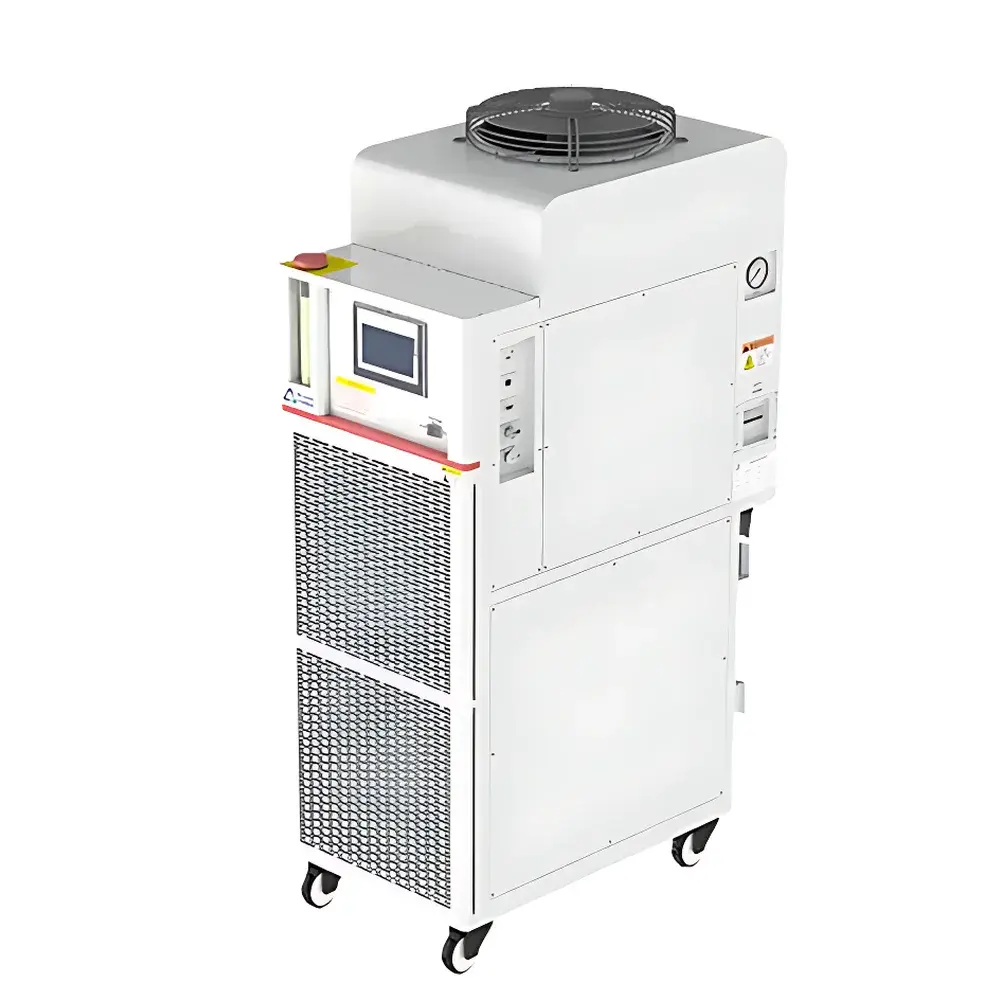
Tongzhou Weipu TC7000 Series High-Low Temperature Circulating Chiller
| Brand | Tongzhou Weipu |
|---|---|
| Origin | Tianjin, China |
| Manufacturer Type | OEM Manufacturer |
| Country of Origin | China |
| Model | TC7000 |
| Temperature Range | −70 °C to +250 °C |
| Display | 7-inch LCD touchscreen interface |
| Control Architecture | PLC-based with multi-dimensional PID algorithm |
| Programmable Steps | Up to 100-step temperature ramping profiles |
| Communication Interfaces | Ethernet (Modbus TCP), RS485 (Modbus RTU), External PT100 input, Dry-contact alarm & status outputs |
| Cooling Method | Air-cooled (F) or Water-cooled (W) configurations |
| Optional Configurations | Explosion-proof, Split-system, OEM-integrated, Stainless-steel enclosure |
| Pump Flow Rate | 20–75 L/min @ 2.0–2.5 bar |
| Heating Power | 2.5–15 kW |
| Refrigeration Capacity | 0.4–19.0 kW @ −60 °C to +200 °C |
| Dimensions (W×D×H) | 55×100×160 cm to 85×190×195 cm |
| Compatible Heat Transfer Fluids | Synthetic oils (e.g., AU-280, AUSI-05, AUSI-10) with flash points from 100 °C to 200 °C and pour points down to −100 °C |
| Fluid Circuit | Stainless-steel braided hoses with customizable insulation (rubber-plastic or aerogel-composite), M30×1.5/M38×1.5 fittings, custom lengths (200/300/500 cm), and adapter options (G1, M16×1.0, M24×1.5, quick-clamp, 90° elbows) |
Overview
The Tongzhou Weipu TC7000 Series High-Low Temperature Circulating Chiller is an industrial-grade thermal management system engineered for precise, stable, and repeatable temperature control across demanding laboratory and pilot-scale applications. Operating on a dual-circuit refrigeration-heating architecture with cascade compression stages and high-efficiency electric resistance heating, the TC7000 delivers continuous thermal regulation from −70 °C to +250 °C—enabling compatibility with exothermic reaction monitoring, cryogenic material characterization, polymer processing validation, and accelerated stability testing per ICH Q1 guidelines. Its closed-loop circulation design ensures consistent heat transfer fluid (HTF) delivery to external reactors, jacketed vessels, calorimeters, or analytical instrumentation, minimizing thermal lag and maximizing process fidelity. The system’s thermodynamic architecture integrates low-GWP refrigerants and synthetic HTFs certified for extended service life under thermal cycling stress, supporting long-term GLP-compliant operation in regulated environments.
Key Features
- Wide operational range: −70 °C to +250 °C, validated per ASTM E2877 for thermal uniformity and stability (±0.3 °C typical at steady state)
- Multi-mode control logic: Internal bath control, external jacket sensing (via optional PT100), and program-defined ramp/soak sequences (up to 100 steps)
- Adaptive multi-dimensional PID algorithm with auto-tuning capability—optimized for rapid thermal recovery following load disturbances
- 7-inch capacitive touchscreen HMI with real-time graphical display of setpoint, actual temperature, flow rate, pressure, and system alarms
- Dual cooling configurations: Air-cooled (TC70xxH25F) and water-cooled (TC70xxH25W) variants, rated for ambient conditions up to 40 °C
- Robust mechanical construction: Stainless-steel fluid circuitry, reinforced hose assemblies with aerogel-enhanced insulation, and IP54-rated electrical enclosures
- Comprehensive I/O interface suite: Modbus TCP (Ethernet), Modbus RTU (RS485), analog 0–10 V/4–20 mA inputs, dry-contact alarm/status outputs, and USB data logging (CSV export)
Sample Compatibility & Compliance
The TC7000 series supports integration with glass/reactor jackets (e.g., Büchi, ChemGlass), DSC/TGA sample chambers, rheometer environmental cells, and chromatography column ovens. It accommodates standard and custom HTFs—including AU-280 (−90 °C to 150 °C), AUSI-05 (−80 °C to 220 °C), and AUSI-10 (−60 °C to 250 °C)—all meeting ISO 6743-12 classification for synthetic heat transfer fluids. All models comply with CE marking requirements (2014/30/EU EMC Directive and 2014/35/EU LVD), RoHS 2011/65/EU, and carry factory calibration certificates traceable to NIST standards. Explosion-proof variants (ATEX II 2G Ex db IIB T4 Gb) are available upon request for Class I, Division 1 hazardous locations.
Software & Data Management
The embedded controller firmware supports audit-trail-enabled operation compliant with FDA 21 CFR Part 11 when paired with optional PC-based supervision software (Tongzhou Weipu TC-Suite v3.2). This application provides remote monitoring, event-driven data capture, electronic signature workflows, and automated report generation (PDF/Excel) aligned with ALCOA+ data integrity principles. Logged parameters include timestamped temperature, flow, pressure, compressor duty cycle, heater output, and alarm history—retained for ≥12 months onboard and exportable via USB or network share. System diagnostics include refrigerant pressure monitoring, oil level verification, and predictive maintenance alerts based on cumulative runtime and thermal cycling counts.
Applications
- Pharmaceutical development: Reaction calorimetry (RC1e, EasyMax), crystallization optimization, and lyophilization cycle support
- Materials science: Thermal aging studies (ASTM D3045), coefficient of thermal expansion (CTE) measurement, and composite curing validation
- Chemical synthesis: Low-temperature Grignard reactions, high-temperature Friedel-Crafts acylations, and catalyst screening under controlled thermal gradients
- Quality control laboratories: Viscosity measurement (per ASTM D445) requiring bath temperature stability < ±0.1 °C over 24 h
- Academic research: Cryo-EM sample preparation support, superconductivity testing, and polymer melt rheology with environmental cell coupling
FAQ
What is the minimum recommended heat transfer fluid volume for stable operation?
A minimum of 8 liters is required for all TC7000 models to ensure adequate reservoir thermal mass and prevent pump cavitation during rapid temperature transitions.
Can the TC7000 be integrated into a SCADA system?
Yes—native Modbus TCP and RS485 Modbus RTU protocols enable seamless integration with Siemens SIMATIC, Rockwell Automation Logix, or Ignition SCADA platforms without gateway hardware.
Is validation documentation (IQ/OQ) provided with the system?
Factory-issued IQ/OQ templates are included; full protocol execution and third-party certification services are available as optional add-ons.
What maintenance intervals are recommended for optimal long-term performance?
Compressor oil analysis every 2,000 operating hours; refrigerant circuit leak check annually; HTF sampling and viscosity testing every 6 months or after 500 thermal cycles.
Are custom fluid circuit configurations supported for non-standard reactor interfaces?
Yes—custom stainless-steel hose assemblies, insulated quick-connect manifolds, and DIN/ISO/GMP-compliant sanitary fittings are available under engineering consultation.



