
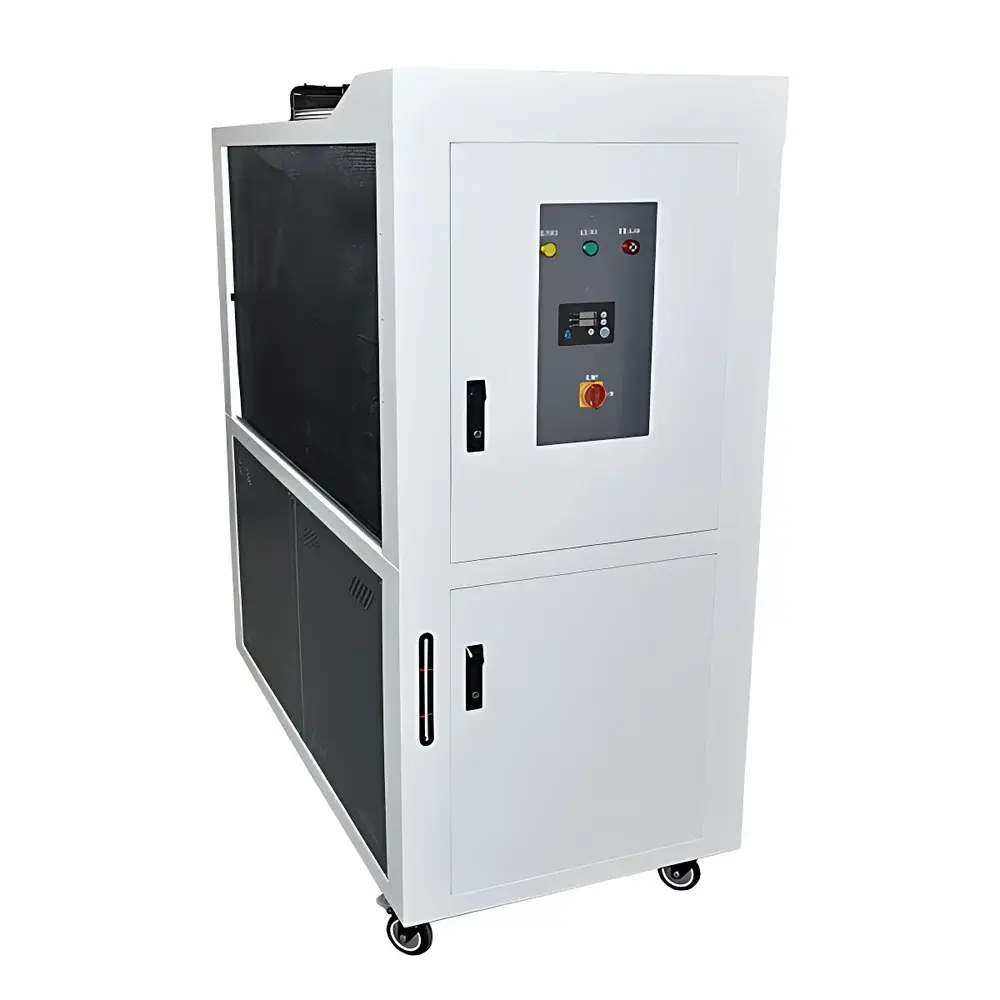
Tongzhou Weipu Industrial Circulating Chiller AR Series
| Brand | Tongzhou Weipu |
|---|---|
| Origin | Beijing, China |
| Manufacturer Type | Direct Manufacturer |
| Product Category | Domestic |
| Model | Industrial King AR |
| Instrument Type | Integrated Circulating Chiller |
| Cooling Method | Air-Cooled |
| Temperature Control Range | 5–35 °C |
| Cooling Capacity | 18–190 kW |
| Temperature Stability | ±1 °C |
| Reservoir Volume | 150–900 L (model-dependent) |
| Operating Mode | Continuous Duty |
| Pump Pressure & Flow Rate | Configurable per model (multiple pump options available) |
Overview
The Tongzhou Weipu Industrial Circulating Chiller AR Series is an integrated, air-cooled recirculating chiller engineered for stable thermal management of medium- to large-scale industrial and laboratory equipment. Designed around a dual-plate finned-tube condenser with side-intake/top-exhaust airflow architecture, the AR Series ensures efficient heat rejection in ambient environments without requiring external water sources or cooling towers. Its blue hydrophilic-coated condenser fins enhance heat transfer efficiency while resisting corrosion and facilitating routine maintenance. The unit operates continuously under full load, maintaining setpoint temperatures within ±1 °C across its 5–35 °C control range — a performance envelope validated for compatibility with high-heat-load processes such as laser material processing, vacuum deposition, and exothermic chemical reaction systems.
Key Features
- Integrated air-cooled design eliminates dependency on municipal water or glycol loops, reducing infrastructure requirements and operational complexity.
- Dual-plate condenser with hydrophilic aluminum fins delivers high surface-area-to-volume ratio and consistent thermal performance across varying ambient conditions (up to 40 °C).
- Two operational modes: “Setpoint Temperature Control” for precise process stabilization and “Room-Temperature Synchronization” for energy-efficient ambient tracking during low-demand cycles.
- Comprehensive safety architecture includes compressor high-pressure/low-pressure cutouts, phase failure protection, flow switch monitoring, and overtemperature shutdown — all with discrete fault-code display for rapid diagnostics.
- Modular pump configuration: multiple centrifugal pump options available with pressure ratings up to 6 bar and flow rates scalable from 10 to 120 L/min (model-dependent), supporting both low-resistance open-loop and high-backpressure closed-loop applications.
- Optional dual-circuit configuration enables sequential startup, automatic redundancy switching, and independent temperature control for multi-load systems — compliant with ISO 5170-2 and ASTM E2500 risk-based qualification frameworks.
Sample Compatibility & Compliance
The AR Series supports integration with a broad spectrum of heat-generating equipment requiring active coolant circulation, including CNC machining centers, plasma and fiber laser systems, vacuum coating chambers, electroplating rectifiers, pharmaceutical bioreactors, and industrial polymerization reactors. All models meet CE electromagnetic compatibility (EMC) Directive 2014/30/EU and Low Voltage Directive 2014/35/EU. Optional water filtration kits (5–25 µm particulate retention) are available to maintain coolant purity in sensitive optical or semiconductor applications, aligning with USP and ISO 8573-1 Class 4 compressed air quality standards when used with closed-loop deionized water circuits. Units are constructed to GLP-compliant documentation practices and support IQ/OQ protocols per GAMP 5 guidelines.
Software & Data Management
Standard digital interface includes RS485 Modbus RTU communication for integration into facility-wide SCADA or MES platforms. Optional Ethernet/IP or Profibus-DP modules enable real-time monitoring of coolant temperature, flow rate, compressor discharge pressure, and cumulative runtime hours. Audit-trail-capable data logging (optional) records all parameter changes, alarm events, and manual overrides with timestamp and operator ID — satisfying FDA 21 CFR Part 11 requirements for electronic records and signatures when deployed in regulated manufacturing environments. Firmware updates are performed via secure USB interface with SHA-256 signature verification.
Applications
- Metalworking: Thermal stabilization of spindle motors, servo drives, and laser cutting heads in CNC mills, EDM machines, and robotic welding cells.
- Surface Engineering: Precise coolant temperature control for sputtering, e-beam evaporation, and ion plating systems where thermal drift affects film adhesion and stoichiometry.
- Pharmaceutical & Biotech: Jacketed reactor cooling during fermentation, crystallization, and lyophilization; compatible with sanitary-grade stainless steel fluid paths (optional).
- Packaging & Plastics: Mold temperature regulation in injection molding, blow molding, and thermoforming lines to ensure cycle repeatability and part dimensional stability.
- Research Infrastructure: Supporting high-power RF amplifiers, superconducting magnet cryocooler precooling stages, and synchrotron beamline optics chillers.
FAQ
What is the maximum allowable ambient operating temperature for the AR Series?
Units are rated for continuous operation at ambient temperatures up to 40 °C, provided adequate clearance (≥500 mm) is maintained around intake and exhaust zones.
Can the chiller be integrated into a Building Management System (BMS)?
Yes — standard Modbus RTU over RS485 allows seamless integration; optional BACnet MS/TP or LonWorks modules are available for direct BMS interfacing.
Is remote firmware update supported over network connection?
Firmware updates require local USB access for security and integrity verification; network-based updates are disabled by default per IEC 62443-3-3 cybersecurity requirements.
What certifications are included with factory shipment?
All units ship with CE Declaration of Conformity, RoHS compliance statement, and full electrical safety test report (EN 61000-6-2/6-4). UL/cUL listing is available upon request with additional qualification testing.
How is coolant contamination mitigated in long-term operation?
Optional inline particulate filters (5–25 µm), activated carbon cartridges for organic removal, and conductivity monitoring sensors can be specified at order entry to maintain coolant resistivity >1 MΩ·cm in deionized water applications.



