
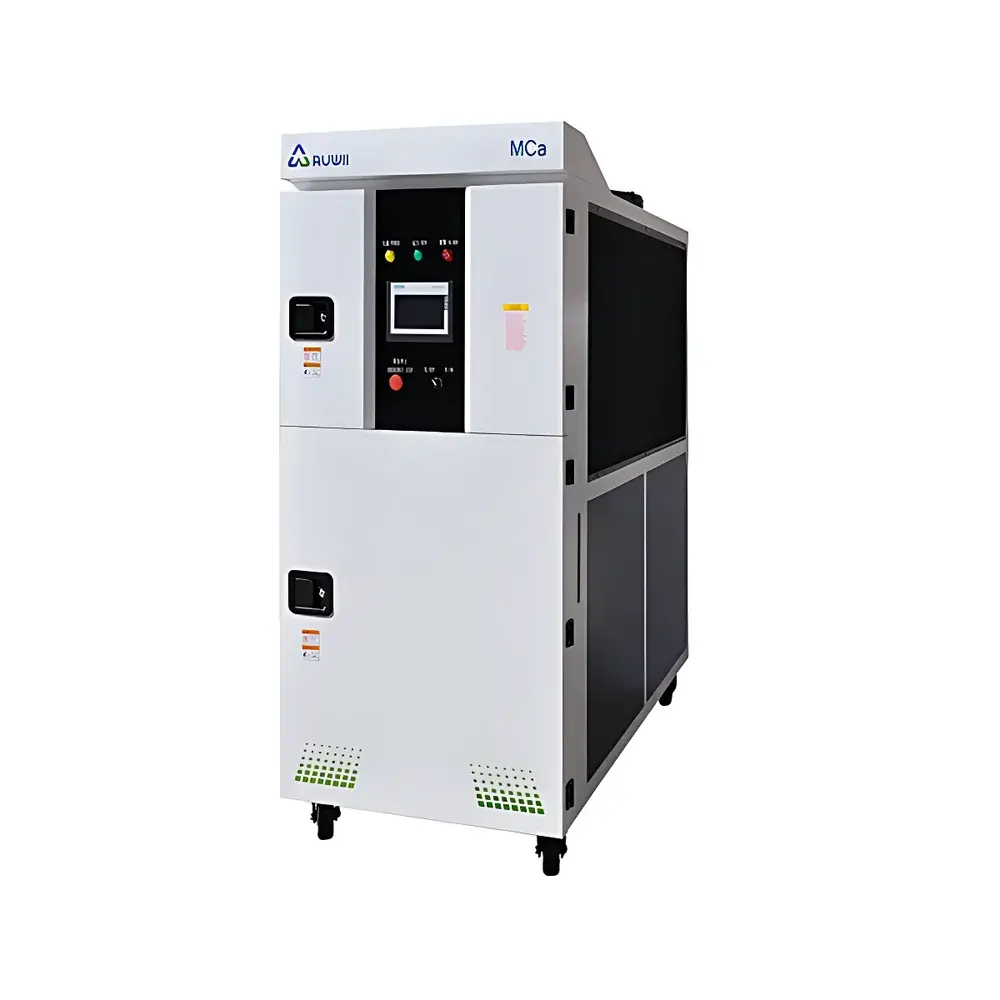
Tongzhou Weipu MCA Series Integrated Circulating Chiller for EV Controller Thermal Testing
| Brand | Tongzhou Weipu |
|---|---|
| Origin | Beijing, China |
| Manufacturer Type | Direct Manufacturer |
| Region of Origin | Domestic (China) |
| Model | MCA |
| Price Range | USD 7,000–14,000 (FOB China) |
| Instrument Type | Integrated Unit |
| Cooling Method | Water-Cooled |
| Temperature Control Range | −40 °C to +120 °C |
| Refrigeration Capacity | 12–40 kW |
| Temperature Stability | ±0.2 °C |
| Circulating Pump Pressure Range | 0–300 kPa |
| Circulating Pump Flow Rate | 2.0–20 L/min (dual-channel configuration available) |
| Reservoir Volume | 100–130 L |
| Operation Mode | Continuous Duty |
Overview
The Tongzhou Weipu MCA Series Integrated Circulating Chiller is an engineered thermal management solution specifically designed for high-fidelity, dynamic temperature control in electric vehicle (EV) powertrain component validation—particularly electric motor controllers, inverters, and battery management systems. Unlike conventional chillers optimized for steady-state laboratory cooling, the MCA leverages dual-stage low-temperature compressors and integrated cold storage technology to deliver rapid thermal transients across a wide operational envelope (−40 °C to +120 °C). Its architecture implements a closed-loop liquid circulation system with precise flow and pressure regulation, enabling controlled heat extraction or injection into DUTs (Devices Under Test) during accelerated life testing, thermal shock profiling, and environmental stress screening per IEC 60068-2-14 and ISO 16750-4. The system operates continuously under full load, supporting 24/7 test campaigns required for automotive-grade reliability qualification.
Key Features
- Dual-stage refrigeration circuit with dedicated low-temperature compressors, enabling stable sub-zero operation down to −40 °C without external cryogenic support
- Integrated cold storage module (phase-change thermal buffer) that decouples compressor cycling from real-time thermal demand—reducing overshoot and accelerating ramp rates up to 3× faster than standard compressor-only systems
- Two independent circulation channels (2.0–20 L/min each), each with variable-frequency pump control, pressure feedback, and flow stability ≤ ±0.2 L/min
- Intelligent return-fluid recovery: automated nitrogen purge sequence evacuates residual coolant from DUT manifolds post-test, minimizing cross-contamination and enabling safe hot-swap of test units
- Modular internal architecture—refrigeration core, fluid management unit, and control electronics are physically and logically isolated—supporting field-upgradable firmware, sensor calibration packages, and communication protocol stacks
- Leak containment design: fully enclosed stainless-steel drip pan with level sensing and automatic shutoff, compliant with ISO 13849-1 Category 3 functional safety requirements for lab equipment
Sample Compatibility & Compliance
The MCA chiller interfaces with EV controller test benches via standardized 1/2″–3/4″ NPT or ISO 228-1 G-threaded ports and supports glycol–water (up to 40% v/v) or specialized dielectric coolants (e.g., 3M Novec 7200). It meets electromagnetic compatibility requirements per EN 61326-1 (industrial environment) and carries CE marking under the EU Machinery Directive 2006/42/EC. All firmware logs—including setpoint history, actual temperature/flow traces, alarm events, and maintenance cycles—are timestamped and stored with audit-trail integrity, satisfying GLP and ISO/IEC 17025 data governance expectations. Optional FDA 21 CFR Part 11-compliant electronic signature modules are available for regulated validation environments.
Software & Data Management
The embedded controller runs a real-time Linux OS with deterministic I/O scheduling and supports native Modbus TCP, CAN 2.0B (ISO 11898-1), and RS-485 (EIA-485) protocols—enabling seamless integration into NI Veristand, dSPACE SCALEXIO, or AVL PUMA Open test automation frameworks. Configuration and monitoring are accessible via web-based HMI (HTML5, responsive layout) or optional OPC UA server (compliant with IEC 62541). All operational parameters—including compressor discharge temperature, evaporator superheat, reservoir level, and pump current—are logged at user-configurable intervals (100 ms to 10 s) and exportable in CSV or HDF5 format. Remote diagnostics include predictive compressor health scoring based on vibration spectral analysis and oil degradation modeling.
Applications
- Dynamic thermal cycling of SiC-based motor controllers under simulated drive-cycle loads (e.g., WLTC, UDDS)
- Thermal shock testing of battery pack cooling plates per SAE J2380 and GB/T 31467.3
- Steady-state junction temperature mapping of high-power IGBT modules using infrared thermography synchronization
- Environmental stress screening (ESS) of DC-DC converters and onboard chargers across −40 °C to +120 °C ramps at 5–10 K/min
- Calibration support for calorimetric battery testing rigs requiring traceable, low-drift thermal sinks
FAQ
What coolant types are compatible with the MCA chiller?
The system supports aqueous ethylene or propylene glycol mixtures (≤40% concentration), deionized water, and non-conductive fluids such as 3M Novec 7200 or Solvay Solkane 365mfc—subject to viscosity and thermal conductivity verification against ASHRAE Guideline 33-2022.
Does the MCA support remote calibration and traceable temperature verification?
Yes—integrated Pt100 Class A sensors (IEC 60751) are factory-calibrated with NIST-traceable certificates; optional on-site recalibration kits include dry-block reference standards and automated deviation reporting per ISO/IEC 17025 Annex A.3.
Can the dual-channel flow be operated at different temperatures simultaneously?
No—the MCA maintains a single reservoir temperature; however, each channel regulates flow and pressure independently, allowing parallel testing of two DUTs with identical thermal setpoints but distinct hydraulic resistance profiles.
Is the system suitable for cleanroom or Class 1000 environments?
Standard configuration meets ISO 14644-1 Class 8; optional HEPA-filtered air intakes, sealed electronics enclosures (IP54), and low-outgassing materials (per ASTM E595) are available for Class 1000 integration.



