
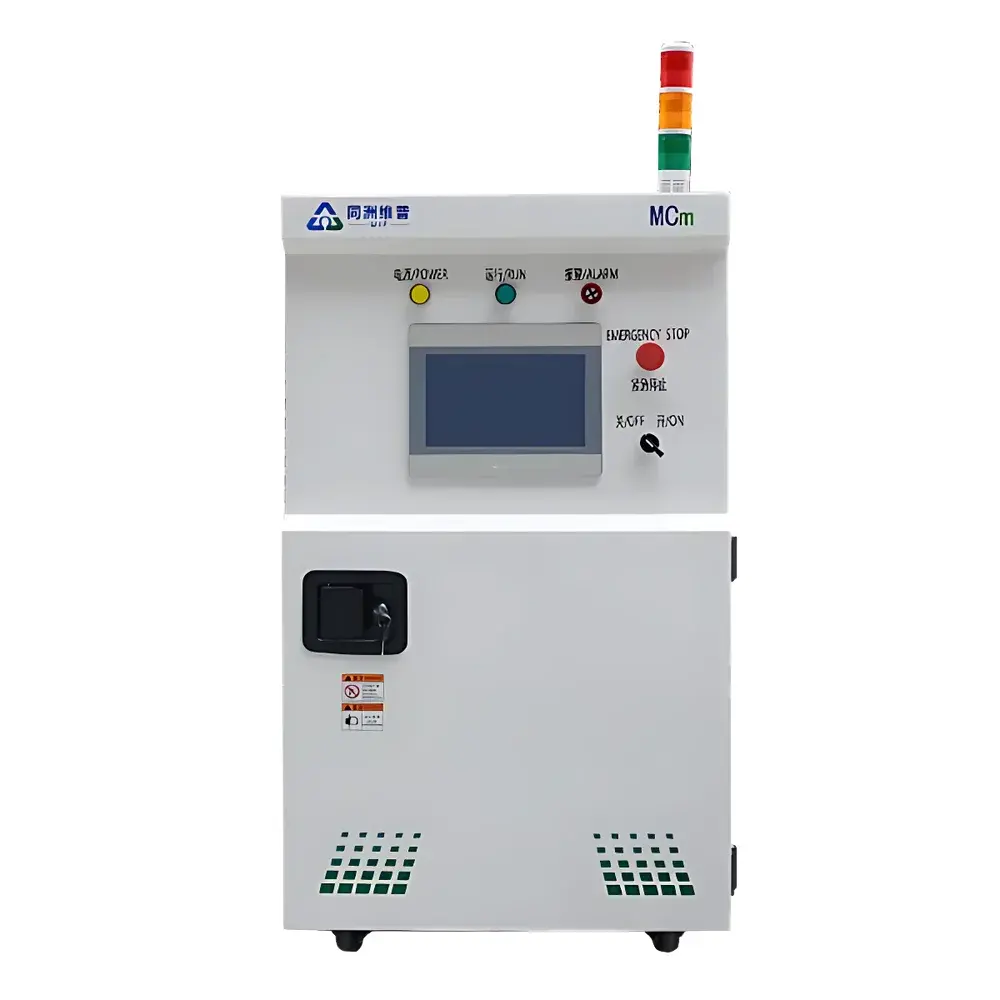
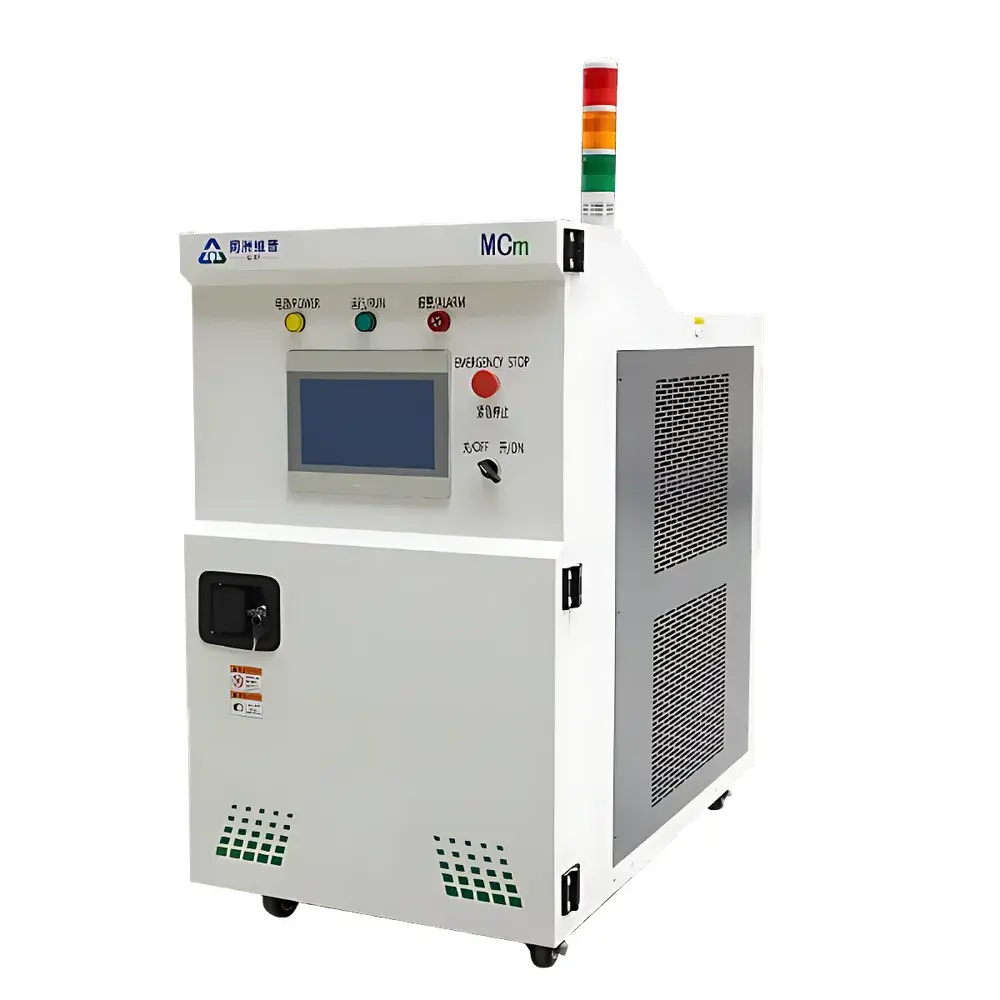
Tongzhou Weipu MCm Integrated Circulating Chiller for EV Battery Pack Testing Systems
| Brand | Tongzhou Weipu |
|---|---|
| Origin | Beijing, China |
| Manufacturer Type | Direct Manufacturer |
| Product Category | Domestic |
| Model | MCm |
| Instrument Type | Integrated (All-in-One) |
| Temperature Control Range | −20 °C to 95 °C |
| Cooling Capacity | 3 kW to 15 kW |
| Temperature Stability | ±0.5 °C |
Overview
The Tongzhou Weipu MCm Integrated Circulating Chiller is an engineered thermal management solution specifically designed for high-fidelity environmental simulation in electric vehicle (EV) battery testing laboratories. Built upon a closed-loop refrigeration architecture with dual-stage compression and PID-controlled expansion valve modulation, the MCm delivers precise, stable, and responsive temperature control across a wide operational envelope—from cryogenic conditioning at −20 °C to high-temperature soak at 95 °C. Its core function is to maintain thermally defined boundary conditions for electrochemical test fixtures during dynamic load cycling, cold/hot shock protocols, and constant-power discharge characterization of lithium-ion cells, modules, and full battery packs. Unlike generic laboratory chillers, the MCm integrates hydraulic design optimizations—including low-turbulence internal manifolds, corrosion-resistant stainless-steel circulation paths, and pressure-compensated flow regulation—to ensure consistent thermal transfer across variable heat loads typical in battery calorimetry and abuse testing.
Key Features
- Integrated all-in-one design eliminates external pump cabinets, refrigerant piping, or auxiliary controllers—reducing footprint by up to 40% compared to modular chiller systems.
- Wide-range temperature control (−20 °C to 95 °C) enabled by R-410A/R-134a dual-refrigerant switching logic and insulated glycol-water mixture compatibility (up to 35% propylene glycol).
- Cooling capacity scalable from 3 kW to 15 kW (at 20 °C ambient), dynamically adjusted via inverter-driven compressors and real-time heat load feedback from integrated PT100 sensors.
- Temperature stability maintained within ±0.5 °C over 24-hour continuous operation, verified per ISO 17025-accredited calibration procedures using traceable NIST-standard reference probes.
- Robust hydraulic architecture supports both internal recirculation (for direct coupling to battery test chambers) and external loop integration (e.g., connection to thermal plates, cold plates, or climatic chambers) with flow rates adjustable from 5 to 30 L/min.
- IP54-rated enclosure with reinforced vibration-damping mounts ensures operational reliability in industrial lab environments subject to mechanical stress from adjacent battery cyclers or shaker tables.
Sample Compatibility & Compliance
The MCm is validated for use with cylindrical, prismatic, and pouch-format lithium-ion and solid-state battery cells (18650 to 73147 formats), module-level assemblies (up to 24S configurations), and full traction battery packs (≤100 kWh). Its fluid path materials—including EPDM gaskets, 316L stainless steel tubing, and PTFE-lined reservoirs—meet USP Class VI biocompatibility standards and resist degradation from common battery electrolyte vapors (e.g., LiPF6, EC/DMC solvents). The system complies with IEC 62660-2 for secondary lithium-ion cells used in electric road vehicles, and its control firmware adheres to functional safety requirements outlined in ISO 13849-1 (PL d, Cat 3). All electrical interfaces conform to CE/EMC Directive 2014/30/EU and RoHS 2011/65/EU restrictions on hazardous substances.
Software & Data Management
The MCm operates under embedded Linux-based firmware with a web-accessible HMI (HTTP/HTTPS, TLS 1.2 encrypted) supporting remote configuration, real-time trend logging, and alarm event archiving. Data export is compliant with ASTM E2500-18 Annex A2 for instrument qualification records, generating CSV- and PDF-formatted reports containing timestamped setpoint/actual temperature traces, compressor duty cycles, and flow rate logs. Audit trails meet FDA 21 CFR Part 11 requirements through role-based user authentication (admin/operator/guest), electronic signatures, and immutable log retention for ≥36 months. Optional OPC UA server integration enables seamless data ingestion into LabVantage, Thermo Fisher SampleManager, or custom MES platforms for full GLP/GMP-aligned test documentation.
Applications
- Dynamic thermal profiling during charge/discharge cycles (e.g., 1C–5C rates) under controlled ambient offsets.
- Cold/hot shock testing per ISO 16750-4 and GB/T 31467.3, including rapid ramp rates (≥10 °C/min) between extreme setpoints.
- Calorimetric validation of cell-level heat generation (q = m·cp·dT/dt) using coupled thermistor arrays and mass flow sensors.
- Thermal runaway propagation studies requiring sustained sub-zero preconditioning followed by localized heating triggers.
- Validation of battery thermal management system (BTMS) performance in prototype pack designs under simulated vehicle drive cycles.
FAQ
What types of battery test fixtures can the MCm interface with directly?
The MCm supports standardized DIN 12917-1 quick-connect couplings and offers configurable analog (4–20 mA) and digital (Modbus RTU over RS-485) I/O for synchronization with Arbin, Bitrode, or Keysight battery cycler control systems.
Is the MCm suitable for UL 9540A-compliant thermal runaway testing?
Yes—the system’s −20 °C minimum setpoint, ±0.5 °C stability, and rapid cooldown recovery (<120 s from 95 °C to 25 °C) satisfy pre-conditioning and post-initiation thermal stabilization requirements specified in UL 9540A Section 7.2.
Can the MCm operate continuously at 95 °C with full 15 kW cooling capacity?
At 95 °C setpoint, maximum sustainable cooling capacity is 8.2 kW (per ISO 5149-2:2014 test conditions; 35 °C ambient, 30% glycol mix); derating occurs above 70 °C due to refrigerant saturation limits.
Does the system include validation documentation for GxP environments?
Factory-installed IQ/OQ documentation packages are available, including as-built schematics, sensor calibration certificates (traceable to NPL/PTB), and firmware version verification reports aligned with Annex 11 and EU GMP Annex 15 expectations.



