
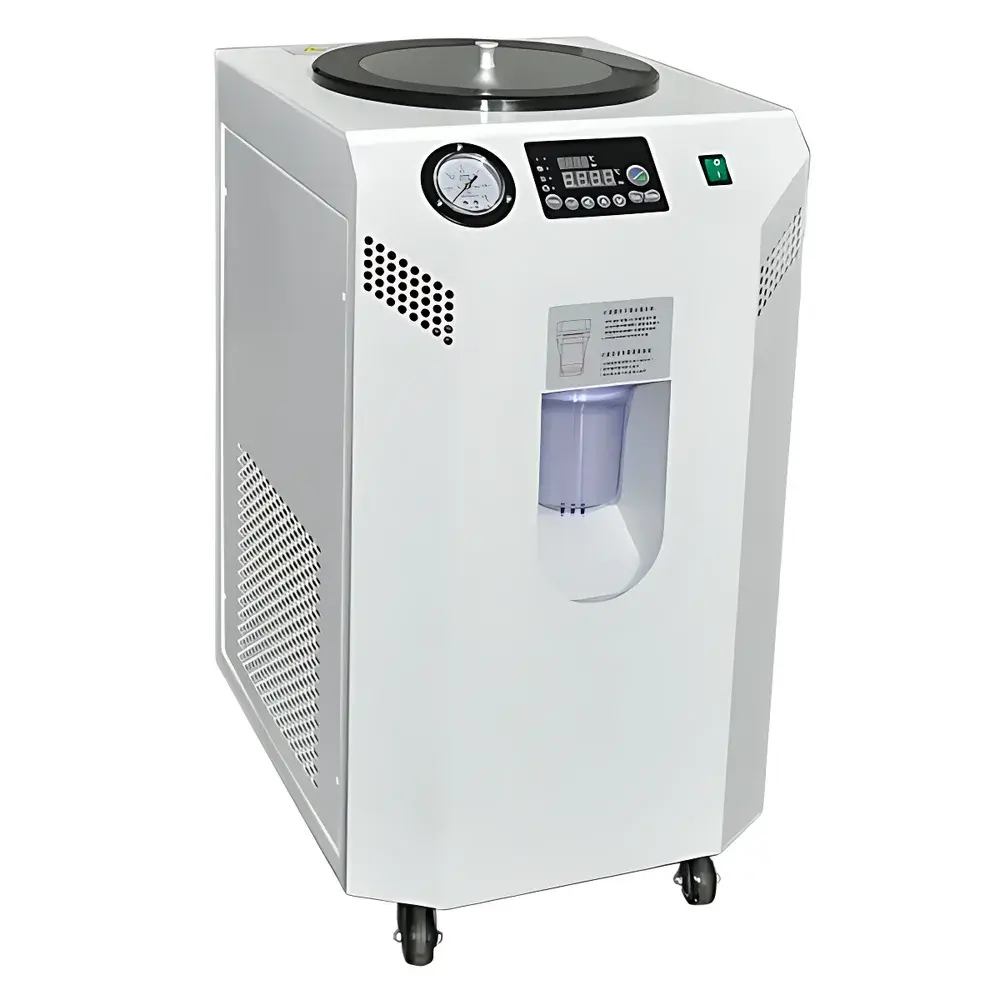
Tongzhou Weipu AC1600 Circulating Chiller
| Brand | Tongzhou Weipu |
|---|---|
| Origin | Beijing, China |
| Manufacturer Type | Direct Manufacturer |
| Product Category | Domestic |
| Model | AC1600 |
| Instrument Type | Integrated Unit |
| Cooling Method | Air-Cooled |
| Temperature Control Range | 5–40 °C |
| Refrigeration Capacity | 1000 W |
| Temperature Stability | ±0.1 °C |
| Circulation Pump Pressure | 2.0 bar |
| Circulation Flow Rate | 38 L/min |
| Reservoir Volume | 19 L |
| Operating Mode | Continuous |
Overview
The Tongzhou Weipu AC1600 Circulating Chiller is an engineered thermal management solution designed for precision laboratory applications requiring stable, continuous coolant delivery. Based on vapor-compression refrigeration with air-cooled condensation, the AC1600 maintains tight temperature control across a wide operational range (5–40 °C) while delivering consistent flow and pressure to external instruments. Its integrated architecture eliminates the need for external condenser water loops or chilled water infrastructure—making it ideal for laboratories with space constraints or limited utility access. The chiller is specifically calibrated to support heat-sensitive analytical instrumentation where thermal drift directly impacts measurement accuracy, repeatability, and system longevity.
Key Features
- PID-based intelligent temperature control algorithm ensures ±0.1 °C stability under dynamic load conditions, minimizing thermal hysteresis during instrument warm-up or high-duty-cycle operation.
- Stainless-steel open-bath reservoir (19 L capacity) with seamless welds and smooth interior finish facilitates rapid cleaning and reduces biofilm or mineral deposit accumulation.
- Corrosion-resistant stainless-steel fluid path—including pump housing, impeller, and all wetted tubing—to ensure long-term compatibility with deionized water, glycol-water mixtures (up to 30% v/v), and other common lab coolants.
- Multi-layer thermal insulation across compressor compartment, refrigerant lines, and reservoir minimizes ambient heat ingress and improves energy efficiency at low-temperature setpoints.
- Comprehensive hardware-level safety monitoring: real-time detection of low-flow, low-level, over-temperature, and high-head-pressure conditions—with automatic shutdown and latching alarm states.
- Low-noise fan array and vibration-damped compressor mount reduce acoustic emissions to ≤58 dB(A) at 1 m, meeting ISO 7779 requirements for shared laboratory environments.
Sample Compatibility & Compliance
The AC1600 is compatible with a broad spectrum of laboratory instrumentation requiring regulated coolant supply—including atomic absorption spectrometers (AAS), inductively coupled plasma optical emission spectrometers (ICP-OES), scanning electron microscopes (SEM), plasma etchers, glovebox purge systems, and automated Kjeldahl digestion units. All wetted materials comply with USP Class VI biocompatibility standards and are non-leaching per ASTM D1248. The unit meets CE marking requirements under the EU Machinery Directive 2006/42/EC and Low Voltage Directive 2014/35/EU. Electrical safety conforms to IEC 61010-1:2010 for laboratory equipment. While not certified to FDA 21 CFR Part 11, its digital interface supports audit-ready logging when integrated with validated LIMS or ELN platforms.
Software & Data Management
- RS232 and RS485 serial interfaces enable bidirectional communication using ASCII-based command protocols—supporting remote setpoint adjustment, real-time parameter readout (temperature, flow status, fault codes), and scheduled start/stop sequences.
- USB-B port allows direct connection to Windows/Linux hosts for configuration via included terminal emulator software; no proprietary drivers required.
- Opto-isolated digital I/O (6-pin D-sub) provides TTL-compatible dry-contact inputs for external enable/disable control and relay outputs for alarm signaling (e.g., integration with building management systems or emergency shutdown circuits).
- Firmware supports user-defined calibration offsets and configurable alarm thresholds—enabling traceable adjustments aligned with internal metrology procedures.
Applications
The AC1600 serves as a critical thermal interface in analytical, materials science, and quality control laboratories. It stabilizes detector temperatures in AAS and ICP-OES systems to suppress dark current noise and improve signal-to-noise ratio. In SEM facilities, it maintains cold traps and column chillers to prevent hydrocarbon contamination and enhance vacuum integrity. For plasma etch tools and RF generators, the chiller mitigates thermal expansion-induced misalignment in waveguide components and power amplifiers. In regulated environments—such as pharmaceutical QC labs—the AC1600 supports USP <797> compliant glovebox cooling and ensures consistent digestion kinetics in automated Kjeldahl analyzers. Its continuous-duty rating and robust overload protection make it suitable for unattended overnight operation in multi-shift facilities.
FAQ
What is the nominal refrigeration capacity rating based on?
The 1000 W rating is measured per ISO 5149-1 at ambient 25 °C and coolant inlet temperature 25 °C. Actual capacity decreases linearly with rising ambient temperature or falling setpoint—consult the derating curve in the technical manual for application-specific sizing.
Can the AC1600 operate with ethylene glycol solutions?
Yes—compatible with aqueous glycol mixtures up to 30% by volume. Viscosity increase must be accounted for in system head loss calculations; maximum recommended concentration is 25% for optimal pump efficiency at 38 L/min.
Is the reservoir level sensor calibrated and field-adjustable?
The capacitive level sensor is factory-calibrated and includes a user-accessible offset trim function via the RS485 interface, allowing compensation for fluid density variations or installation tilt.
Does the unit support NIST-traceable temperature validation?
The internal PT1000 sensor is calibrated to ±0.05 °C at 25 °C. An optional external reference probe input (via analog voltage channel) enables real-time comparison against certified reference thermometers during IQ/OQ protocols.
What maintenance intervals are recommended for continuous operation?
Air filter cleaning every 30 days in standard lab environments; full refrigerant circuit inspection and oil analysis every 24 months; stainless-steel reservoir descaling with citric acid solution every 6 months if using tap water.



