
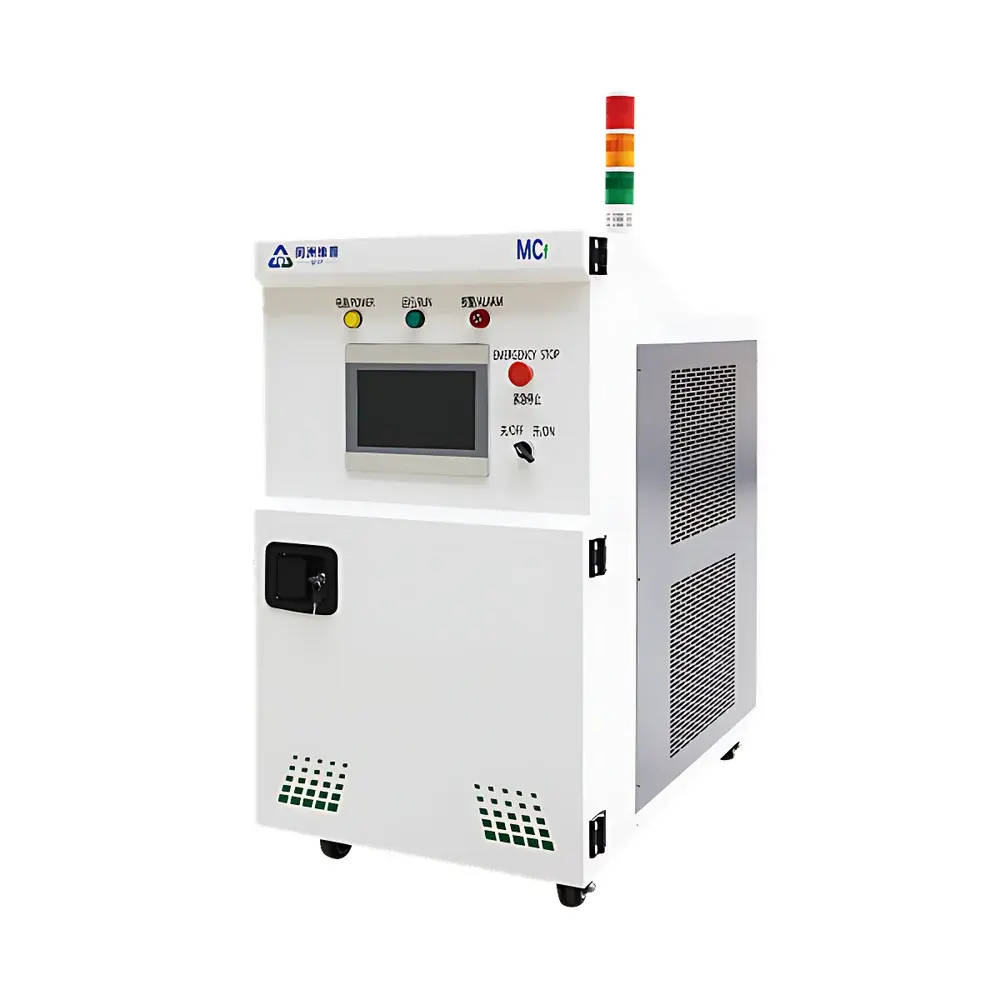
Tongzhou Weipu MCf Direct Refrigerant-Cooled EV Battery Thermal Management System
| Brand | Tongzhou Weipu |
|---|---|
| Origin | Beijing, China |
| Manufacturer Type | Direct Manufacturer |
| Instrument Type | Integrated Circulating Chiller |
| Temperature Control Range | –15 °C to 55 °C |
| Temperature Stability | ±2 °C |
Overview
The Tongzhou Weipu MCf Direct Refrigerant-Cooled EV Battery Thermal Management System is an integrated circulating chiller engineered specifically for electric vehicle (EV) battery pack testing and development. Unlike conventional liquid-cooled thermal management systems that rely on water-glycol mixtures as secondary heat transfer fluids, the MCf implements a direct refrigerant circulation architecture—utilizing fluorinated refrigerants (e.g., R134a, R404A, or R1234yf-compatible formulations) as the primary cooling/heating medium. This design enables phase-change heat transfer directly within battery module cold plates or embedded evaporator channels, significantly improving thermal response time, system efficiency, and spatial temperature uniformity across large-format prismatic or pouch cells. The system operates on a closed-loop vapor-compression cycle with digitally controlled expansion valves, hermetic scroll compressors, and high-efficiency brazed plate heat exchangers—optimized for laboratory-scale validation of battery thermal runaway mitigation strategies, fast-charge thermal profiling, and low-temperature performance characterization under ISO 12405-4 and GB/T 31467.3 test conditions.
Key Features
- Integrated single-unit architecture with built-in refrigeration circuit, expansion control, and PID-based temperature regulation—no external condenser or auxiliary coolant loops required.
- Wide operational temperature range from –15 °C to +55 °C, supporting both sub-zero battery preconditioning and high-temperature abuse testing scenarios.
- Temperature stability maintained at ±2 °C under dynamic load conditions (typical for 5–50 kW battery cycling), verified per IEC 60068-3-5 thermal performance protocols.
- Refrigerant-side pressure monitoring and safety interlocks—including high-pressure cut-off, low-refrigerant-level detection, and compressor overheat protection—to comply with EN 60335-1 electrical safety requirements.
- Modular interface design compatible with standard EV battery test fixtures: quick-connect SAE J1939 CAN bus for real-time communication with battery management systems (BMS), analog 0–10 V / 4–20 mA setpoint inputs, and digital dry-contact emergency stop integration.
Sample Compatibility & Compliance
The MCf system is validated for use with lithium-ion battery packs employing direct refrigerant cooling architectures—including cold plate-integrated microchannel evaporators and serpentine tube designs commonly found in OEM platforms (e.g., Tesla Model Y, BYD Blade, and VW MEB modules). It supports sample volumes up to 120 L and thermal loads up to 45 kW (refrigeration capacity), making it suitable for full-pack level testing under UN 38.3 T5/T6 thermal shock protocols. All fluid-contact materials—including stainless steel refrigerant lines, EPDM O-rings, and aluminum cold plates—meet USP Class VI biocompatibility standards and are certified free of halogenated contaminants per IEC 61215-2 MQT 17. The unit carries CE marking under the EU Machinery Directive 2006/42/EC and complies with RoHS 2011/65/EU and REACH (EC) No. 1907/2006 substance restrictions.
Software & Data Management
Equipped with embedded Linux-based controller firmware (v3.2+), the MCf provides local HMI operation via a 7-inch capacitive touchscreen with multi-language support (English, German, Chinese). Remote supervision is enabled through Ethernet (TCP/IP) and optional Wi-Fi modules, supporting Modbus TCP and OPC UA server profiles for seamless integration into LabVIEW, MATLAB, or Siemens Desigo CC test automation environments. All temperature setpoints, actual readings, refrigerant pressures, compressor run hours, and alarm logs are timestamped and stored internally for ≥30 days. Audit-trail functionality meets GLP and GMP data integrity expectations per FDA 21 CFR Part 11 when paired with user-authenticated login and electronic signature configuration. Export formats include CSV, PDF reports, and JSON API endpoints for LIMS synchronization.
Applications
- Dynamic thermal validation of battery packs during constant-current/constant-voltage (CC/CV) charging cycles at rates up to 4C.
- Thermal runaway propagation studies using localized heater-triggered cell failure under controlled ambient ramp profiles.
- Low-temperature discharge capacity retention testing per ISO 12405-2 Annex B at –20 °C and –30 °C.
- Calibration and verification of embedded battery temperature sensors (NTC, PT1000) against NIST-traceable reference probes.
- Development of model-based thermal control algorithms for predictive BMS thermal management strategies.
FAQ
Does the MCf support dual-refrigerant configurations for extended low-temperature operation?
No—the MCf is configured for single-refrigerant operation optimized for EV battery applications; however, custom refrigerant charge options (e.g., R513A for lower GWP) can be specified at order entry.
Is external water cooling required for the condenser section?
No—condenser heat rejection is air-cooled via variable-speed EC fans; no chilled water or tap water connection is needed.
Can the system interface with third-party battery cyclers such as Arbin or Bitrode?
Yes—via analog voltage/current signals or CAN bus (J1939 PGN 0xFEF2), with protocol documentation available under NDA.
What is the maximum allowable refrigerant line length between chiller and battery pack?
For optimal dynamic response and pressure drop control, total equivalent length should not exceed 15 meters (including bends and fittings); longer runs require hydraulic modeling and optional booster pump integration.
Is firmware update capability available over-the-air (OTA)?
Yes—secure HTTPS-based firmware updates are supported through the web interface, with version rollback and SHA-256 signature verification enabled by default.



