
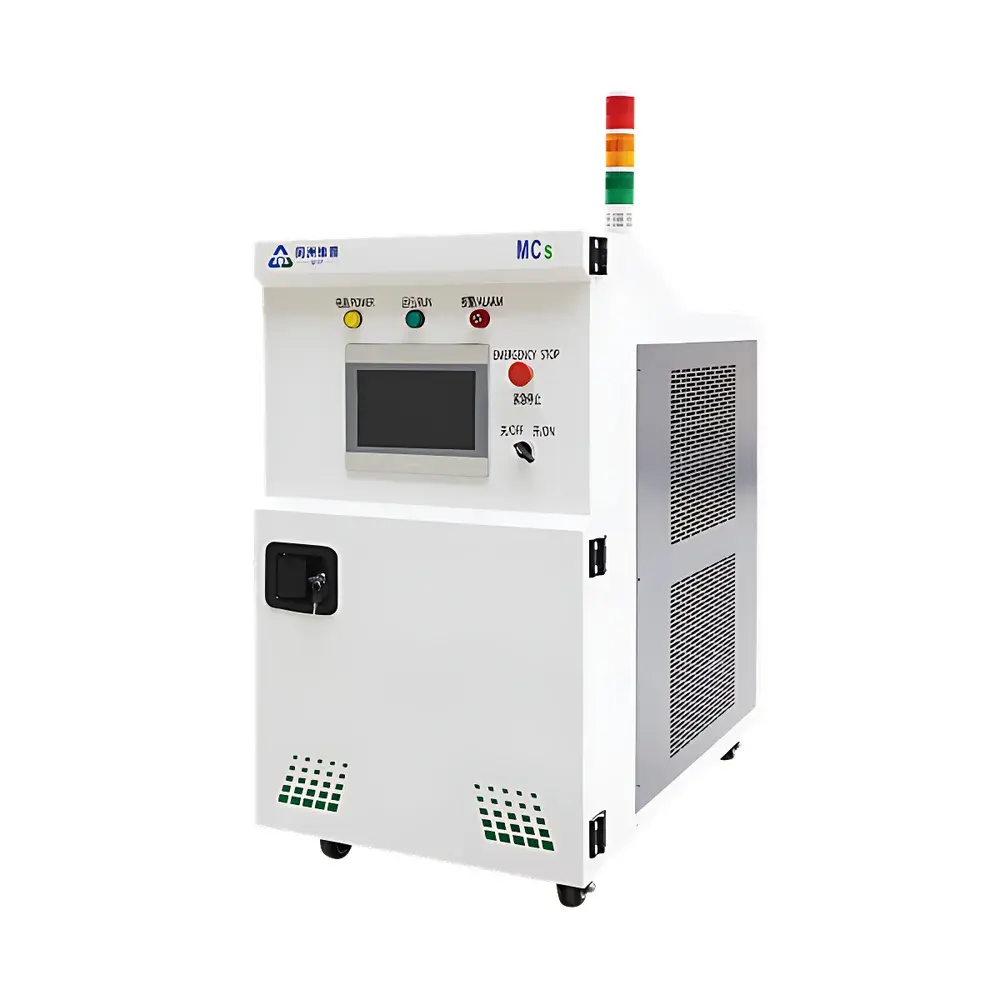
Tongzhou Weipu MCs Inline EV Test Temperature Control System
| Brand | Tongzhou Weipu |
|---|---|
| Origin | Beijing, China |
| Manufacturer Type | Direct Manufacturer |
| Product Origin | Domestic (China) |
| Model | MCs |
| Instrument Type | Integrated Circulating Chiller |
| Temperature Control Range | −20 °C to +95 °C |
| Cooling Capacity | 3 kW to 100 kW |
| Temperature Stability | ±0.5 °C |
Overview
The Tongzhou Weipu MCs Inline EV Test Temperature Control System is an integrated circulating chiller engineered for high-throughput thermal management in electric vehicle (EV) component validation and production-line electrochemical testing environments. Designed around a closed-loop, forced-circulation thermofluid architecture, the system delivers precise, dynamic temperature control across a wide operational envelope—from sub-zero battery preconditioning (−20 °C) to high-temperature power electronics stress testing (+95 °C). Its core thermal regulation mechanism relies on a dual-mode refrigeration circuit (vapor-compression with optional heat recovery or electric heating augmentation), enabling rapid ramp rates and sustained stability under variable thermal loads typical of EV battery module cycling, motor inverter thermal soak, and onboard charger (OBC) functional verification. Unlike benchtop chillers optimized for single-point lab use, the MCs series integrates modular flow-path interfaces, industrial-grade pressure/flow sensors, and real-time PID feedback loops—making it suitable for inline deployment within automated test cells where repeatability, long-duration unattended operation, and I/O interoperability with PLC-based test sequencers are mission-critical.
Key Features
- Integrated design with compact footprint—engineered for seamless integration into automated EV test lines without requiring external pump skids or expansion tanks
- Wide operational temperature range (−20 °C to +95 °C) supported by multi-stage refrigerant staging and auxiliary electric heating elements
- Cooling capacity scalable from 3 kW to 100 kW (at 20 °C ambient, ΔT = 10 K), accommodating single-cell, module-level, and pack-level thermal load profiles
- Temperature stability maintained at ±0.5 °C under steady-state conditions, verified per ISO 17025-accredited calibration protocols using traceable Pt100 Class A sensors
- Corrosion-resistant fluid path constructed from 316 stainless steel and EPDM/FKM-sealed components, compatible with common glycol–water mixtures (up to 40% vol.) and low-conductivity deionized coolants
- Industrial communication interfaces including Modbus RTU (RS-485), EtherNet/IP, and optional OPC UA server support for SCADA and MES integration
Sample Compatibility & Compliance
The MCs system is compatible with standard EV test fixtures requiring liquid-cooled thermal interface—such as battery thermal test plates (BTTP), power module cold plates, and e-motor stator cooling jackets. It supports flow rates from 5 to 120 L/min (adjustable via integrated variable-frequency drive pump), with pressure delivery up to 6 bar(g) and differential pressure sensing across user-defined inlet/outlet ports. From a regulatory standpoint, the unit complies with CE marking requirements (2014/30/EU EMC Directive and 2014/68/EU PED for pressure equipment above 0.5 bar), RoHS 2011/65/EU, and meets UL 61010-1 safety standards for laboratory and industrial control equipment. While not certified to IEC 61850 or ISO 26262 ASIL levels, its control architecture supports configuration for ASIL-B–compatible test cell environments when deployed with external safety relays and watchdog timers.
Software & Data Management
The MCs incorporates an embedded Linux-based controller running a deterministic real-time OS, with local HMI (7″ capacitive touchscreen) and remote web interface (HTTPS-enabled). All setpoints, actual values, alarms, and event logs—including timestamped thermal transient data (sampled at 1 Hz)—are stored internally for ≥30 days and exportable via USB or SFTP. Audit trail functionality records operator login/logout events, parameter changes, and alarm acknowledgments—fully compliant with GLP and FDA 21 CFR Part 11 requirements when configured with user role-based access control (RBAC) and digital signature enforcement. Optional software packages include MATLAB® Simulink® co-simulation support for hardware-in-the-loop (HIL) thermal modeling and Python SDK for custom CI/CD-integrated test automation workflows.
Applications
- Preconditioning and thermal cycling of lithium-ion battery modules (e.g., NMC, LFP, solid-state prototypes) per UN GTR 20, ISO 12405, and GB/T 31485 test schedules
- Thermal load simulation for traction inverters and DC–DC converters during power-on functional testing and efficiency mapping
- Stabilization of fuel cell stack coolant loops during polarization curve acquisition and freeze-thaw durability assessment
- Support of calorimetric measurements in isothermal microcalorimetry (IMC) setups for EV electrolyte decomposition kinetics studies
- Environmental stress screening (ESS) of automotive-grade PCBAs and sensor assemblies under controlled thermal gradients
FAQ
What coolant types are approved for use with the MCs system?
Propylene glycol–water mixtures (20–40% vol.), ethylene glycol–water (for non-food-contact applications), and deionized water with ≤5 µS/cm conductivity are validated. Silicone oils and fluorinated fluids require prior compatibility review.
Does the MCs support external temperature feedback control from a DUT-mounted sensor?
Yes—via analog 0–10 V or 4–20 mA input; the system can operate in cascade mode where the chiller regulates bath temperature while the DUT sensor drives final setpoint modulation.
Is remote firmware update capability available?
Firmware updates may be performed over secure HTTPS or local USB; all updates undergo cryptographic signature verification and automatic rollback on integrity failure.
Can the MCs be operated in a cleanroom environment (ISO Class 7)?
Standard units are rated for ISO Class 8; Class 7 operation requires optional HEPA-filtered air intake and non-shedding enclosure finishes—available upon request with cleanroom qualification documentation.
What is the mean time between failures (MTBF) under continuous 24/7 operation?
Based on field data from >1,200 installed units in Tier-1 EV supplier facilities, MTBF exceeds 12,500 hours at 85% load and 25 °C ambient, per IEC 61508 Annex B methodology.



