
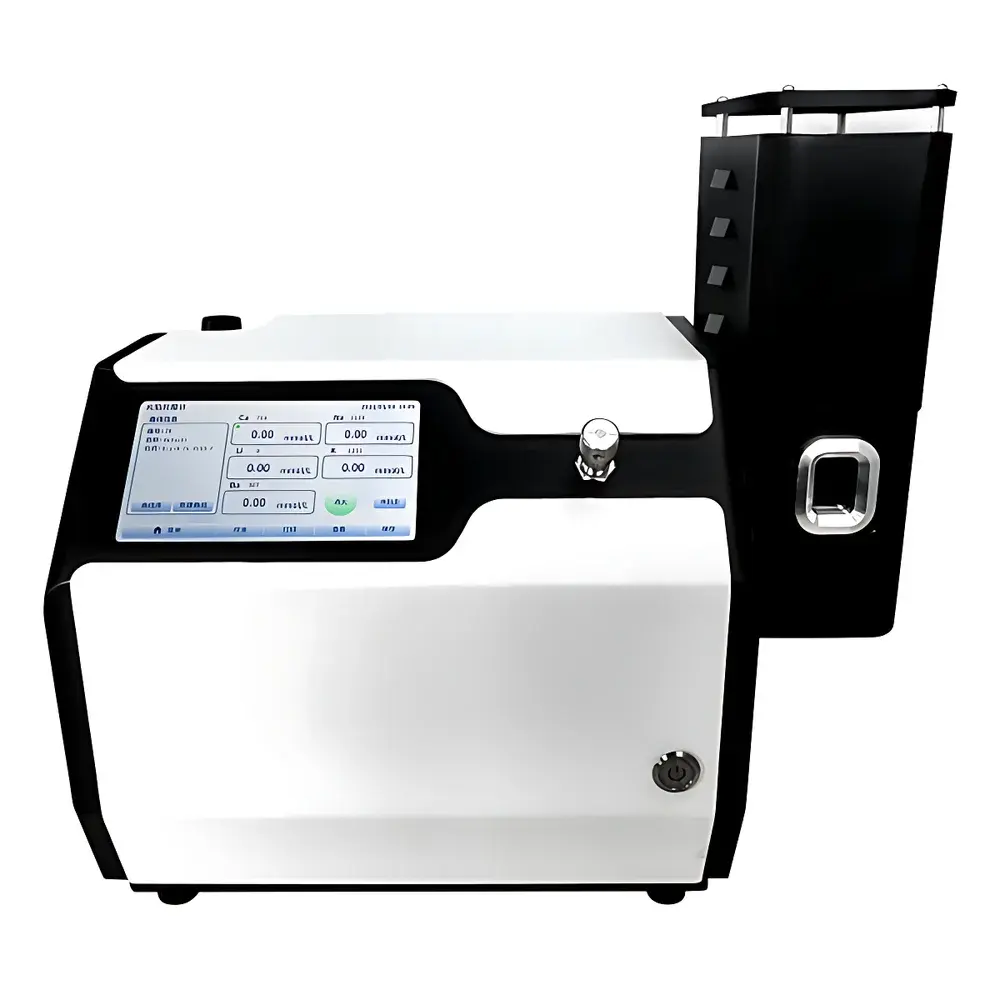
Yoke FP6430 Multi-Element Flame Photometer
| Brand | Yoke |
|---|---|
| Origin | Shanghai, China |
| Manufacturer | Yoke Instrument Co., Ltd. |
| Model | FP6430 |
| Detection Limits | K ≤ 0.004 mmol/L |
| Response Time | < 8 s |
| Repeatability | ≤ 3% RSD |
| Sample Introduction Rate | < 6 mL/min |
| Display | 7-inch capacitive touch LCD |
| Power | 30 W (220 ± 22 V, 50 ± 1 Hz) |
| Operating Temperature | 10–35 °C |
| Relative Humidity | ≤ 85% RH |
| Elements Measured | K, Na, Li, Ca, Ba |
| Safety Features | Flame-out protection, gas leakage alarm |
| Data Storage | Up to 10 calibration curves and 200 sample datasets |
| Connectivity | USB port, U-disk export, cloud interface |
| Compliance | Designed for GLP-compliant routine analysis in regulated labs |
Overview
The Yoke FP6430 Multi-Element Flame Photometer is a benchtop atomic emission spectrometer engineered for quantitative determination of alkali and alkaline earth metals—specifically potassium (K), sodium (Na), lithium (Li), calcium (Ca), and barium (Ba)—in aqueous solution samples. It operates on the fundamental principle of flame atomic emission spectroscopy (FAES): nebulized sample aerosol is introduced into a stable, stoichiometric air–liquefied petroleum gas (LPG) flame, where thermal energy excites valence electrons of target metal atoms; upon relaxation, characteristic wavelength photons are emitted and measured by a photomultiplier tube (PMT) or solid-state detector. The instrument’s optical path employs interference filters optimized for each element’s primary emission line (e.g., 766.5 nm for K, 589.0/589.6 nm for Na), ensuring high spectral selectivity and minimal inter-element interference. Designed for routine laboratory environments—including QC labs in agriculture, construction materials, pharmaceuticals, and environmental testing—the FP6430 delivers rapid, reproducible results without requiring high-resolution monochromators or complex alignment procedures.
Key Features
- 7-inch high-resolution capacitive touch LCD display with intuitive graphical user interface for real-time monitoring, curve fitting, and direct concentration readout
- Dual-safety architecture: automatic flame extinction detection with immediate gas cutoff, plus integrated LPG leakage sensor compliant with IEC 61000-4 electromagnetic immunity standards
- Automated calibration workflow: linear and quadratic regression with auto-calculation of correlation coefficient (r²), slope, and intercept for each element-specific calibration curve
- Local data management: internal memory stores up to 10 multi-point calibration curves and 200 raw measurement records; supports export via USB-A port to standard FAT32-formatted USB flash drives
- Cloud-enabled connectivity: optional secure TLS 1.2–encrypted upload to Yoke’s proprietary LabLink™ platform for remote data review, audit trail generation, and multi-instrument fleet monitoring
- Compact footprint (W × D × H: 360 × 320 × 420 mm) and low power consumption (30 W nominal) enable deployment in space-constrained or mobile lab settings without dedicated HVAC or exhaust ducting
- Direct elemental concentration readout—no manual calculation required—for K, Na, Li, Ca, and Ba across user-defined concentration ranges
Sample Compatibility & Compliance
The FP6430 accepts clarified aqueous extracts prepared per standard methods including ASTM D511 (for water-soluble cations), ISO 11260 (soil extractable K/Na), and USP (alkali content in pharmaceutical excipients). Sample introduction is achieved via peristaltic pump-driven nebulization at ≤6 mL/min, compatible with 0.45 µm filtered solutions and low-viscosity digestates (e.g., HNO₃/HF microwave digests of ceramics or cement). The system meets essential requirements of ISO/IEC 17025:2017 for calibration verification and intermediate checks. While not certified to FDA 21 CFR Part 11 out-of-the-box, its audit-ready data log (timestamped measurements, operator ID, curve parameters, and instrument status flags) supports implementation of electronic signature workflows under GMP/GLP environments when paired with validated LabLink™ server configurations.
Software & Data Management
Embedded firmware provides full local control: calibration setup, sample measurement, statistical evaluation (mean, SD, RSD), and report preview. All measurement metadata—including date/time stamp, calibration ID, element selected, raw signal intensity (µA), and calculated concentration—are stored with traceability. USB export generates CSV files compatible with Excel, JMP, or LIMS ingestion. The optional LabLink™ cloud service adds role-based access control, versioned calibration history, automated backup, and configurable alerting (e.g., out-of-spec results, low gas pressure warnings). Audit trails comply with ALCOA+ principles (Attributable, Legible, Contemporaneous, Original, Accurate, Complete, Consistent, Enduring, Available) for regulatory submissions.
Applications
- Agricultural science: rapid quantification of exchangeable K⁺ and Na⁺ in soil extracts and fertilizer formulations per AOAC 975.03
- Construction materials: determination of alkali content in cement, concrete admixtures, and ceramic glazes to assess ASR (alkali–silica reaction) risk per ASTM C1260/C1567
- Environmental testing: analysis of leachate from municipal solid waste per TCLP (EPA Method 1311) and landfill monitoring wells
- Pharmaceutical QA: verification of residual sodium in active pharmaceutical ingredients (APIs) and excipients per ICH Q5D guidelines
- Clinical & nutritional research: measurement of serum or urine K/Na ratios in metabolic studies (non-diagnostic use)
- Food & beverage quality control: monitoring salt (NaCl) and potassium additives in beverages, dairy products, and processed foods per ISO 6496
FAQ
What gases are compatible with the FP6430?
The instrument is configured exclusively for liquefied petroleum gas (LPG) as fuel, combined with compressed air as oxidant. Natural gas or acetylene are not supported due to burner head geometry and flame temperature requirements.
Can the FP6430 measure magnesium or iron?
No. The FP6430 is optimized for elements with strong, low-excitation-potential emission lines in the visible range (K, Na, Li, Ca, Ba). Mg (285.2 nm) and Fe (various lines below 250 nm) require UV-capable optics and vacuum purging, which are outside this instrument’s design scope.
Is method validation documentation available?
Yes—Yoke provides a comprehensive Instrument Qualification Package (IQ/OQ/PQ protocols) aligned with ISO/IEC 17025, including linearity, LOD/LOQ, precision, and robustness test templates for user execution.
Does the system support 21 CFR Part 11 compliance?
The base unit does not include electronic signatures or biometric authentication. However, when deployed with LabLink™ Enterprise Edition and validated IT infrastructure, it satisfies all technical controls required for Part 11 compliance in GxP environments.
What maintenance intervals are recommended?
Daily: nebulizer cleaning with 5% HNO₃; weekly: burner cap inspection and air filter replacement; annually: PMT sensitivity verification and optical alignment check using NIST-traceable K/Na standards.






