
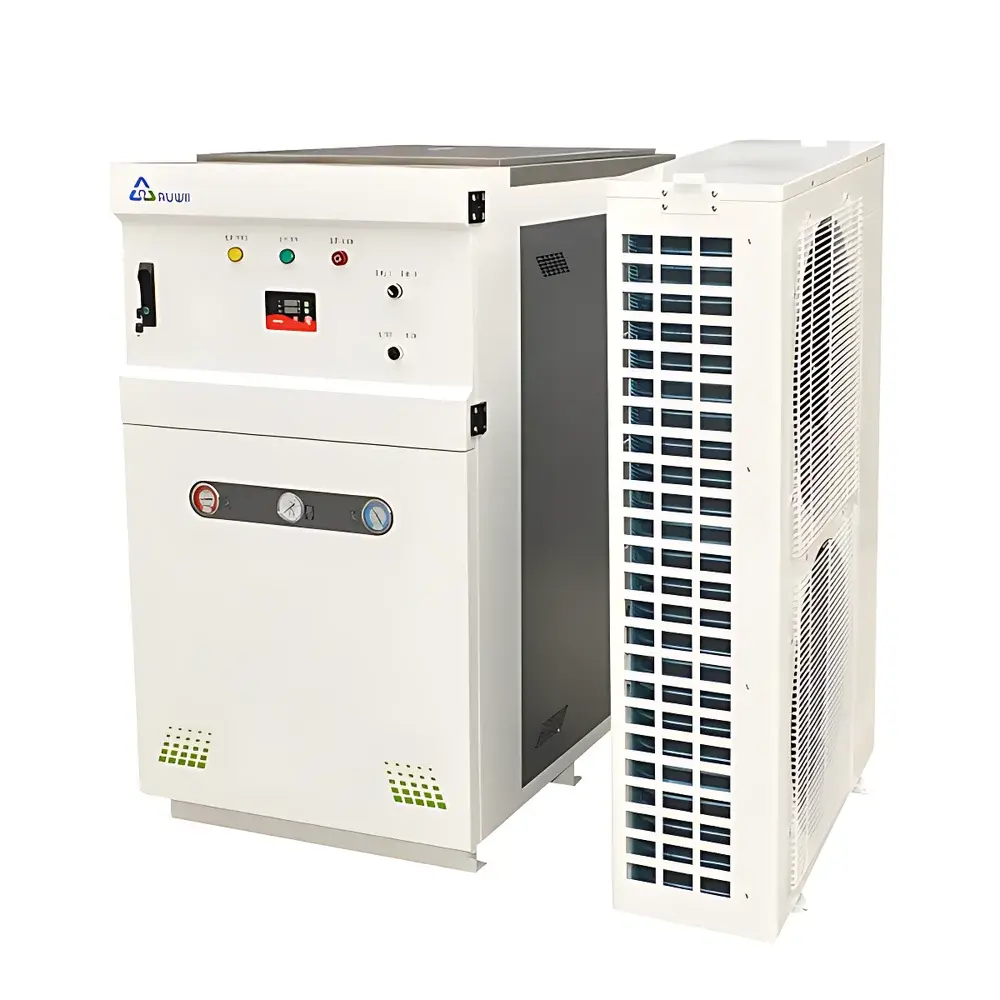
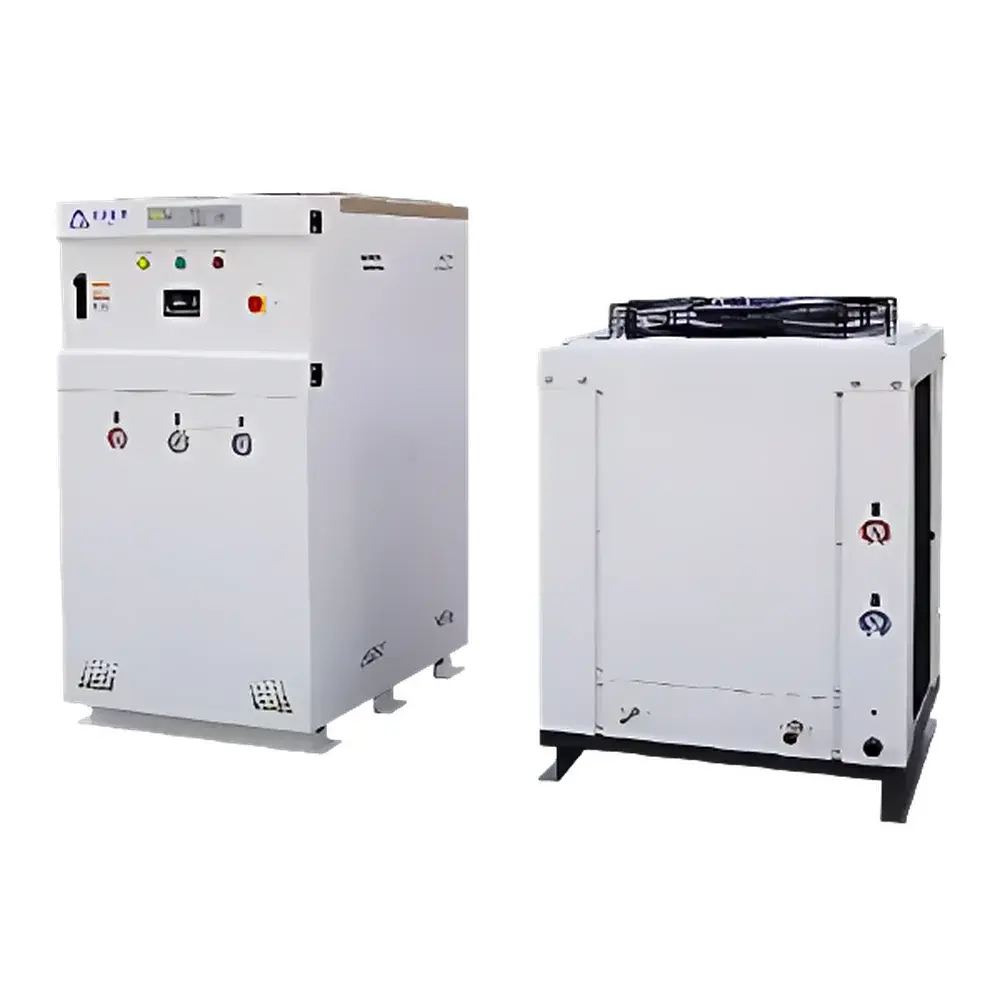
Tongzhou Weipu RG Series Air-Cooled Split Circulating Chiller
| Brand | Tongzhou Weipu |
|---|---|
| Origin | Beijing, China |
| Manufacturer Type | Direct Manufacturer |
| Instrument Type | Split-System |
| Cooling Method | Air-Cooled |
| Temperature Range | 5–35 °C |
| Temperature Stability | ±1 °C |
| Refrigeration Capacity | 5000 W |
| Circulating Pump Pressure | 3.0 bar |
| Circulating Pump Flow Rate | 60 L/min |
| Reservoir Volume | 100 L |
| Operation Mode | Continuous Duty |
Overview
The Tongzhou Weipu RG Series Air-Cooled Split Circulating Chiller is an engineered thermal management solution designed for precision temperature control in demanding laboratory and industrial environments. Based on vapor-compression refrigeration cycle architecture with R410A or R134a refrigerant (system-dependent), it delivers stable, continuous cooling to heat-generating instrumentation requiring reliable thermal dissipation without direct water supply dependency. Its split-system configuration physically separates the condensing unit (outdoor or ventilated mechanical room) from the evaporator/reservoir module (indoor lab space), minimizing acoustic emissions and heat load within sensitive experimental areas. This design supports ISO 14644-1 Class 7–8 cleanroom-compatible installations and meets ambient noise requirements typical of ISO/IEC 17025-accredited laboratories where operator comfort and instrument stability are co-dependent.
Key Features
- Split-system architecture enables low-noise indoor operation (<58 dB(A) at 1 m from chiller module), critical for quiet-zone labs housing X-ray diffractometers (XRD), scanning electron microscopes (SEM), and plasma etch systems.
- High-efficiency scroll or rotary compressor paired with optimized finned-tube air-cooled condenser ensures consistent refrigeration output across ambient temperatures up to 43 °C (IEC 60034-1 ambient class B).
- Stainless steel 304 reservoir (100 L capacity) with integrated level sensor, anti-corrosion coating, and overflow protection; compatible with deionized water, 30% ethylene glycol/water mixtures, and other non-aggressive heat-transfer fluids.
- Variable-speed centrifugal circulation pump delivering precise flow regulation (0–60 L/min) at up to 3.0 bar head pressure — sufficient to overcome pressure drops in multi-instrument manifolds or long coolant loops.
- Digital PID temperature controller with NTC thermistor feedback (±0.1 °C sensor accuracy) and real-time setpoint adjustment via intuitive 4.3-inch TFT touchscreen interface.
- Comprehensive safety suite including high/low pressure cutouts, overtemperature shutdown, dry-run protection, phase failure detection, and refrigerant leak monitoring (optional).
Sample Compatibility & Compliance
The RG chiller is validated for continuous-duty thermal coupling with high-heat-flux analytical and process equipment, including but not limited to: X-ray fluorescence spectrometers (XRF), transmission electron microscopes (TEM), inductively coupled plasma mass spectrometers (ICP-MS), RF sputtering systems, vacuum arc deposition units, and industrial vacuum furnaces operating at ≤1200 °C. It complies with GB/T 10870–2014 (Chinese national standard for liquid chillers), CE marking per EN 60335-1 and EN 60335-2-40, and electromagnetic compatibility per EN 61000-6-3/6-4. Optional IQ/OQ documentation packages support GLP and GMP environments under FDA 21 CFR Part 11 and EU Annex 11 requirements.
Software & Data Management
Equipped with RS485 Modbus RTU and optional Ethernet TCP/IP interfaces, the RG chiller integrates into centralized facility monitoring systems (e.g., LabVantage, Siemens Desigo, or custom SCADA). The embedded firmware logs timestamped operational data — including inlet/outlet temperatures, pump status, compressor run hours, and alarm history — for ≥30 days onboard. Remote access via secure HTTPS web interface allows real-time parameter adjustment, historical trend review (min/max/avg over user-defined intervals), and export of CSV-formatted reports compliant with audit trail requirements. All configuration changes are logged with user ID, timestamp, and pre/post values — satisfying ALCOA+ data integrity principles.
Applications
- Thermal stabilization of X-ray source tubes (Cu/Kα, Mo/Kα) in single-crystal and powder XRD systems to maintain wavelength consistency and detector linearity.
- Cooling high-power RF generators (≥5 kW) in plasma-enhanced chemical vapor deposition (PECVD) and reactive ion etching (RIE) tools to prevent frequency drift and impedance mismatch.
- Heat rejection from electron beam welders and high-vacuum diffusion pumps where oil contamination from water-cooled condensers must be avoided.
- Secondary cooling loop support for laser-based metrology systems (e.g., interferometric displacement sensors) requiring sub-0.5 °C thermal gradient control over 8-hour measurement cycles.
- Process cooling in pilot-scale thin-film coating lines using magnetron sputtering or electron-beam evaporation, where coolant temperature stability directly impacts film stoichiometry and adhesion.
FAQ
What is the maximum allowable coolant temperature differential between inlet and outlet?
The recommended ΔT is ≤5 °C to ensure laminar flow conditions and avoid localized boiling or cavitation in high-heat-flux instruments.
Can this chiller operate continuously at 35 °C ambient temperature?
Yes — rated for continuous operation at ambient temperatures up to 43 °C when installed with ≥1 m clearance around condenser airflow paths and no direct solar exposure.
Is the reservoir compatible with deionized water only, or can glycol mixtures be used?
Both are supported; however, concentrations exceeding 35% propylene glycol reduce effective refrigeration capacity by ~12% and require recalibration of flow-pressure curves.
Does the system include built-in validation tools for temperature uniformity mapping?
No — uniformity verification requires external calibrated PT100 probes per ASTM E1112 or ISO 17025 procedures; however, the chiller provides stable setpoint hold for such qualification studies.
What maintenance intervals are recommended for compressor oil and refrigerant charge verification?
Compressor oil analysis every 2000 operating hours; refrigerant charge verification annually or after any service event involving refrigerant circuit opening.



