
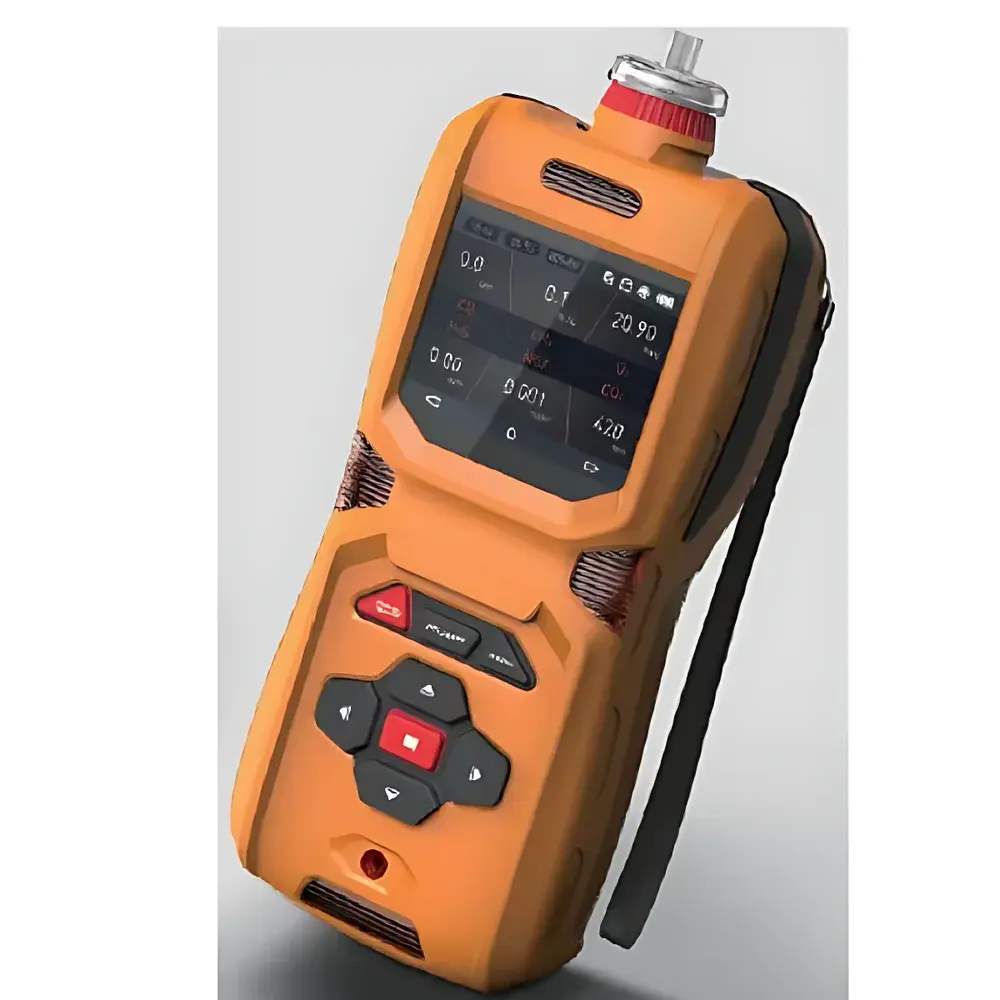
ADEV FS-200 Portable Hydrogen Gas Detector
| Brand | ADEV |
|---|---|
| Origin | Italy |
| Model | FS-200 |
| Instrument Type | Portable Gas Detector |
| Detectable Gases | H₂, NH₃, SF₆ |
| Response Time (T90) | ≤5 s |
| Measurement Accuracy | ±1% of Full Scale |
| Measurement Range | ppm to 100% vol |
| Sensor Principle | Electrochemical (H₂/NH₃), Optional Catalytic Bead / Infrared / Thermal Conductivity |
| Display | 2.5" 320×240 Color TFT Screen |
| Operating Temperature | −40 °C to +70 °C |
| IP Rating | IP66 |
| Explosion Protection | Ex d IIC T6 Gb / Intrinsic Safety Certified |
| Dimensions | 180 × 78 × 33 mm |
| Weight | 350 g |
| Power Supply | Rechargeable 3.6 V DC / 5000 mAh Polymer Battery |
| Data Storage | 100,000 records (configurable interval) |
| Communication | USB, RS232, Infrared |
| Compliance | ATEX, IECEx, EN 60079-0/11/26, ISO 9001, CE |
Overview
The ADEV FS-200 Portable Hydrogen Gas Detector is a certified intrinsically safe, multi-gas monitoring instrument engineered for rapid, reliable detection of hydrogen (H₂), ammonia (NH₃), and sulfur hexafluoride (SF₆) in industrial and field environments. Built on electrochemical sensor technology for H₂ and NH₃—complemented by optional catalytic bead (for combustible gases), infrared (for CO₂/SF₆), or thermal conductivity (for H₂ in inert backgrounds)—the FS-200 delivers high reproducibility and low cross-sensitivity across diverse gas matrices. Its integrated sampling pump operates at a stable 500 mL/min flow rate, enabling consistent draw-through analysis even under variable ambient pressure or particulate load. The device conforms to international hazardous area classification standards including ATEX Directive 2014/34/EU and IECEx System requirements for Group II C equipment with T6 temperature class, making it suitable for Zone 1 and Zone 2 classified locations in petrochemical, pharmaceutical, power generation, and semiconductor facilities.
Key Features
- Intrinsically safe and flameproof dual-certified design (Ex d IIC T6 Gb & intrinsic safety per EN 60079-11), validated for use in explosive atmospheres containing hydrogen-air mixtures.
- Multi-gas capability: Simultaneous detection of up to five gases—including primary targets H₂ and NH₃—with optional O₂, CO, CO₂, SO₂, Cl₂, HCl, NO₂, and VOCs via modular sensor configuration.
- High-resolution 2.5-inch color TFT display (320 × 240 pixels) with intuitive 8-button interface and configurable language support (English or Chinese).
- Robust environmental resilience: Operational range from −40 °C to +70 °C; IP66-rated enclosure ensures protection against dust ingress and water jets; internal hydrophobic filter enables stable performance in >99% RH or high-particulate conditions.
- Extended sensor service life: Electrochemical sensors rated for 2–3 years (H₂/NH₃), oxygen sensors available in 2-year or 6-year variants, infrared modules rated for 5–10 years, and thermal conductivity cells rated for ≥5 years under typical duty cycles.
- Comprehensive alarm system: Configurable tri-modal alerts—audible (≥85 dB), visual (high-brightness LED strobe), and haptic vibration—with programmable thresholds, latching/non-latching modes, and alarm event logging.
Sample Compatibility & Compliance
The FS-200 supports direct ambient air sampling as well as extractive measurement via optional 1–2 m telescopic probe or high-temperature sampling handle (rated to 800 °C with integrated cooling and filtration). It accommodates sample gas temperatures from −40 °C to +70 °C; with external pre-treatment systems, it handles hot, humid, or corrosive streams typical of flue gas, biogas upgrading, or electrolyzer stack monitoring. All sensor modules are calibrated traceably to NIST-traceable standards and comply with ISO 17025-accredited procedures. The instrument meets functional safety requirements per IEC 61508 SIL 2 for gas detection subsystems and supports audit-ready data integrity features required under FDA 21 CFR Part 11 and EU Annex 11 when used in GMP-regulated environments.
Software & Data Management
Data acquisition and reporting are managed through ADEV’s free PC-based communication software, compatible with Windows OS and supporting USB, RS232, and infrared interfaces. The device stores up to 100,000 timestamped records—including gas concentration, temperature (−40 °C to +120 °C, ±0.5 °C), relative humidity (0–100% RH, ±3% RH), battery status, alarm events, and calibration logs—with user-defined storage intervals (1 s to 24 h). Export formats include CSV and PDF reports; all records retain immutable timestamps and operator ID fields where enabled. Firmware updates and configuration changes are performed securely via encrypted USB transfer, with version-controlled revision history and rollback capability.
Applications
- Hydrogen infrastructure: Leak detection in PEM electrolyzers, fueling stations, storage vessels, and pipeline maintenance.
- Chemical process safety: Real-time NH₃ monitoring in refrigeration plants, fertilizer synthesis, and nitric acid production.
- Electrical utilities: SF₆ leak verification in GIS switchgear and circuit breakers per IEC 62271-1 and IEEE C37.122.1.
- Pharmaceutical manufacturing: Ambient H₂ monitoring during hydrogenation reactions and inert gas purging validation.
- Environmental compliance: Stack emission testing, landfill gas analysis, and indoor air quality assessment in laboratories and cleanrooms.
- Emergency response: First-responder deployment for post-incident gas hazard mapping in confined spaces or industrial accidents.
FAQ
What certifications does the FS-200 hold for use in hazardous areas?
The instrument carries ATEX (EU), IECEx (international), and UKCA certifications for Group II C, T6 temperature class, with dual protection modes (flameproof enclosure and intrinsic safety) per EN 60079-0, -1, and -11.
Can the FS-200 measure hydrogen in %LEL and ppm simultaneously?
Yes—dual-range H₂ sensing is standard: 0–100% LEL (resolution 0.1% LEL) and 0–40,000 ppm (resolution 1 ppm), both with ≤20 s T90 response and ±2% F.S. accuracy.
Is firmware update supported remotely?
No remote OTA updates; firmware upgrades require local connection via USB and authenticated software client to ensure configuration integrity and regulatory compliance.
Does the device support GLP/GMP audit trails?
Yes—full electronic audit trail includes user login/logout, calibration actions, alarm acknowledgments, and data export events, all time-stamped and non-erasable per 21 CFR Part 11 §11.10(e).
What is the recommended calibration frequency?
Bump testing before each shift is advised; full span calibration every 3–6 months depending on exposure frequency and criticality, per ISO 4074 and manufacturer guidelines.
Related Products







