
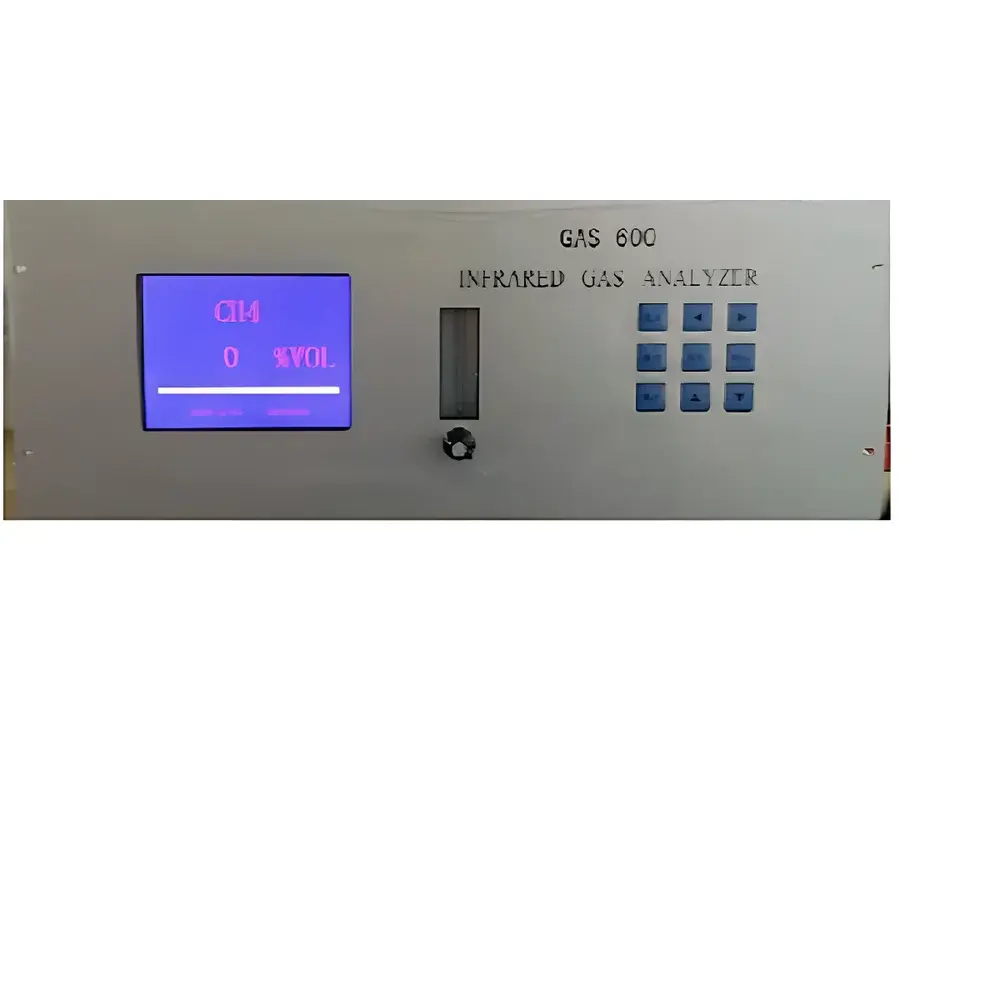
ADEV GAS400 Online Biogas Analyzer
| Brand | ADEV |
|---|---|
| Model | GAS400 |
| Gas Detection Principle | Electrochemical (EC), Non-Dispersive Infrared (NDIR), Thermal Conductivity (TCD), Paramagnetic, Photoionization (PID) |
| Measurable Gases | CH₄, CO₂, O₂, CO, H₂S, H₂, SO₂, NO, NO₂, NH₃, SF₆, CₓHᵧ (HC), BrCH₃, SO₂F₂, Ar, He, N₂, Cl₂ (optional), etc. |
| Measurement Ranges | O₂ (0–100% vol), CH₄ (0–100% vol), CO₂ (0–100% vol), CO (0–5000 ppm), H₂S (0–10,000 ppm), H₂ (0–100% vol), SO₂/NO/NO₂ (0–2000 ppm), NH₃ (0–200 ppm), SF₆ (0–100% vol), HC (0–9999 ppm or 0–100% vol) |
| Accuracy | ±2% to ±2.5% FS depending on gas and sensor type |
| Response Time (T₉₀) | 15–30 s |
| Output | 4–20 mA, 0–10 mA, RS485 Modbus RTU |
| Alarm Outputs | Relay (265 VAC / 1 A), Visual/Audible Interface |
| Enclosure | 19" Rack-Mount (Online) |
| Operating Temp | –20 to +50 °C (Ambient), –10 to +600 °C (Flue Gas Probe, optional) |
| Power Supply | 220 VAC ±10%, 50 Hz ±5% |
| Dimensions (Online) | 483 × 303 × 177 mm |
| Weight (Online) | 5.0 kg |
Overview
The ADEV GAS400 Online Biogas Analyzer is an industrial-grade, multi-gas continuous emission monitoring system engineered for real-time compositional analysis of biogas, landfill gas, syngas, digester off-gas, and other process gas streams. It operates on a hybrid sensing architecture—integrating electrochemical (EC), non-dispersive infrared (NDIR), thermal conductivity (TCD), paramagnetic, and photoionization (PID) detection technologies—to deliver simultaneous, selective, and stable quantification of up to 16 gas species within a single platform. Unlike single-sensor analyzers, the GAS400 employs gas-specific transducer selection logic to ensure optimal signal-to-noise ratio and cross-interference suppression—critical for accurate CH₄/CO₂ ratio calculation, combustion efficiency assessment, and safety-critical H₂S or CO monitoring in anaerobic digestion facilities. Its modular sensor bay supports field-replaceable cartridges with calibrated lifetime tracking, minimizing downtime during routine maintenance.
Key Features
- Multi-gas capability with configurable sensor combinations—including CH₄, CO₂, O₂, CO, H₂S, H₂, SO₂, NO, NO₂, NH₃, SF₆, total hydrocarbons (THC), and specialty gases (e.g., methyl bromide, sulfuryl fluoride)
- Dual-mode deployment: rack-mounted online configuration (19″ DIN enclosure) or portable handheld variant (1.0 kg, rechargeable Li-ion battery)
- Industrial I/O suite: isolated 4–20 mA analog outputs (up to 4 channels), Modbus RTU over RS485, dry-contact relay outputs (265 VAC / 1 A) for fan interlock, flare ignition, or emergency shutdown
- Real-time digital display with large-backlit LCD; configurable alarm thresholds with visual/audible alert interface
- Embedded temperature, pressure, and humidity compensation algorithms per ISO 14644-3 and ASTM D6216 guidelines for trace gas reporting under variable ambient conditions
- Ruggedized construction: aluminum alloy chassis, conformal-coated PCBs, and optional IP65-rated front panel for harsh industrial environments
Sample Compatibility & Compliance
The GAS400 accommodates both extractive and in-situ sampling configurations. For biogas applications, it interfaces with heated sample lines (up to 180 °C), particulate filters (0.1 µm), and moisture removal systems (chiller or permeation dryer) to prevent condensate-induced sensor drift. The analyzer meets EN 15267-3 (QAL1 certified components), EPA Method 21 for fugitive emissions screening, and ISO 14064-1 Annex B requirements for GHG quantification. Its data logging firmware supports audit-ready timestamped records compliant with GLP and 21 CFR Part 11 when paired with ADEV’s optional secure software module. Calibration traceability follows NIST-traceable standards, with documented uncertainty budgets available per sensor channel.
Software & Data Management
The GAS400 includes embedded firmware with dual-mode operation: standalone mode (local display + relay control) and networked mode (via optional Ethernet/WiFi gateway). ADEV’s AEGIS™ Data Manager software provides remote configuration, real-time trend visualization, automated calibration scheduling, and CSV/PDF report generation. All data points are time-stamped with microsecond precision and include metadata on sensor health, zero/span drift, and environmental compensation status. Audit trails record user actions, parameter changes, and calibration events—enabling full compliance with ISO/IEC 17025 internal quality audits. Firmware updates are delivered via signed OTA packages to maintain cryptographic integrity.
Applications
- Biogas upgrading plants: CH₄/CO₂ ratio monitoring for membrane separation or amine scrubbing control
- Landfill gas recovery systems: LEL (lower explosive limit) safety monitoring and VOC abatement verification
- Wastewater treatment digesters: O₂ ingress detection, H₂S corrosion risk assessment, and process stability indexing
- Combined heat and power (CHP) units: Combustion efficiency optimization via O₂/CO co-monitoring
- Environmental compliance reporting: Continuous emission monitoring (CEM) for EPA Subpart HH, EU Directive 2010/75/EU (IED), and China’s HJ 75-2017 standard
- Research & development labs: Anaerobic digestion kinetics studies, substrate degradation profiling, and inhibitor screening (e.g., ammonia toxicity thresholds)
FAQ
Can the GAS400 be configured for explosion-proof environments?
Yes—optional ATEX-certified variants (II 2G Ex d IIB T4 Gb) and IECEx-compliant enclosures are available upon request.
Does the analyzer support automatic zero and span calibration?
It supports scheduled auto-calibration using external gas standards (N₂ for zero, certified CH₄/CO₂ blends for span), with manual override and validation logs.
Is third-party software integration possible?
Yes—the Modbus RTU protocol enables native integration with Siemens PCS7, Emerson DeltaV, Honeywell Experion, and open-platform SCADA systems.
What is the recommended calibration frequency for biogas applications?
Per ISO 14644-3 and ADEV’s Field Service Bulletin FSB-GAS400-02, quarterly calibration is advised for continuous operation; semi-annual for intermittent use—with drift verification before each critical measurement campaign.
How does the system handle high-humidity biogas samples?
Integrated thermoelectric cooling (TEC) condensate traps and heated sample lines (standard up to 60 °C, optional 180 °C) maintain dew point control to prevent water film formation on optical windows and EC electrodes.







