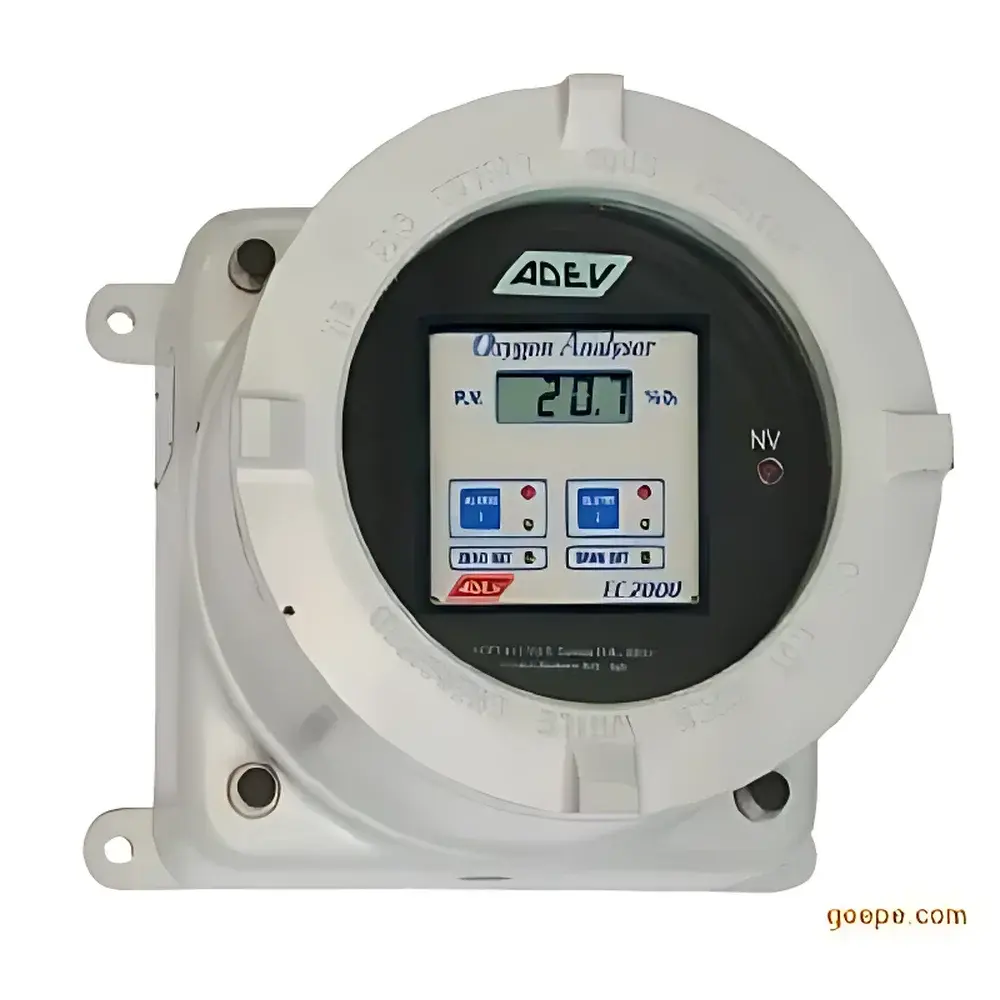
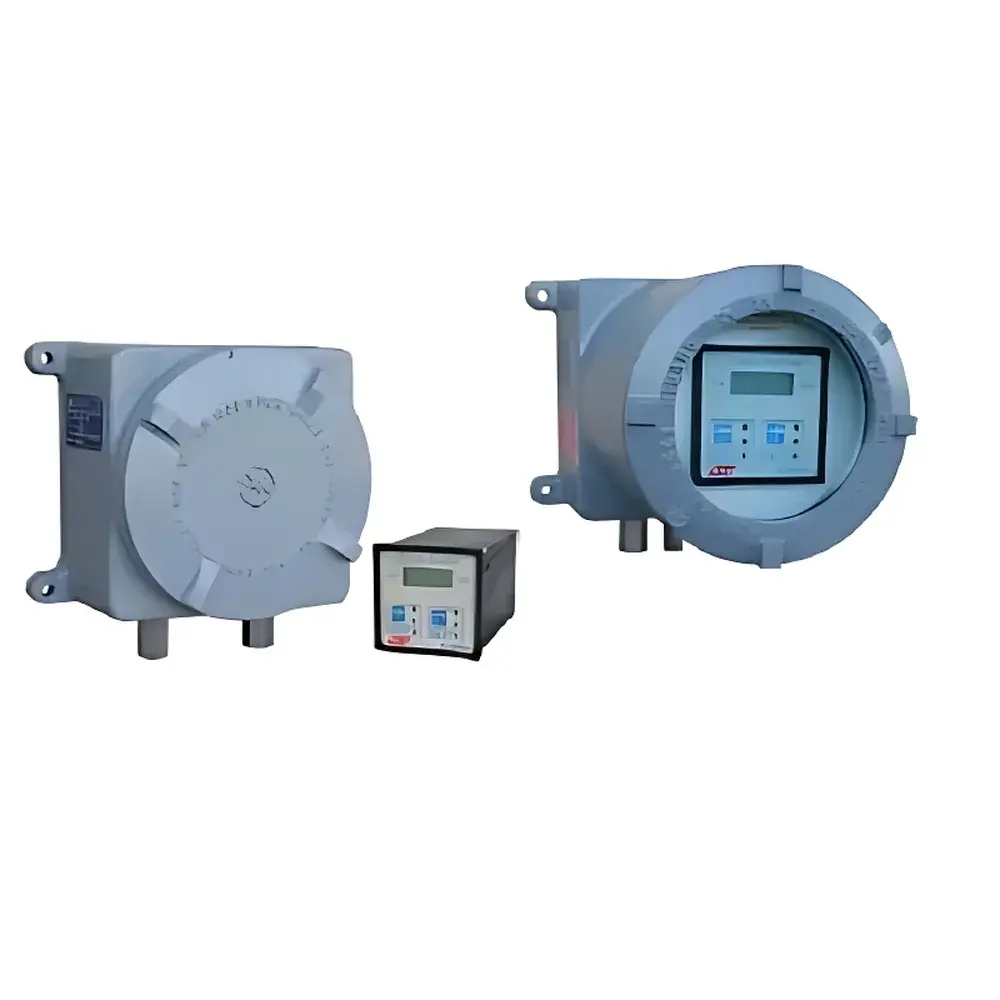
ADEV EC2000D Online Paramagnetic Oxygen Analyzer
| Brand | ADEV |
|---|---|
| Origin | Italy |
| Model | EC2000D |
| Detection Principle | Electrochemical (Galvanic Cell) |
| Measurement Range | E-type: 0.01%–100% O₂ |
| N-type | 100 ppm–50% O₂ |
| L-type | 0.1 ppm–25% O₂ |
| Resolution | Down to 0.1 ppm (L-type) |
| Response Time | <3 s (ppb-level), ~20 s (ppm-level) |
| Accuracy | ±2% of reading (10–100 ppm), ±1 ppm (10–99 ppm), ±0.2 ppm (0.1–9.9 ppm) |
| Stability | Better than ±2% of reading or ±0.5 ppm/month (whichever is greater) |
| Display | Multi-digit auto-ranging LCD, character height 12.7 mm |
| Analog Output Options | 0–5 V or 4–20 mA (user-selectable at order) |
| Alarm Outputs | 2 programmable relay channels (NO/NC, 250 VAC / 3 A, 60 W max) |
| Sample Flow Rate | 100–300 mL/min |
| Sample Temperature | –5 to +40 °C (non-condensing) |
| Ambient Operating Temp. | 0–40 °C (continuous), –5 to +55 °C (intermittent) |
| Enclosure Rating | IP40 standard (IP54 optional with lockable transparent door) |
| Explosion Protection | ATEX/IECEx EEx ia IIC T6 certified sensor interface (requires Zener barrier or galvanic isolator for hazardous area installation) |
| Power Supply | 110/120 V or 220/240 V AC, 50/60 Hz |
| Sample Connection | 6 mm OD compression fitting |
Overview
The ADEV EC2000D Online Paramagnetic Oxygen Analyzer is a high-stability, microprocessor-controlled electrochemical analyzer engineered for continuous, real-time oxygen monitoring in industrial process and safety-critical environments. Unlike paramagnetic or zirconia-based analyzers, the EC2000D employs a temperature-compensated galvanic cell sensor — a self-powered, maintenance-optimized electrochemical transducer offering long-term drift stability and no requirement for external bias voltage or reference gas. This principle enables reliable detection across an exceptionally wide dynamic range: from trace-level applications down to 0.1 ppm O₂ (L-type sensor) up to full-scale 100% O₂ (E-type sensor), with automatic range switching and intelligent signal conditioning integrated into the firmware. The instrument is designed for integration into nitrogen purge systems, inert gas blanketing loops, pharmaceutical headspace verification, food packaging integrity validation, glovebox atmosphere control, and medical gas production lines — all while meeting operational demands for ISO 8573-1 air purity classification, USP <1231> compressed gas specifications, and GMP-aligned data integrity requirements.
Key Features
- Triple-sensor architecture support: E-type (0.01–100% O₂), N-type (100 ppm–50% O₂), and L-type (0.1 ppm–25% O₂) — each optimized for specific chemical compatibility, including resistance to low-concentration acidic gases (e.g., CO₂, H₂S) without catalytic poisoning.
- Auto-ranging multi-digit LCD display with 12.7 mm character height ensures legibility under ambient lighting and glovebox viewing conditions; dynamically updates resolution based on active concentration range (e.g., 0.1 ppm below 50 ppm, 0.01% between 0.5–9.99%).
- Two fully programmable alarm relays with user-defined setpoints, hysteresis, and delay timers; each provides fail-safe dry-contact outputs rated 250 VAC / 3 A, normally energized, compliant with SIL 2 functional safety principles per IEC 61508.
- Configurable analog output (0–5 V or 4–20 mA) mapped to any segment of the measurement span — enabling seamless integration with DCS, PLC, or chart recorders without external signal scaling.
- Hazardous area-ready design: Sensor module complies with ATEX Directive 2014/34/EU and IECEx as “simple apparatus” (EEx ia IIC T6); installation in Zone 0/1 requires certified Zener barrier or galvanic isolator per EN 60079-11.
- Low-power architecture (≤4 VA) supports dual-voltage AC (110/220 V) or 24 VDC operation — suitable for mobile skids, cleanroom utility panels, and battery-backed backup systems.
Sample Compatibility & Compliance
The EC2000D accommodates non-corrosive, non-condensing sample streams within –5 to +40 °C, with recommended flow rates of 100–300 mL/min via 6 mm OD stainless-steel or PTFE tubing. Optional acid-resistant sensor variants extend service life in CO₂-rich or sour-gas environments typical of fermentation off-gas, modified-atmosphere packaging (MAP), or syngas purification. The analyzer conforms to electromagnetic compatibility standards EN 61326-1 (industrial environment) and meets mechanical robustness requirements per EN 60529 (IP40 standard enclosure; IP54 optional). For regulated industries, its fixed calibration protocol, audit-trail-capable parameter logging (via optional RS-232/485 interface), and deterministic response behavior support compliance with FDA 21 CFR Part 11 (when paired with validated software), EU GMP Annex 15, and ISO/IEC 17025 method validation frameworks.
Software & Data Management
While the EC2000D operates as a standalone hardware analyzer, its microprocessor firmware embeds configurable data handling logic: analog output scaling, alarm thresholds, hysteresis values, and display units are retained through power cycles. Optional serial communication (RS-232 or RS-485 Modbus RTU) enables remote readout of live concentration, sensor status, and relay states into SCADA or LIMS platforms. All configuration changes are timestamped internally; though the base unit lacks onboard storage, integration with external historian systems satisfies ALCOA+ (Attributable, Legible, Contemporaneous, Original, Accurate, Complete, Consistent, Enduring, Available) data governance expectations. No proprietary drivers or cloud dependencies are required — ensuring deterministic performance in air-gapped or legacy automation infrastructures.
Applications
- Air separation units (ASUs): Monitoring O₂ breakthrough in high-purity nitrogen product streams prior to cryogenic distillation column exit.
- Pharmaceutical manufacturing: Verifying residual O₂ levels (<1 ppm) in lyophilization chamber backfill gas and vial headspace post-capping per USP <1231>.
- Food packaging: In-line validation of modified atmosphere (MAP) gas mixtures (e.g., 0.5–2% O₂ in meat trays) to inhibit microbial growth while preserving color.
- Glovebox and inerting systems: Continuous surveillance of argon/nitrogen purge efficiency during semiconductor wafer handling or pyrophoric reagent synthesis.
- Medical gas production: Final QC release testing of USP Nitrogen, USP Oxygen, and USP Carbon Dioxide per compendial limits.
- Industrial safety: Area monitoring of confined spaces where O₂ depletion (<19.5%) or enrichment (>23.5%) poses physiological hazard per OSHA 1910.146.
FAQ
What sensor technology does the EC2000D use, and how does it differ from paramagnetic or zirconia analyzers?
The EC2000D utilizes a galvanic (electrochemical) oxygen sensor — a self-powered, diffusion-limited cell generating current proportional to O₂ partial pressure. It requires no external power for sensing, exhibits minimal cross-sensitivity to CO₂ or humidity, and delivers superior long-term baseline stability compared to heated zirconia cells. Unlike paramagnetic analyzers, it avoids moving parts and magnetic field interference but trades absolute precision at ultra-high concentrations (>90%) for broader trace-to-full-scale coverage.
Can the EC2000D be installed directly in Zone 0 hazardous areas?
The sensor head is certified as “simple apparatus” per EEx ia IIC T6, permitting installation in Zone 0 when connected via an approved intrinsically safe barrier (Zener or galvanic isolator) mounted in the safe area. The main electronics housing is rated IP40 and intended for non-hazardous locations only.
Is single-point calibration sufficient for regulatory compliance?
Yes — the galvanic cell’s linear response and factory-established zero/span coefficients allow valid single-point (fresh-air or certified span gas) calibration for most GMP and ISO applications. Full two-point calibration is supported but not mandated unless specified by internal SOPs or audit findings.
Does the analyzer support digital communication protocols for integration with modern DCS systems?
Standard EC2000D units include isolated RS-232; RS-485 with Modbus RTU is available as a factory option. No Ethernet, BACnet, or Profibus interfaces are natively supported — integration relies on serial-to-protocol gateways if required.
What is the expected service life of the galvanic sensor under continuous operation?
Typical field lifetime ranges from 18 to 36 months depending on exposure profile: sensors operating below 10 ppm O₂ average concentration typically exceed 30 months, whereas those continuously exposed to >20% O₂ may require replacement after 18–24 months. ADEV provides sensor end-of-life diagnostics via internal voltage monitoring.
Related Products