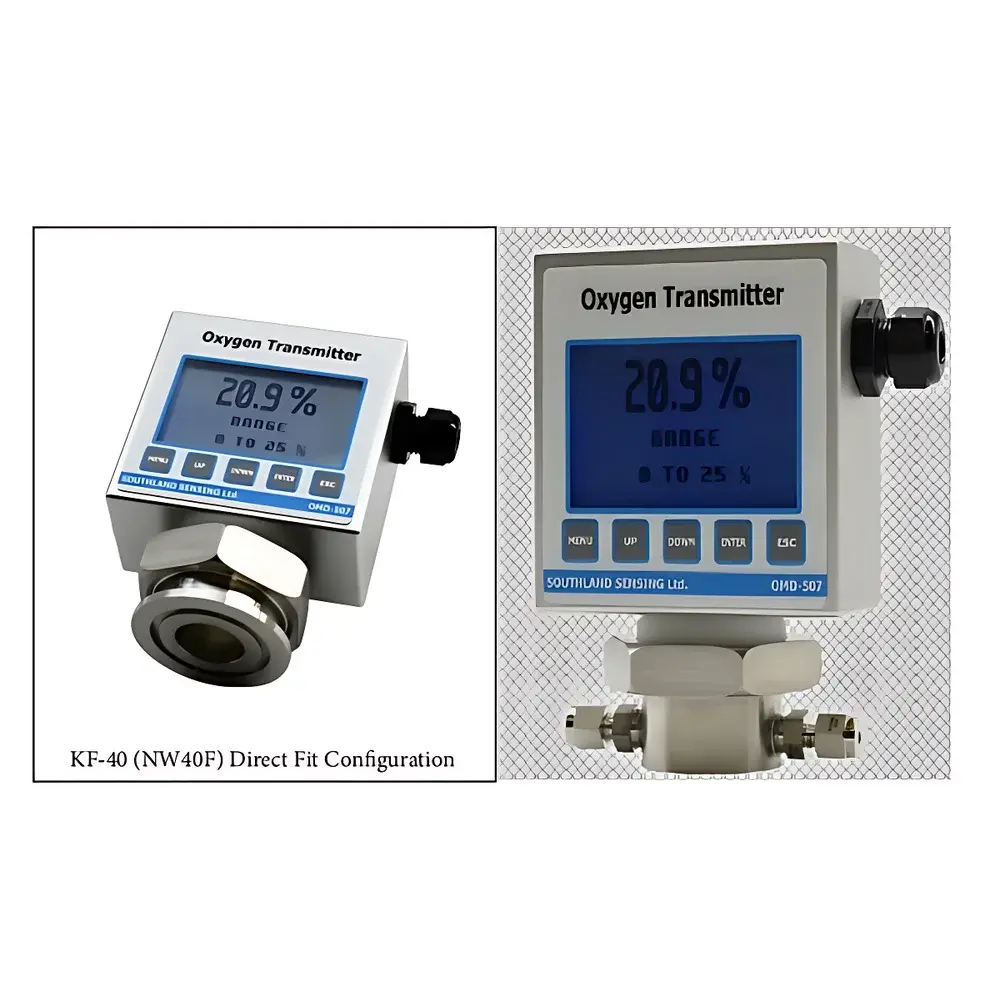
Southland Sensing OMD-507 Micro-Oxygen Analyzer
| Origin | USA |
|---|---|
| Manufacturer Type | Authorized Distributor |
| Origin Category | Imported |
| Model | OMD-507 |
| Price Range | USD 1,400 – 4,200 (FOB) |
| Measurement Ranges | 0–10 ppm / 0–100 ppm / 0–1,000 ppm / 0–1 % / 0–25 % (selectable) |
| Accuracy | < ±1 % FS |
| Sensor Type | Miniature Electrochemical Fuel Cell |
| Temperature Compensation | Built-in, Automatic |
| Operating Temp. | –10 to +50 °C |
| Dimensions | 241 × 165 × 96 mm |
| Power Supply | 12–24 VDC |
| Current Draw | 25 mA |
| Analog Outputs | 4–20 mA and 0–10 VDC (isolated) |
| Sample Flow Rate | 230–2,500 mL/min |
| Certifications | CE compliant |
| Warranty | 12 months |
| Compatible Media | N₂, Ar, He, H₂, hydrocarbon streams, and other inert or reducing gases |
| Acid-Gas Option | Available with H₂S/CO₂/SO₂-resistant sensor |
| Enclosure | IP65-rated housing |
| Calibration Interval | Recommended every 6–12 months per ISO 17025 guidelines |
Overview
The Southland Sensing OMD-507 Micro-Oxygen Analyzer is a field-deployable, electrochemical fuel cell–based trace oxygen measurement system engineered for continuous, real-time monitoring in demanding industrial process environments. Unlike paramagnetic or zirconia-based analyzers, the OMD-507 employs a miniature, temperature-compensated galvanic fuel cell sensor that generates a current proportional to the partial pressure of molecular oxygen (O₂) in the sample gas stream. This principle delivers high specificity for O₂ without cross-sensitivity to CO₂, H₂S, SO₂, or hydrocarbons—provided the optional acid-resistant sensor variant is selected for corrosive gas matrices. Designed for integration into nitrogen purge systems, glovebox atmospheres, semiconductor inert gas lines, and metallurgical off-gas streams, the OMD-507 operates across five user-selectable ranges—from ultra-trace (0–10 ppm) to high-concentration (0–25 % vol)—with full-scale accuracy better than ±1 %, enabling compliance with ASTM D3176, ISO 8573-3, and USP oxygen purity specifications.
Key Features
- Miniaturized electrochemical fuel cell sensor with intrinsic selectivity for O₂ and minimal drift over extended operation
- Automatic temperature compensation circuitry ensuring stable output across –10 to +50 °C ambient conditions
- Dual analog outputs (4–20 mA and 0–10 VDC), both electrically isolated for noise immunity in industrial control cabinets
- Compact, IP65-rated enclosure (241 × 165 × 96 mm) suitable for panel mounting or direct pipeline integration via H1 flow cell or KF-40 flange
- Low power consumption (25 mA @ 24 VDC) enabling deployment in remote or energy-constrained locations
- Configurable range selection via internal DIP switches—no software required for basic operation
- Optional acid-resistant sensor variant certified for continuous exposure to ≤100 ppm H₂S, ≤500 ppm CO₂, or ≤50 ppm SO₂
Sample Compatibility & Compliance
The OMD-507 is validated for use with inert gases (N₂, Ar, He), hydrogen, and saturated hydrocarbon streams where oxygen concentration must be tightly controlled below specification thresholds. It is not intended for oxidizing or halogenated gas matrices without prior validation. For applications involving acidic impurities, the factory-installed acid-resistant sensor option extends service life and maintains metrological integrity under ASTM D1946 and ISO 14687–2 test conditions. The analyzer complies with CE marking requirements for electromagnetic compatibility (EMC Directive 2014/30/EU) and low-voltage safety (LVD Directive 2014/35/EU). While not intrinsically safe, it may be installed in Zone 2/Class I, Division 2 areas when housed in an approved barrier enclosure per IEC 60079-15.
Software & Data Management
The OMD-507 operates as a stand-alone transmitter with no embedded firmware update capability; configuration is hardware-based. However, its 4–20 mA output is fully compatible with distributed control systems (DCS), programmable logic controllers (PLC), and SCADA platforms supporting HART-enabled input modules. When integrated with a data acquisition system compliant with FDA 21 CFR Part 11, the device supports audit-trail–capable logging of oxygen excursions, calibration events, and sensor health diagnostics—provided the host system implements electronic signatures and secure user access controls. Routine calibration verification follows ISO/IEC 17025–aligned procedures using certified zero gas (N₂ ≥99.999 %) and span gas (e.g., 10 ppm O₂ in N₂, traceable to NIST SRM 2659a).
Applications
- Glovebox atmosphere monitoring for lithium battery manufacturing and air-sensitive synthesis (target: ≤1 ppm O₂)
- Purity verification of nitrogen blanketing gas in pharmaceutical fluid-bed dryers and reactor purges
- O₂ leak detection in hydrogen supply lines for PEM electrolyzer feed systems
- Residual oxygen quantification in argon-shielded TIG welding manifolds
- Process gas monitoring in cryogenic air separation unit (ASU) product streams
- Quality assurance testing of modified-atmosphere packaging (MAP) headspace gases
FAQ
What sample gas conditioning is required prior to analysis?
No external scrubbing or drying is needed for clean, dry inert gases. For wet or particulate-laden streams, a coalescing filter (0.1 µm) and PTFE membrane dryer are recommended upstream of the flow cell.
Can the OMD-507 measure oxygen in CO₂-rich biogas streams?
Only with the acid-resistant sensor option; standard fuel cells degrade rapidly in >1 % CO₂. Cross-sensitivity to CO₂ is reduced to <0.5 % FS error in the acid-resistant variant.
Is the sensor replaceable in the field?
Yes—the fuel cell module is a user-serviceable subassembly with standardized M12 electrical and ¼” NPT gas connections; replacement requires no recalibration if performed per Southland Sensing Technical Bulletin TB-OMD-02.
Does the analyzer support digital communication protocols such as Modbus RTU?
No—only analog outputs are provided. For digital integration, a third-party 4–20 mA-to-Modbus converter is required.
What is the typical sensor lifetime under continuous operation?
24–36 months in clean N₂ at 25 °C; lifetime reduces proportionally with elevated O₂ partial pressure, temperature, and presence of reactive contaminants—even with the acid-resistant variant.
Related Products