
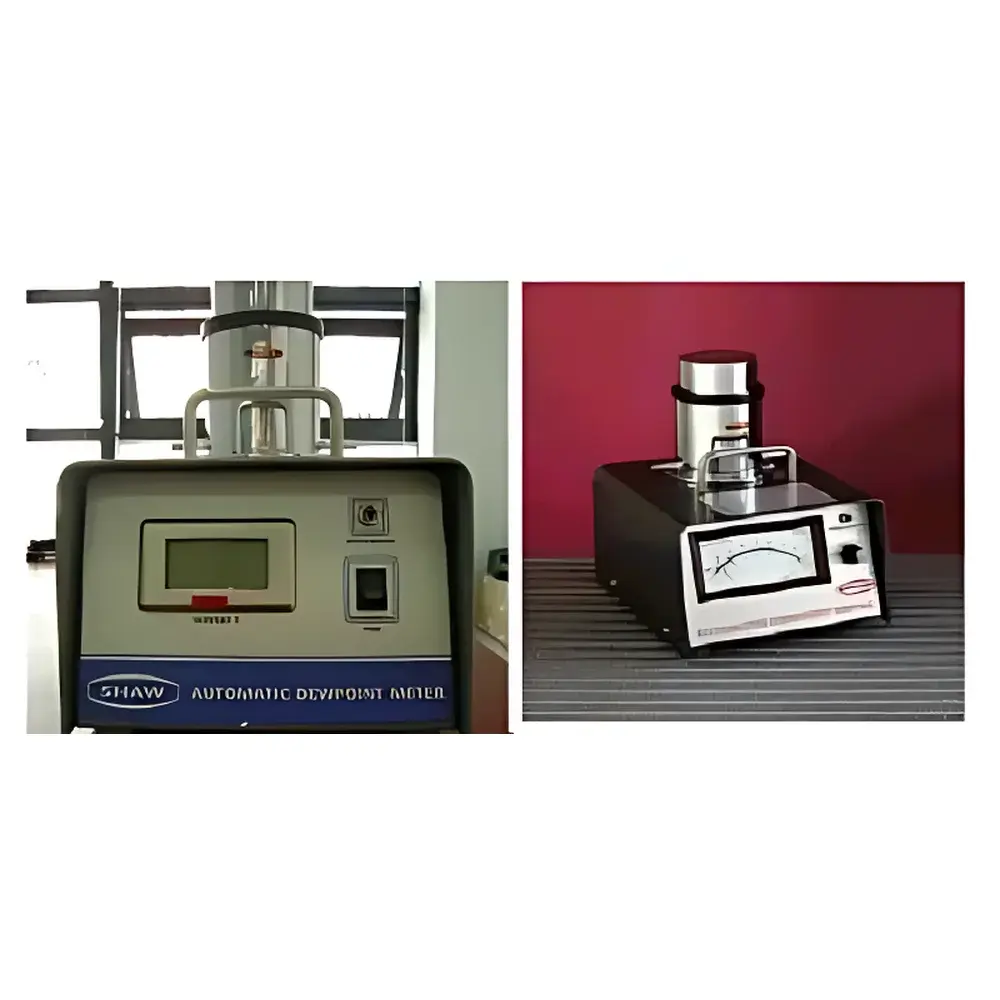
Shaw SADP-U-P Portable Dew Point Meter
| Brand | Shaw |
|---|---|
| Origin | United Kingdom |
| Model | SADP-U-P |
| Type | Portable Dew Point Meter |
| Measurement Principle | Aluminum Oxide Capacitive Sensor |
| Operating Temperature Range | −10 °C to +60 °C |
| Storage Temperature Range | −40 °C to +80 °C |
| Dew Point Range Options | −110 °C to +20 °C (configurable by sensor variant) |
| Accuracy | ±2 °C DP (traceable to NPL and NIST) |
| Repeatability | ±0.2 °C DP |
| Response Time (dry → wet) | <20 s (−110 °C to −20 °C) |
| Response Time (wet → dry) | <120 s (−10 °C to −60 °C) |
| Sample Flow Rate | 2–5 L/min (max 10 L/min) |
| Operating Pressure | ≤30 kPa(g) |
| Relative Humidity Limit | 95% RH (non-condensing) |
| Power Supply | Rechargeable Li-ion battery (250 h continuous operation, 6 h charge time) |
| Display | 126 × 64 pixel backlit LCD |
| Communication Interfaces | RS485, USB (optional), 4–20 mA analog output (optional) |
| Calibration | Two-point user-initiated auto-calibration |
| Pressure Dew Point Calculation | Built-in, supports multiple gauge pressure units |
| Gas Path | Dual stainless-steel inlet/outlet ports (6 mm Swagelok + PTFE tubing) |
| Sensor Lifetime | 5–10 years (gas-dependent) |
| Maintenance | User-replaceable sensor and molecular sieve cartridge |
Overview
The Shaw SADP-U-P is a high-precision, handheld dew point meter engineered for field-deployable and laboratory-grade moisture analysis in compressed air, industrial gases, and natural gas systems. It employs a robust aluminum oxide capacitive sensor—certified for long-term stability and traceable calibration against National Physical Laboratory (NPL) and National Institute of Standards and Technology (NIST) reference standards. Unlike semiconductor-based hygrometers, the aluminum oxide sensing element operates on the principle of dielectric constant variation induced by water vapor adsorption on a porous anodized alumina film. This enables accurate, low-moisture-level detection across an extended range from −110 °C to +20 °C dew point, with full temperature compensation applied across the entire operating span (−10 °C to +60 °C ambient). The instrument’s compact, ruggedized housing meets IP65 ingress protection requirements, making it suitable for use in demanding production environments, offshore platforms, and pipeline commissioning sites.
Key Features
- True portable architecture: Weighs under 1.2 kg with integrated ergonomic grip and five intuitive membrane keys for one-handed operation
- Multi-parameter display: Simultaneous readout in °C, °F, ppmv, ppmw, ppbv, g/m³, and lbs/MMSCF—enabling direct compliance assessment per ISO 8573-1, ASTM D6673, and CGA G-4.1
- Onboard pressure dew point calculation: Accepts user-input gauge pressure in kPa(g), bar(g), psi(g), or MPa(g) to derive true pressure-corrected dew point values
- Molecular sieve pre-dryer system: Integrated desiccant cartridge ensures rapid stabilization and eliminates condensation risk during low-dew-point measurements
- Extended battery life: 250 hours of continuous measurement on a single Li-ion charge; charging completed in ≤6 hours via dedicated AC adapter
- Configurable connectivity: Optional RS485 serial interface (Modbus RTU protocol), USB virtual COM port, and isolated 4–20 mA analog output support integration into SCADA, DCS, and QA data logging systems
- Secure operational control: Multi-level password protection (operator, technician, administrator) aligned with GLP/GMP audit trail expectations
Sample Compatibility & Compliance
The SADP-U-P is validated for use with non-corrosive, non-particulate gas streams including compressed air (ISO 8573-1 Class 0–4), nitrogen, argon, hydrogen, helium, natural gas (per ISO 10715 and AGA Report No. 10), and SF₆. Its stainless-steel gas path and PTFE-wetted components ensure chemical inertness and minimal adsorption artifacts. The instrument complies with electromagnetic compatibility requirements per EN 61326-1:2013 and carries CE marking for the European Economic Area. While not intrinsically safe certified, it is rated for use in non-hazardous areas (Zone 2 / Class I Division 2) when operated within specified pressure (≤30 kPa(g)) and temperature limits. Calibration certificates include full uncertainty budgets per ISO/IEC 17025:2017, with documented traceability to national metrology institutes.
Software & Data Management
Data capture is supported via optional PC software compatible with Windows 10/11, enabling real-time graphing, CSV export, and automated report generation per 21 CFR Part 11 Annex 11 requirements. The software logs timestamped readings, calibration events, battery status, and sensor diagnostics—including raw capacitance values and temperature-compensated dielectric drift metrics. Audit trails are immutable and include operator ID, action type, and system timestamps. Firmware updates are performed over USB without external programmers. All stored data resides exclusively on the host PC or local network drive—no cloud transmission or vendor-hosted databases are employed, preserving data sovereignty for regulated industries.
Applications
- Compressed air system validation and routine monitoring per ISO 8573-1 purity classes
- Pre-commissioning moisture verification in natural gas pipelines and LNG transfer lines
- Quality assurance of instrument air in pharmaceutical cleanrooms and semiconductor fab utilities
- Moisture control in SF₆-insulated switchgear maintenance and re-filling operations
- Field verification of desiccant dryer performance and regeneration cycle efficacy
- Supporting root-cause analysis of corrosion, freezing, or catalyst poisoning incidents linked to residual moisture
FAQ
Is the SADP-U-P suitable for measuring dew point in high-pressure gas systems?
No—the maximum allowable operating pressure is 30 kPa(g). For higher-pressure applications (e.g., pipeline gas at 4–10 MPa), a pressure-reducing regulator and sample conditioning system must be used upstream.
Can the sensor be recalibrated in-house without sending the unit to a service center?
Yes—two-point user calibration is fully supported using certified humidity reference standards (e.g., chilled mirror or electrolytic hygrometer) at two distinct dew points within the sensor’s range.
What maintenance intervals are recommended for optimal accuracy?
The molecular sieve cartridge should be replaced every 6–12 months depending on sample cleanliness; the sensor itself requires no routine servicing but benefits from annual verification against traceable standards.
Does the instrument meet FDA or EU GMP requirements for use in pharmaceutical manufacturing?
It satisfies key technical prerequisites (audit trail capability, calibration traceability, secure access controls); however, final qualification must be conducted as part of the user’s site-specific validation protocol (IQ/OQ/PQ).
How does temperature compensation affect measurement integrity across ambient extremes?
An embedded Pt100 RTD continuously monitors sensor head temperature and applies dynamic correction coefficients derived from factory characterization across −40 °C to +80 °C, ensuring stated accuracy is maintained throughout the full operating envelope.




