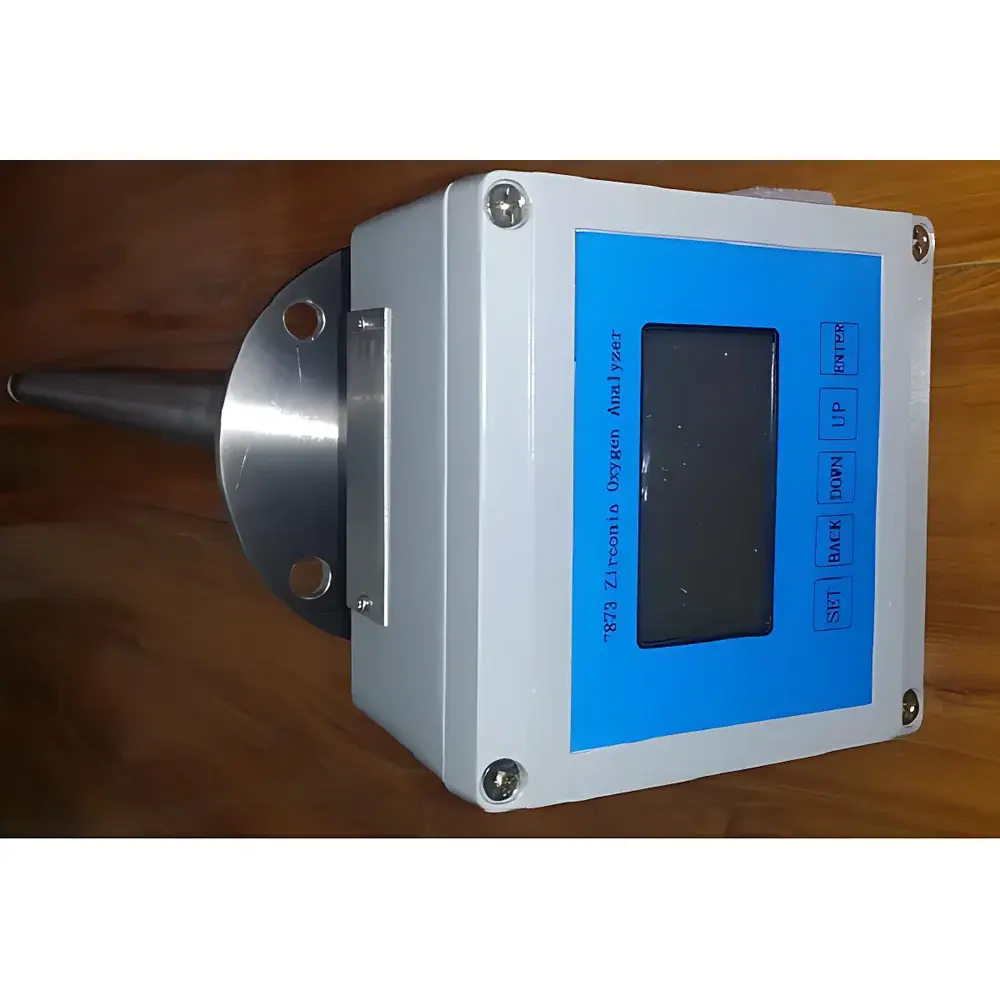
Zirconia Oxygen Analyzer Model 7873A
| Origin | Italy |
|---|---|
| Manufacturer Type | Authorized Distributor |
| Origin Category | Imported Instrument |
| Model | 7873A |
| Price | USD 2,500 (FOB Italy) |
| Operating Temperature Range | Up to 1400 °C (sensor element) |
| Measurement Range | 0–21% O₂ or 0–25% O₂ (field-selectable) |
| Probe Material | AISI 304 stainless steel (optional AISI 316L) |
| Enclosure Rating | IP65 |
| Flue Gas Temperature Limit | ≤700 °C |
| Flue Gas Pressure Range | −10 kPa to +10 kPa |
| Gas Flow Velocity Range | 0–50 m/s |
| T₉₀ Response Time | ≤3 s (upon exposure to certified calibration gas) |
| Typical Service Life | 1–5 years (dependent on operating conditions) |
| Standard Insertion Lengths | 500 mm, 800 mm, 1000 mm, 1200 mm (custom lengths available) |
Overview
The Zirconia Oxygen Analyzer Model 7873A is a compact, cost-optimized in-situ oxygen monitoring solution engineered for continuous measurement of oxygen concentration in high-temperature industrial flue gases and process streams. It employs the principle of electrochemical potential generation across a stabilized zirconium dioxide (ZrO₂) ceramic electrolyte, operating at elevated temperatures (up to 1400 °C at the sensing element) to ensure ionic conductivity and stable Nernst voltage output. This solid-state, non-dispersive sensing architecture eliminates the need for consumables, optical components, or sample extraction systems—making it inherently robust for harsh combustion environments including boilers, kilns, incinerators, and thermal oxidizers. The analyzer delivers direct, real-time O₂ readings with field-selectable ranges of 0–21% or 0–25%, supporting both air-equivalence ratio control and combustion efficiency optimization under variable load conditions.
Key Features
- Integrated zirconia sensor assembly with built-in heater and temperature control circuitry—no external furnace required
- Wide operational tolerance: compatible with flue gas temperatures up to 700 °C and pressure fluctuations from −10 kPa to +10 kPa
- Rugged probe construction using AISI 304 stainless steel (standard), with optional AISI 316L for enhanced corrosion resistance in chloride-rich or acidic gas streams
- IP65-rated electronics housing suitable for outdoor or semi-outdoor installation without additional weatherproof enclosures
- Fast dynamic response: achieves ≥90% of final reading within 3 seconds upon step change in O₂ concentration when exposed to traceable calibration gas
- Modular insertion lengths (500 mm, 800 mm, 1000 mm, 1200 mm) designed for standardized duct and stack mounting; custom lengths supported per ASME B16.5 and EN 1092-1 flange interfaces
- Low-maintenance design with no moving parts, zero reagent consumption, and minimal drift over extended operation
Sample Compatibility & Compliance
The 7873A is validated for use in dry or moderately humid combustion exhaust streams containing CO, CO₂, NOₓ, SO₂, and particulate matter typical of coal-, oil-, gas-, and biomass-fired systems. It is not intended for use in reducing atmospheres with free carbon or unburnt hydrocarbons above stoichiometric thresholds, nor in condensing or heavily sooting gas streams without upstream filtration or purge-air assist. While the instrument itself does not carry CE marking or UL certification as a complete system (as it is supplied via authorized distributor channels), its core sensor module complies with IEC 61298-1 (industrial process measurement devices) and meets functional safety requirements aligned with SIL 2 per IEC 61508 when integrated into a certified control loop. All materials conform to RoHS Directive 2011/65/EU. Traceable calibration certificates (NIST-traceable or ISO/IEC 17025-accredited) are provided with each unit shipment.
Software & Data Management
The 7873A outputs a linear 4–20 mA analog signal proportional to measured O₂ concentration, fully compatible with DCS, PLC, and SCADA systems. Optional digital interface modules support Modbus RTU (RS-485) or HART 7 protocol for remote configuration, diagnostics, and real-time data logging. Configuration parameters—including range selection, damping time, zero/span offset correction, and alarm thresholds—are accessible via front-panel push-button interface or handheld configurator. Data integrity is maintained through EEPROM-based parameter storage with write-protection logic. For regulatory environments, the device supports audit-ready operation when paired with a compliant historian system meeting FDA 21 CFR Part 11 requirements for electronic records and signatures (e.g., timestamped calibration logs, user-access tracking).
Applications
- Combustion optimization in steam generators and industrial boilers
- O₂ trim control in fired heaters and reformers
- Emissions monitoring compliance support for EPA Method 3A and EN 14792
- Process safety interlocks in inerting and blanketing systems
- Energy efficiency auditing in cement rotary kilns and glass melting furnaces
- Post-combustion monitoring in municipal solid waste incinerators
FAQ
What is the recommended calibration frequency?
Calibration is advised prior to initial commissioning and at intervals not exceeding 90 days under continuous operation. Field verification using certified span gas (e.g., 8.0% O₂ in N₂) is sufficient; full two-point calibration (zero and span) is recommended if drift exceeds ±0.3% O₂.
Can the probe be installed horizontally?
Yes, horizontal installation is permitted, but orientation must prevent condensate accumulation at the sensor tip. A minimum downward pitch of 5° is recommended where ambient dew point exceeds flue gas temperature.
Is hot-tap insertion possible?
Hot-tap installation is technically feasible but requires strict adherence to plant lockout/tagout (LOTO) procedures and use of thermally rated isolation valves. We recommend cold insertion during scheduled shutdowns unless site-specific risk assessment confirms safe hot insertion protocols.
Does the analyzer require reference air?
Yes—the zirconia cell operates using ambient air as the reference electrode. A dedicated, filtered reference air supply line (with particulate and moisture removal) must be connected to the analyzer’s reference port; internal pump-assisted sampling is not included in this model.
How is sensor aging compensated?
The 7873A includes programmable sensor aging compensation based on cumulative operating hours and average temperature history. Users may input degradation coefficients derived from historical calibration records to maintain long-term accuracy within ±0.5% O₂ of full scale.