
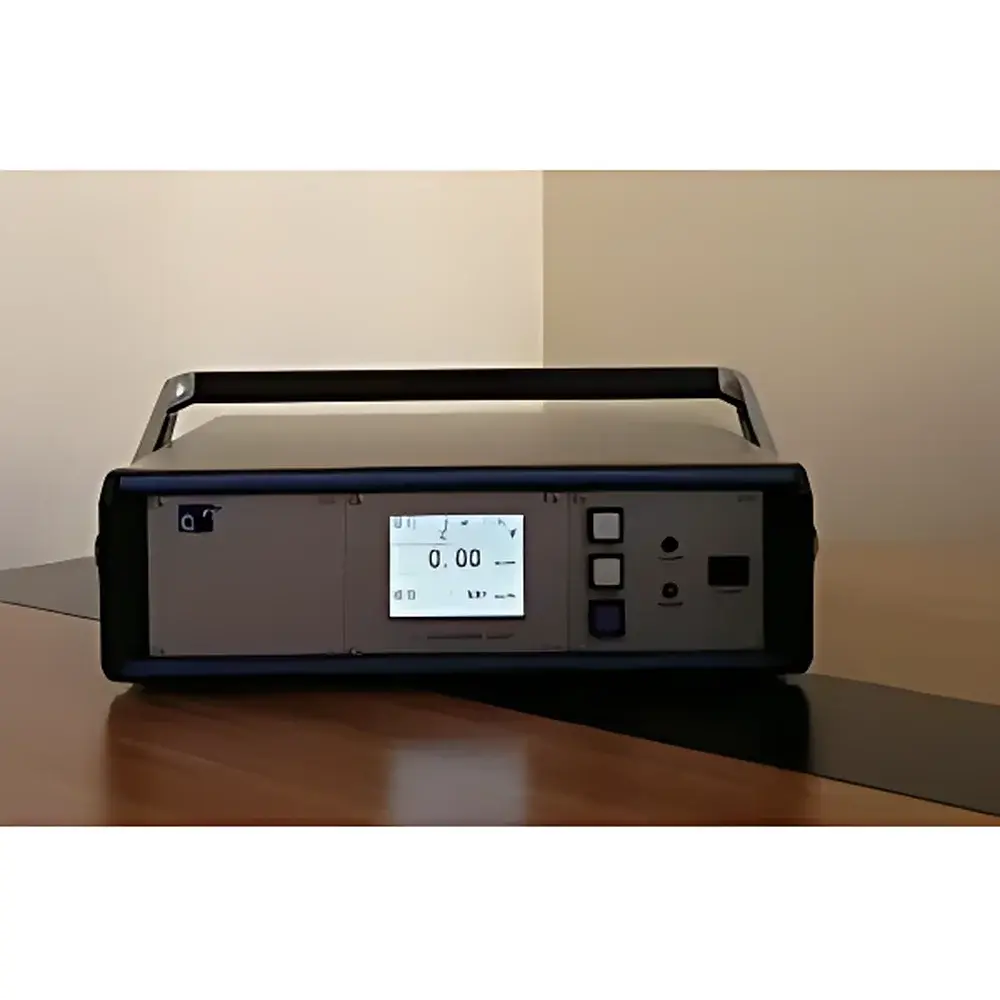
CMC TMA-210-P Phosphorus Pentoxide Electrolytic Trace Moisture Analyzer
| Brand | CMC |
|---|---|
| Origin | Germany |
| Model | TMA-210-P |
| Product Type | Portable Dew Point Analyzer |
| Measurement Principle | Phosphorus Pentoxide (P₂O₅) Electrolytic Method |
| Operating Temperature Range | -20 °C to +80 °C |
| Accuracy | ±0.2 °C dew point equivalent |
| Repeatability | ±0.1 °C dew point equivalent |
Overview
The CMC TMA-210-P is a high-precision, portable trace moisture analyzer engineered for real-time quantification of water vapor in aggressive and reactive industrial gas streams. It employs the well-established phosphorus pentoxide (P₂O₅) electrolytic measurement principle — a primary standard method recognized for its intrinsic accuracy and long-term stability in ultra-low moisture applications. In this technique, sample gas passes over a dual-electrode sensor coated with a thin film of phosphoric acid (H₃PO₄). Water molecules are electrolytically dissociated into hydrogen and oxygen at the anode and cathode, forming P₂O₅ as an intermediate product. As P₂O₅ is highly hygroscopic, it continuously absorbs moisture from the sample stream; the resulting electrolysis current is directly proportional to the absolute water concentration (ppmv). This fundamental electrochemical relationship enables trace-level detection down to single-digit ppmv, with no zero drift and minimal calibration dependency — making the TMA-210-P especially suitable for demanding applications in semiconductor process gases, high-purity specialty chemicals, and corrosive feedstocks.
Key Features
- Electrolytic P₂O₅ sensor architecture with platinum or rhodium electrodes, optimized for chemical resistance against HCl, Cl₂, SO₂, H₂S, HF, and other acidic or oxidizing gases
- Sub-second response time (t₉₀ < 1 s), enabling dynamic process monitoring and rapid leak detection
- Automatic range switching across four user-selectable spans: 0–10, 0–100, 0–1000, and 0–2500 ppmv
- Microprocessor-based control system with built-in self-diagnostic routines at power-on and during operation
- NAMUR-compliant output interface supporting 4–20 mA analog signal transmission with HART protocol option
- Dual programmable relay outputs for alarm and control functions, configurable for high/low limit or deviation thresholds
- Backlit LCD display with intuitive menu navigation and real-time data logging capability
Sample Compatibility & Compliance
The TMA-210-P is validated for continuous analysis of technically dry gases including but not limited to Ar, Kr, Xe, He, N₂, O₂, H₂, CO₂, CH₄, SF₆, C₂H₂, natural gas, and fluorocarbons. Its robust sensor design ensures reliable performance in high-purity chlorine, hydrogen chloride, sulfur dioxide, and hydrogen sulfide — gases that degrade conventional capacitive or chilled-mirror sensors. The instrument complies with IEC 61000-6-2 (EMC immunity) and IEC 61000-6-4 (EMC emission) standards. While not intrinsically safe certified, it may be deployed in Zone 2/Class I Div 2 environments when installed per local electrical codes. Data integrity aligns with GLP and GMP requirements through audit-trail-capable firmware (optional), supporting 21 CFR Part 11 compliance when integrated with validated SCADA or LIMS platforms.
Software & Data Management
The analyzer operates autonomously without external PC dependency; however, optional RS-232/RS-485 serial interface enables integration into centralized control systems. Configuration, calibration history, and alarm logs are stored internally with timestamping. Firmware supports remote parameter adjustment via Modbus RTU or ASCII command sets. For laboratory or QA documentation, CSV export of measurement records (including dew point, ppmv, temperature, pressure, and sensor status) is available through USB host port or optional Ethernet module. All calibration events generate immutable entries with operator ID, date/time, and before/after span verification values — satisfying traceability requirements under ISO/IEC 17025 and ASTM D6649.
Applications
- Monitoring moisture ingress in HCl synthesis and purification loops within chlor-alkali plants
- Quality assurance of cylinder-filling gas for electronics-grade etchants and dopants
- In-line verification of desiccant dryer efficiency in bulk gas distribution networks
- Leak testing of vacuum chambers and gloveboxes using tracer gas humidity profiling
- Regulatory compliance testing for pharmaceutical excipient drying processes (USP )
- Validation of purge gas dryness prior to catalyst activation in petrochemical reactors
FAQ
What gases are incompatible with the P₂O₅ sensor?
Gases containing ammonia (NH₃), amines, or alcohols react irreversibly with phosphoric acid and must be excluded. Halogenated hydrocarbons with active hydrogen (e.g., CHCl₃) may also interfere.
Is field calibration required?
Zero calibration using ultra-dry nitrogen (<0.1 ppmv) is recommended quarterly; span calibration with NIST-traceable moisture standards is advised annually or after sensor exposure to condensation or contamination.
Can the TMA-210-P measure dew point directly?
Yes — the instrument calculates and displays dew point temperature (°C) in real time based on measured ppmv, sample temperature, and pressure inputs; optional integrated pressure transducer enhances accuracy.
What maintenance does the sensor require?
The P₂O₅ sensor has no consumables and requires only periodic cleaning of inlet filters and verification of electrode continuity; typical service interval exceeds 24 months under normal operating conditions.
How is sample conditioning handled?
A dedicated sample conditioning kit (optional) includes particulate filtration, coalescing pre-filter, and pressure regulation to maintain 0.1–0.5 barg flow pressure and 100 NL/h nominal velocity — critical for minimizing residence time and ensuring representative measurement.
Related Products






