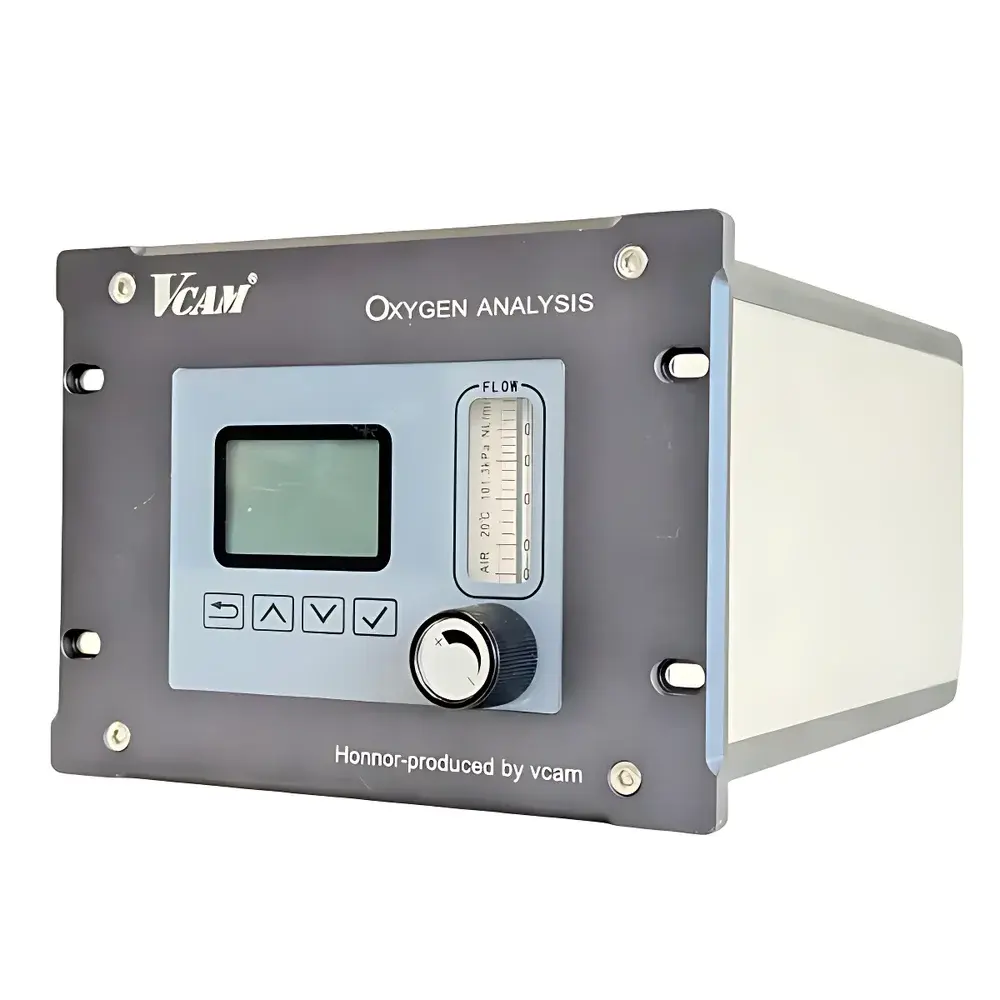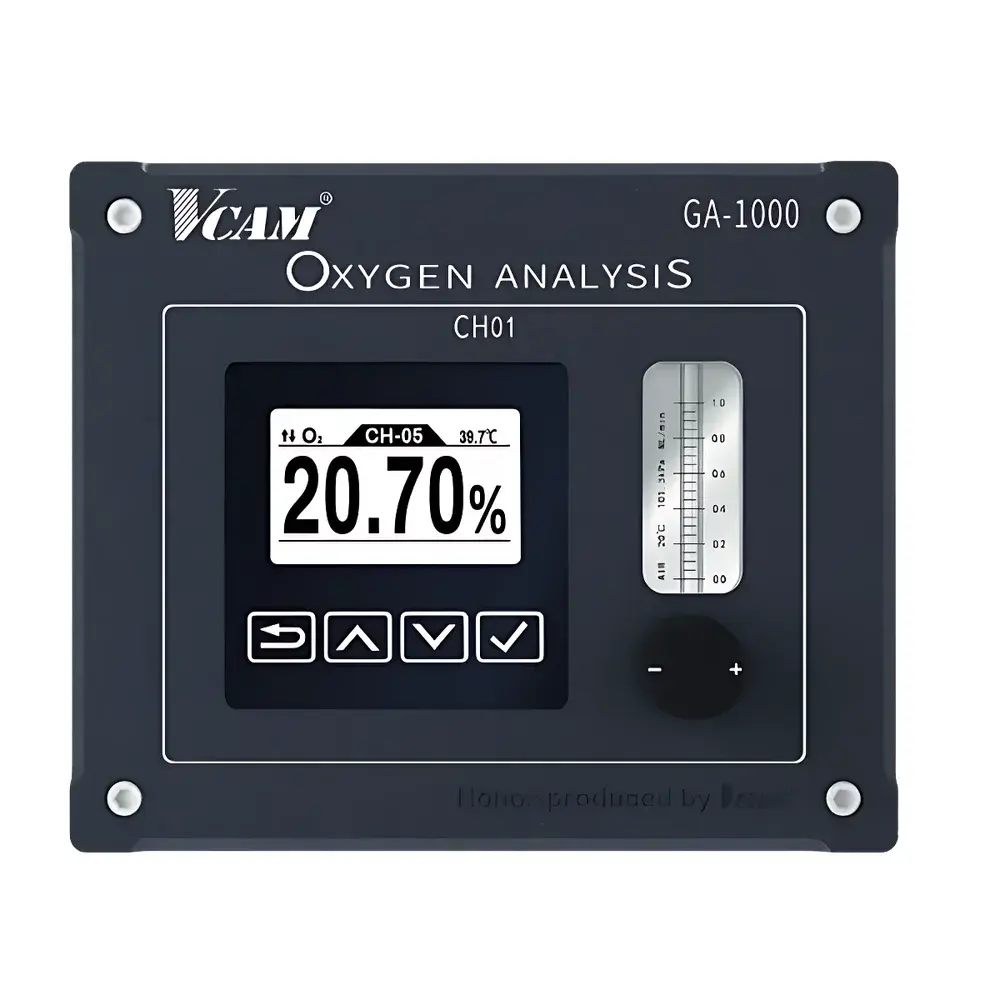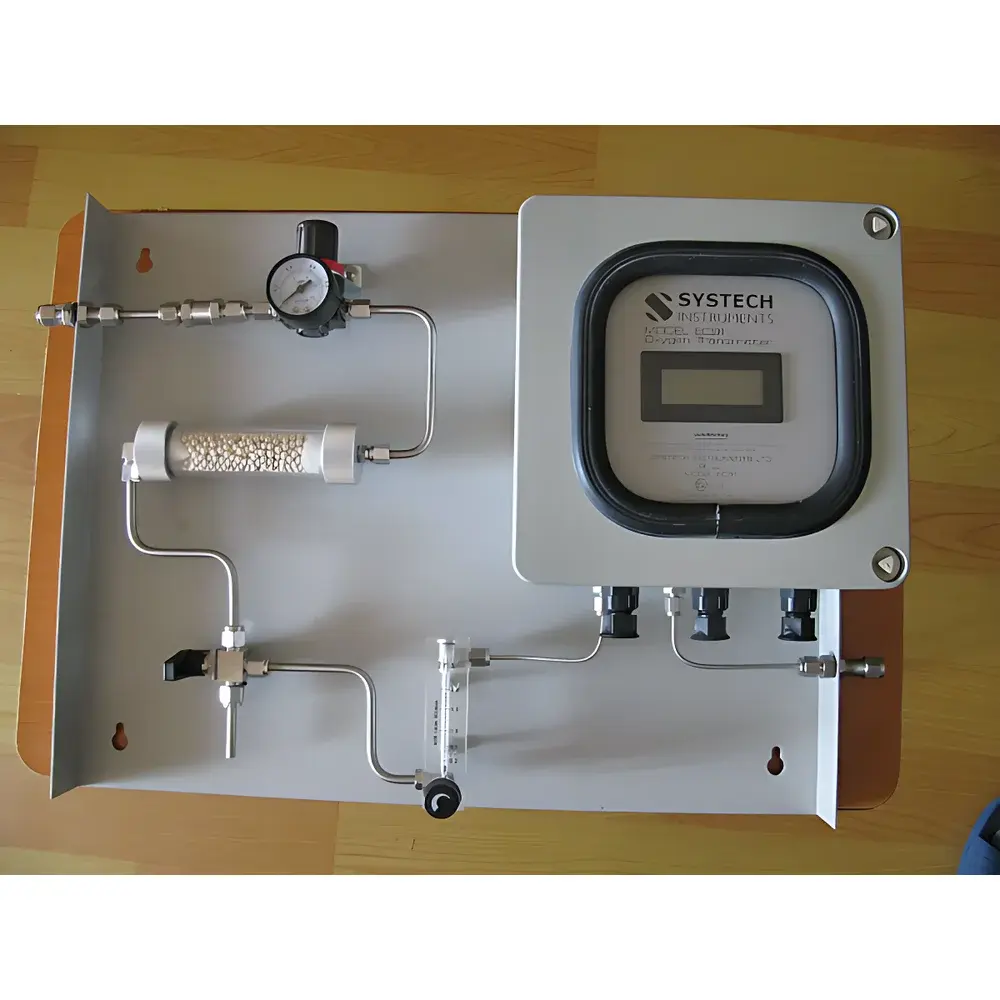
Systech EC91 Oxygen Analyzer
| Brand | Systech |
|---|---|
| Origin | United Kingdom |
| Model | EC91 |
| Measurement Principle | Electrochemical (Galvanic) Cell |
| Selectable Ranges | 0–20, 0–200, 0–2000 ppm |
| Resolution | 0.05% of full scale |
| Response Time (t₉₀) | ≤20 s (typical) |
| Accuracy (Repeatability) | ±1% FS at constant temperature (±3% FS for ranges <10 ppm) |
| Temperature Stability | ±3% FS over 0–45 °C |
| Operating Temperature | 0–45 °C (32–113 °F) |
| Ingress Protection | IP66 / NEMA 4X |
| Hazardous Area Certification | ATEX Ex II 1G Ex ia IIC T4 Ga |
| Output Signals | Isolated 4–20 mA + 0–1 VDC |
| Relay Outputs | 2 programmable C-contact relays (3 A, 100 VAC/DC) |
| Power Supply | 100/117/230 VAC ±10%, 50/60 Hz, <5 W |
| Panel Cutout | 177.8 mm × 95.25 mm |
| Overall Dimensions | 212.73 mm × 128.52 mm × 127 mm (W×H×D) |
| Weight | 2.72 kg |
| Sample Inlet | 316 stainless steel 1/4" compression fitting |
| Wetted Materials | Nickel-plated brass block, 316 stainless steel fittings |
| Communication Interface | RS232 (bidirectional) |
Overview
The Systech EC91 Oxygen Analyzer is a robust, intrinsically safe electrochemical (galvanic cell) analyzer engineered for continuous, real-time measurement of oxygen concentration in industrial process and safety-critical environments. Unlike paramagnetic or zirconia-based analyzers, the EC91 employs a maintenance-free, self-powered galvanic sensor that generates a current proportional to partial pressure of O₂—eliminating the need for external bias voltage, zero gas, or reference gas supply. Its design prioritizes operational resilience in Class I, Div. II, Groups C & D hazardous locations, as certified under ATEX Ex II 1G Ex ia IIC T4 Ga. The analyzer delivers stable performance across variable sample flow rates and is inherently immune to interference from hydrocarbons, CO₂, SO₂, NOₓ, and other common oxidizing gases—making it especially suitable for inerting, blanketing, glovebox, and nitrogen generation applications where chemical specificity and long-term baseline stability are essential.
Key Features
- Intrinsically safe operation certified to ATEX Ex II 1G Ex ia IIC T4 Ga for use in Zone 0/20 hazardous areas
- True flow-insensitive measurement: no flow regulator or critical orifice required; performance unaffected by ±50% flow variation
- Front-accessible sensor chamber enables rapid field replacement without disassembling the instrument housing
- Dual analog outputs: isolated 4–20 mA (HART-compatible when configured with optional module) and buffered 0–1 VDC for redundant signal routing
- Two fully programmable alarm relays (C-contact, 3 A, 100 V) plus dedicated solid-state fault relay for system-level diagnostics
- IP66/NEMA 4X-rated front panel enclosure ensures protection against dust ingress and high-pressure water jets
- RS232 bidirectional serial interface supports remote configuration, calibration logging, and firmware updates via terminal emulation or host SCADA integration
- Temperature-compensated electronics maintain repeatability within ±1% FS (±3% FS for sub-10 ppm ranges) across 0–45 °C ambient
- No consumables, no heaters, no pumps—zero routine maintenance beyond periodic calibration verification
Sample Compatibility & Compliance
The EC91 is designed for dry, non-corrosive gas streams with dew point below 0 °C. Sample compatibility includes nitrogen, argon, helium, CO₂, and air-based mixtures. Wetted components consist exclusively of 316 stainless steel inlet fittings and a nickel-plated brass sensor block—resistant to oxidation and compatible with ISO 8573-1 Class 3 compressed air quality. The analyzer complies with electromagnetic compatibility standards per EN 61326-1 (industrial environment) and includes integrated RFI shielding. For regulated industries, its deterministic analog output architecture and non-volatile calibration memory support audit-ready documentation aligned with FDA 21 CFR Part 11 requirements when paired with compliant data acquisition systems. It meets relevant portions of IEC 60079-0, IEC 60079-11, and UL 913 for intrinsic safety.
Software & Data Management
While the EC91 operates as a standalone hardware analyzer with no embedded OS, its RS232 interface enables full parameter access—including span/zero calibration points, alarm thresholds, relay hysteresis, and response damping—using standard ASCII command protocols. Calibration events are timestamped and stored in non-volatile memory with retention exceeding 10 years. When integrated into a validated control system, the device supports electronic record integrity through configurable write-protection modes and checksum-verified configuration uploads. Optional PC-based configuration utility (Systech ConfigTool v3.x) provides graphical setup, trend logging, and export to CSV for QA/QC traceability. No cloud connectivity or firmware OTA updates are implemented—ensuring deterministic behavior required for GMP/GLP environments.
Applications
- Inert gas blanketing in pharmaceutical reactors and API synthesis vessels
- Oxygen monitoring in nitrogen generator outlet streams (PSA/VSA systems)
- Control of modified atmosphere packaging (MAP) gas mixtures
- Safety interlock for gloveboxes and anaerobic chambers
- Leak detection in vacuum furnaces and heat-treating atmospheres
- Quality assurance in semiconductor purge gas lines (N₂, Ar)
- Process validation during sterilization cycles using steam-air mixtures
FAQ
Does the EC91 require zero gas or span gas for calibration?
No. The galvanic sensor is self-zeroing and requires only a single-point span calibration using certified O₂-in-N₂ gas at any selected range endpoint.
Can the EC91 measure oxygen in corrosive gas matrices such as HCl or Cl₂?
No. The sensor is incompatible with acidic, halogenated, or reducing gases. Sample conditioning (e.g., catalytic scrubbers, particulate filters, and desiccants) is mandatory for aggressive process streams.
What is the expected service life of the electrochemical sensor?
Typical sensor lifetime is 24–36 months in clean, dry, ambient-temperature applications. Lifetime decreases proportionally with elevated O₂ partial pressure, temperature, and humidity exposure.
Is the 4–20 mA output intrinsically safe?
Yes—the loop-powered analog output is inherently current-limited and certified as part of the overall ATEX approval; no additional barrier is required for connection to IS-rated DCS I/O cards.
How often should calibration be performed?
Initial commissioning requires two-point calibration. Subsequent verification is recommended every 3–6 months depending on application severity, per ASTM D6347/D6347M guidelines for electrochemical gas analyzers.
Related Products