
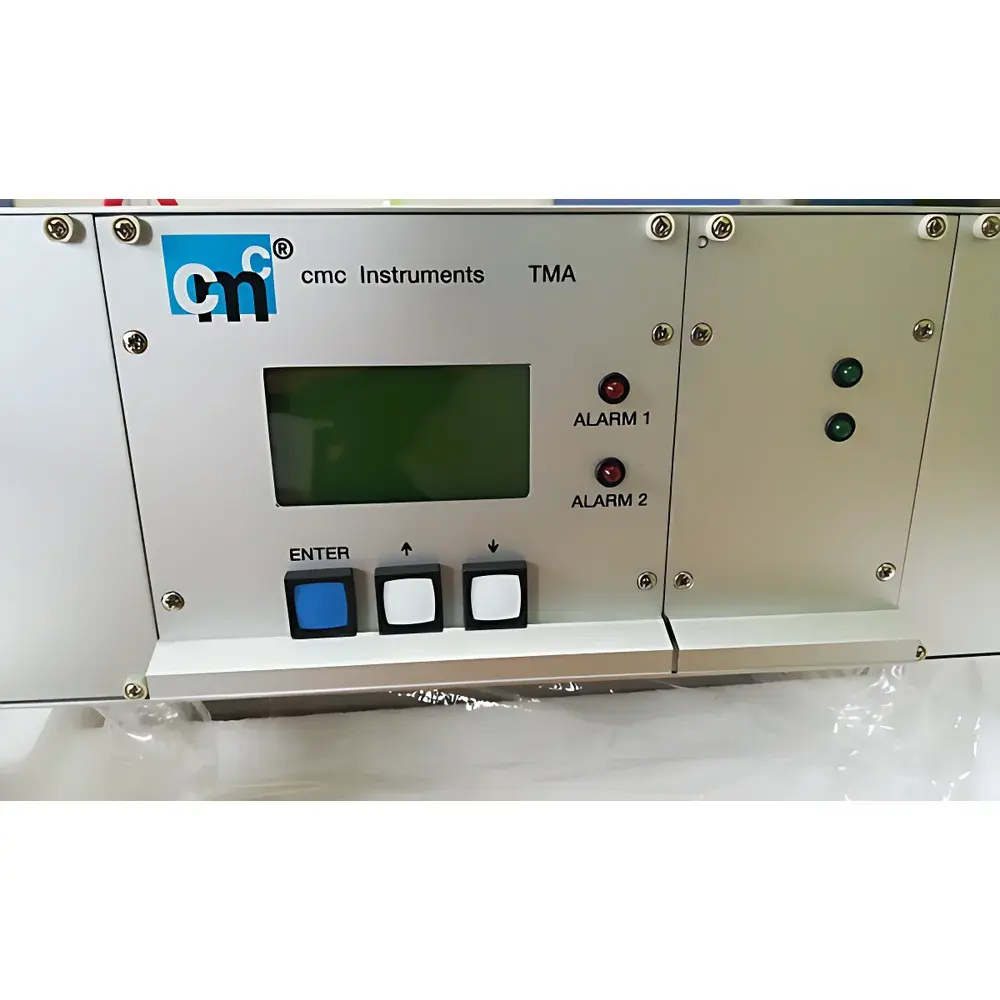
CMC TMA-202-W P₂O₅ Electrolytic Trace Moisture Analyzer
| Origin | Germany |
|---|---|
| Manufacturer Type | Authorized Distributor |
| Origin Category | Imported |
| Model | TMA-202-W |
| Product Type | Online Dew Point Analyzer |
| Operating Principle | Phosphorus Pentoxide (P₂O₅) Electrolytic Method |
| Operating Temperature Range | -20 °C to +50 °C |
| Accuracy | ±1 ppm(v) |
| Repeatability | ±1 ppm(v) |
| Measurement Range | 0–10 / 100 / 1000 / 2500 ppm(v) (Auto-ranging) |
| Full-Scale Accuracy | ±1% FS |
| Sensitivity | 0.1% FS |
| Display | Backlit LCD with Multilingual Interface (including Chinese) |
| Analog Output | 4–20 mA or 0–10 V |
| Alarm Outputs | 2 Relay Outputs |
| Sample Flow Rate | 20 NL/h |
| Recommended Sample Pressure | 0.1–0.5 barg |
| Sample Temperature Range | 5–150 °C |
| T₅₀ Response Time | <8 s |
| Total Response Time | <1 s |
| Ambient Temperature Range | 5–65 °C |
| Cable Length | Standard 3 m, up to 300 m optional |
| Enclosure Options | Rack-mount (482 × 133 × 350 mm), Wall-mount (300 × 260 × 280 mm), Bench-top (257 × 160 × 316 mm) |
| Power Supply | NiMH Battery (replacing legacy lead-acid), Extended Runtime |
Overview
The CMC TMA-202-W is a high-precision, online trace moisture analyzer engineered for continuous, real-time measurement of water vapor concentration in industrial process gases down to sub-ppm(v) levels. It operates on the well-established phosphorus pentoxide (P₂O₅) electrolytic principle: moisture in the sample gas is transported across a thin, hygroscopic phosphoric acid (H₃PO₄) film coated between two parallel electrodes—typically platinum or rhodium—within a fused-silica cell. An applied DC voltage drives the electrolysis of adsorbed water into hydrogen and oxygen; the resulting current is stoichiometrically proportional to the water mass flow rate. This current is amplified, linearized, and converted into a stable ppm(v) reading. Unlike optical or capacitive methods, the P₂O₅ technique delivers inherent zero-drift stability and immunity to hydrocarbon interference, making it the reference-grade method for ultra-dry gas monitoring in semiconductor, specialty gas, and high-purity chemical production environments.
Key Features
- Electrolytic P₂O₅ sensor with fused-silica cell architecture for long-term baseline stability and minimal drift
- Auto-ranging capability across four dynamic ranges (0–10, 0–100, 0–1000, 0–2500 ppm(v)) without manual intervention
- Sub-second total response time (<1 s) and T₅₀ response <8 s—optimized for fast process control loops
- Full microprocessor-based electronics with built-in self-diagnostic routines at power-up and during operation
- Backlit multilingual LCD display supporting English, German, French, Spanish, and Chinese—designed for global engineering teams
- NAMUR-compliant interface (NE 43) for seamless integration into DCS/PLC systems
- Robust enclosure options: 19″ rack-mount (TMA-202-19″), wall-mount (TMA-202-W), and bench-top (TMA-202-D) configurations
- Integrated NiMH battery pack replacing legacy lead-acid units—enabling extended field deployment and reduced maintenance overhead
Sample Compatibility & Compliance
The TMA-202-W is validated for use with inert, reactive, and corrosive gases including Ar, Kr, Xe, He, N₂, O₂, H₂, D₂, CO₂, CH₄, natural gas, SF₆, Freons, C₂H₂, PH₃, HBr, O₃, and high-purity acid gases such as Cl₂, HCl, SO₂, and H₂S. Its electrode material selection (Pt/Rh) and chemically inert cell construction ensure operational integrity even under aggressive chemical exposure. The analyzer complies with IEC 61000-6-2 (EMC immunity) and IEC 61000-6-4 (EMC emission) standards. While not intrinsically safe by default, explosion-proof variants (e.g., TMA-202-W-ZB) are available for Zone 1/2 hazardous area installations per ATEX and IECEx directives. Data integrity meets GLP/GMP requirements via non-volatile memory storage and timestamped event logging.
Software & Data Management
The TMA-202-W features embedded firmware supporting Modbus RTU over RS-485 (optional) and analog output scaling with user-defined engineering units. All configuration parameters—including range selection, alarm thresholds, damping factor, and language preference—are accessible via the front-panel interface without external software. For centralized fleet management, optional CMC DataLink software enables remote parameterization, trend visualization, and CSV export of historical readings. Audit trails record all configuration changes, calibration events, and alarm activations—supporting compliance with FDA 21 CFR Part 11 when deployed with appropriate system validation protocols.
Applications
- Monitoring moisture in bulk and cylinder-filling lines for electronic-grade specialty gases (e.g., NF₃, SiH₄, BCl₃)
- In-line verification of drying efficiency in nitrogen purge systems for lithium-ion battery dry rooms
- Quality assurance of compressed air used in pharmaceutical fluid-bed dryers and lyophilizers
- Continuous surveillance of moisture ingress in SF₆-insulated switchgear and GIS systems
- Process control of chlorine and hydrogen chloride synthesis and purification trains
- Validation of molecular sieve regeneration cycles in petrochemical feedstock drying skids
FAQ
What gases are incompatible with the P₂O₅ sensor?
Gases that react chemically with phosphoric acid or reduce P₂O₅—such as ammonia (NH₃), amines, or strong reducing agents like silane (SiH₄)—are not recommended. Consult CMC’s compatibility matrix before deployment.
Is routine calibration required?
Yes. Annual calibration using certified NIST-traceable moisture standards (e.g., permeation tubes or chilled-mirror reference analyzers) is recommended to maintain ±1 ppm accuracy. Zero checks with ultra-dry nitrogen (≤0.1 ppm) should be performed weekly.
Can the TMA-202-W operate unattended for extended periods?
With its NiMH battery (up to 72 h runtime) and non-volatile memory, the unit supports autonomous operation in remote locations. Optional AC/DC power adapters and signal isolators extend uptime in permanent installations.
Does the analyzer support digital communication protocols?
Standard models include analog outputs (4–20 mA / 0–10 V) and relay alarms. RS-485 Modbus RTU is available as an optional module for SCADA integration.
How is sensor contamination mitigated?
A pre-filter assembly (part number F-PTFE-5µ) is recommended upstream to remove particulates and aerosols. For hydrocarbon-laden streams, a catalytic scrubber (e.g., CMC SC-100) may be installed to prevent oil fouling of the P₂O₅ film.





