
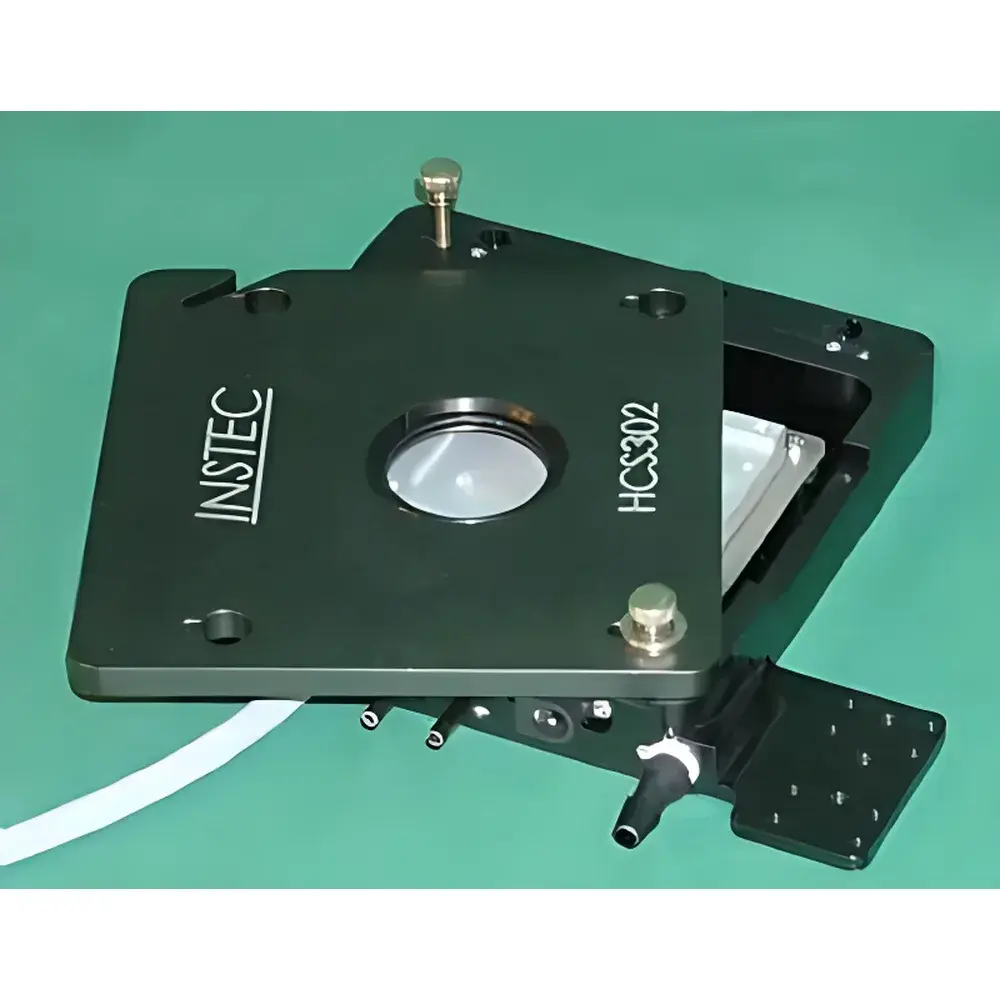
Instec HCS302 High-Performance Cryo-Hot Stage for In Situ Microscopy
| Brand | Instec |
|---|---|
| Origin | USA |
| Model | HCS302 |
| Temperature Range | −190 °C to 400 °C |
| Temperature Resolution | 0.01 °C |
| Temperature Stability | ±0.01 °C at 100 °C |
| Max Heating Rate | +100 °C/min at 100 °C |
| Max Cooling Rate | −100 °C/min at 100 °C |
| Min Working Distance | 3.3 mm (outer window removed) |
| Operating Working Distance | 5.6 mm |
| Condenser Distance | 10.0 mm |
| Sample Area | 38 mm × 50 mm |
| Chamber Height | 2.0–12.5 mm (with optional spacers) |
| Viewing Aperture Options | 2 / 5 / 8 / 10 mm |
| Optional X-Y Micropositioner | 10 µm resolution |
| Temperature Sensor | 100 Ω Platinum RTD |
| Control Method | Switching PID (LVDC PID optional) |
Overview
The Instec HCS302 is a high-precision, dual-mode cryo-hot stage engineered for in situ optical and electron microscopy applications requiring rigorous thermal control across an exceptionally wide operational range—from cryogenic temperatures of −190 °C up to 400 °C. Unlike conventional heating or cooling stages, the HCS302 employs a symmetric Peltier-based thermoelectric architecture combined with active liquid nitrogen cooling and resistive heating elements, enabling bidirectional thermal ramping with sub-millikelvin stability under dynamic load conditions. Its design conforms to fundamental requirements for quantitative phase transition analysis, including controlled nucleation studies, solid–liquid–mesophase equilibria mapping, and real-time crystallization kinetics in polymers, liquid crystals, pharmaceuticals, and functional thin films. The stage integrates seamlessly into upright, inverted, and confocal microscope configurations—supporting both transmitted-light and reflected-light modalities—while maintaining compatibility with standard objective lenses (including high-NA oil-immersion optics) through optimized working distance and condenser clearance specifications.
Key Features
- Ultra-wide temperature range: −190 °C to +400 °C, validated per ASTM E220 and ISO 11357 calibration protocols
- Temperature resolution of 0.01 °C and long-term stability of ±0.01 °C at 100 °C, verified using traceable platinum resistance thermometers (100 Ω Pt RTD)
- Programmable ramp rates from ±0.01 °C/h (ultra-slow annealing) to ±100 °C/min (rapid thermal cycling), with independent control of heating and cooling profiles
- Large sample viewing area (38 mm × 50 mm) with interchangeable aperture inserts (2, 5, 8, or 10 mm diameter) to optimize contrast, field uniformity, and depth of field
- Modular chamber height: standard 2.0 mm gap, extendable to 12.5 mm via precision-machined stainless-steel spacers for thick samples or multi-layer assemblies
- Low-profile optical path: 5.6 mm operating working distance; reducible to 3.3 mm when outer quartz window is removed—enabling use with high-magnification objectives
- Optional motorized X–Y micropositioner with 10 µm step resolution and closed-loop feedback for automated grid-based thermal mapping
Sample Compatibility & Compliance
The HCS302 accommodates diverse sample formats—including bulk polymer films, single-crystal wafers, fiber bundles, lyophilized powders, and electroactive liquid crystal cells—within its inert, vacuum-compatible chamber. Quartz observation windows provide >90% transmission from UV (200 nm) to NIR (2500 nm), supporting polarized light microscopy (PLM), differential interference contrast (DIC), and fluorescence imaging. Electrical feedthroughs (optional) allow simultaneous application of DC/AC bias fields up to ±200 V for electro-optic characterization of ferroelectric or nematic phases. All materials comply with RoHS Directive 2011/65/EU and meet UL 61010-1 safety standards for laboratory equipment. The stage supports GLP-compliant operation when paired with Instec’s certified temperature validation kits and NIST-traceable calibration reports.
Software & Data Management
Control is managed via Instec’s proprietary StageLink™ software (Windows 10/11 compatible), which provides synchronized logging of temperature, ramp rate, setpoint deviation, and user-defined analog inputs (e.g., camera trigger signals, external sensor data). The software supports IEC 62443-3-3 compliant audit trails, electronic signatures, and 21 CFR Part 11–ready data export (CSV, HDF5, and vendor-neutral TIFF stacks). Programmable thermal protocols—including multi-step isothermal holds, linear ramps, and custom non-linear profiles—can be saved, versioned, and recalled with timestamped metadata. Integration with third-party platforms (e.g., MATLAB, Python via PySerial API, or LabVIEW drivers) enables fully automated experiment orchestration within larger metrology workflows.
Applications
- Polymorph screening and solid-state phase behavior of active pharmaceutical ingredients (APIs) per USP and ICH Q5A guidelines
- In situ observation of smectic–nematic–isotropic transitions in liquid crystal displays (LCDs) under applied electric fields
- Morphological evolution during melt–crystallization cycles in semi-crystalline polyolefins and biodegradable polyesters
- Thermal degradation onset analysis of carbon-fiber composites and dielectric thin films
- Real-time monitoring of dendrite formation in solid-state battery electrolytes at sub-zero temperatures
- Calorimetric correlation of optical birefringence changes with DSC-derived enthalpy data
FAQ
What vacuum or inert gas environments is the HCS302 rated for?
The stage operates under ambient air, dry nitrogen purge (≤0.1 mbar residual moisture), or high-vacuum conditions down to 10−6 mbar when equipped with optional vacuum flange kits.
Can the HCS302 be used with scanning electron microscopes (SEM)?
Yes—when configured with an SEM-compatible version (HCS302-SEM), featuring low-outgassing materials, non-magnetic construction, and differential pumping ports for chamber isolation.
Is temperature calibration traceable to national standards?
Each unit ships with a NIST-traceable calibration certificate covering three points (−100 °C, 25 °C, and 200 °C), with optional annual recalibration services available.
Does the system support simultaneous electrical stimulation and thermal profiling?
Yes—via two isolated 200 V DC/AC feedthroughs (optional), enabling concurrent electro-thermal experiments such as dielectric spectroscopy or electrochemical impedance monitoring.
How is thermal uniformity across the sample area characterized?
Uniformity is specified as ±0.15 °C over the central 25 mm × 25 mm region at steady state, measured using a 5-point micro-thermocouple array per ISO 17025-accredited procedures.



