
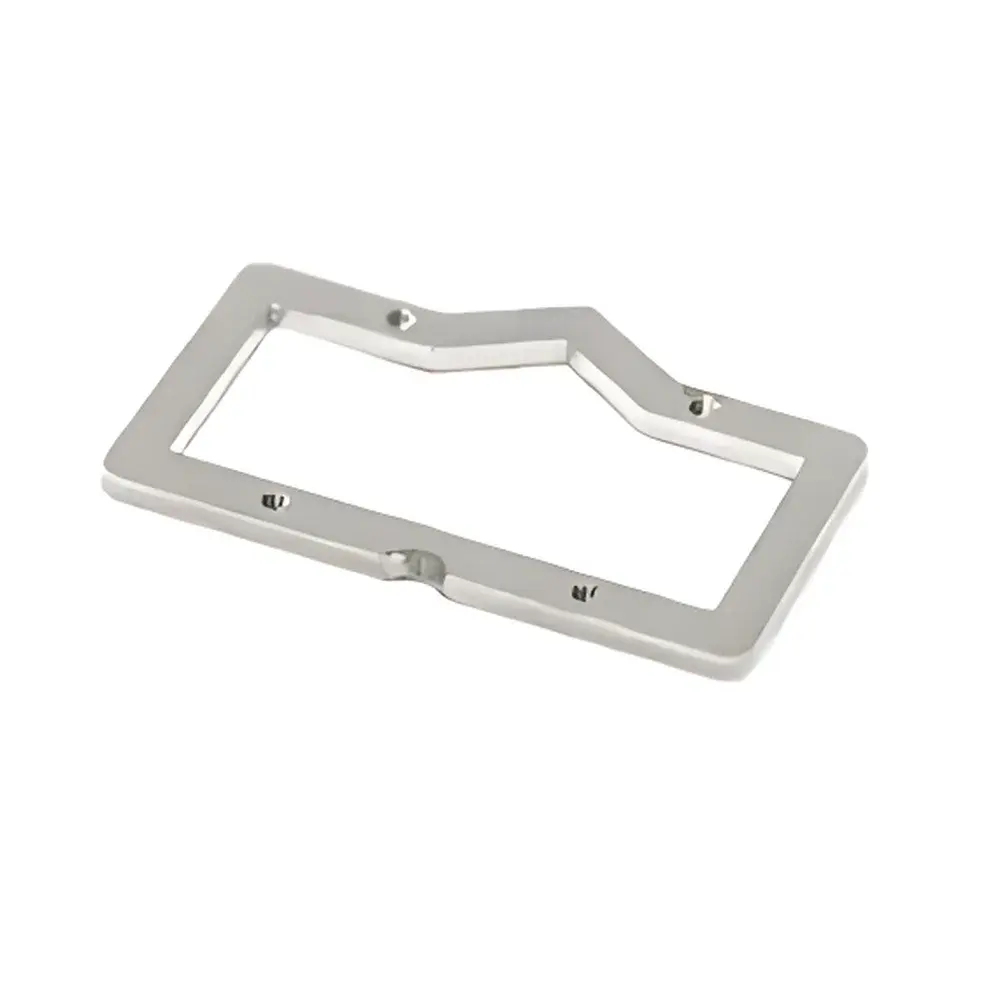
Narishige CFR-2 Rat Chronic Cranial Chamber Frame
| Brand | Narishige |
|---|---|
| Origin | Japan |
| Model | CFR-2 |
| Dimensions (W×D×H) | 50 × 30 × 2 mm |
| Weight | 8 g per unit |
| Package Quantity | 10 units |
| Compatibility | Rats (adult, standard skull anatomy) |
| Mounting | Screw-based cranial fixation with four 0.9 mm threaded holes |
| Observation Window Area | ≥80% of frame footprint |
| Material | Medical-grade titanium alloy (Ti-6Al-4V), autoclavable |
| Compliance | ISO 13485–certified manufacturing, USP Class VI biocompatibility tested |
Overview
The Narishige CFR-2 Rat Chronic Cranial Chamber Frame is a precision-engineered stereotactic anchoring platform designed for longitudinal, awake-behaving neuroscience experiments in adult rats. Built upon the established principles of chronic cranial window preparation and head-fixed behavioral paradigms, the CFR-2 serves as a stable, low-profile mechanical interface between the animal’s skull and external instrumentation—including micromanipulators, optical imaging systems, electrophysiology rigs, and optogenetic delivery devices. Its ultra-thin 2 mm profile minimizes tissue displacement and surgical trauma during implantation, while its rigid titanium alloy construction ensures long-term dimensional stability under repeated mechanical loading. Unlike temporary headposts or dental cement–based mounts, the CFR-2 provides reproducible, millimeter-level spatial registration across sessions—enabling reliable re-access to identical cortical or subcortical coordinates over days or weeks. It is intended for use following craniotomy and dural preservation or replacement (e.g., with glass coverslip or polymer membrane), forming part of a complete chronic recording or imaging preparation compliant with institutional animal care guidelines.
Key Features
- Low-profile design (2 mm height) reduces interference with microscope objectives, two-photon lenses, and multi-electrode arrays
- Four precisely spaced 0.9 mm threaded holes for secure, symmetric fixation using biocompatible stainless-steel screws (M0.9 × 0.25 pitch)
- Optimized observation window geometry: 50 mm width × 30 mm depth footprint accommodates bilateral or large unilateral cortical fields, with ≥80% unobstructed optical access
- Medical-grade Ti-6Al-4V construction ensures corrosion resistance, MRI compatibility, and full autoclave sterilizability (134°C, 3 bar)
- Surface finish meets ISO 10993–1 biocompatibility requirements; validated for chronic (>28-day) intracranial implantation in rodent models
- Interoperable with Narishige SR-10R-HT, SR-1, and other stereotactic frames featuring standardized baseplate interfaces
Sample Compatibility & Compliance
The CFR-2 is validated for use in Sprague-Dawley and Wistar rats weighing 250–500 g, with standard skull curvature and interparietal suture morphology. Implantation requires standard aseptic craniotomy technique and adherence to IACUC-approved surgical protocols. The frame conforms to ISO 13485:2016 quality management standards for medical device manufacturers and carries documentation supporting USP Class VI biological safety testing (cytotoxicity, sensitization, intracutaneous reactivity). While not a regulated medical device per FDA 21 CFR Part 820, its design and material traceability support GLP-compliant preclinical study reporting. All units are individually laser-marked with batch number and sterility validation code.
Software & Data Management
The CFR-2 is a passive mechanical component and does not incorporate embedded electronics or firmware. However, its geometric consistency enables seamless integration into digital workflow pipelines: coordinate mapping from preoperative MRI or CT scans can be registered to the frame’s fiducial screw holes using standard neuroinformatics tools (e.g., Allen Brain Atlas CCFv3, SimpleITK, or MATLAB-based stereotaxic alignment scripts). When used with Narishige’s digital stereotactic controllers (e.g., MO-10 or MN-151), the CFR-2 allows sub-10 µm repeatability in electrode or pipette tip positioning across sessions—critical for longitudinal calcium imaging, patch-clamp stability, or chronic LFP/MEA recordings. Audit trails for implantation date, screw torque values, and post-op recovery metrics may be logged in compliant ELN systems (e.g., LabArchives, Benchling) per institutional GLP/GCP policies.
Applications
- Chronic two-photon calcium imaging through cranial windows
- Repeated whole-cell patch-clamp recordings in awake, head-fixed rodents
- Longitudinal optogenetic stimulation with fiber photometry or multi-color LED arrays
- Stable extracellular electrophysiology using silicon probes or tetrodes
- Combined behavioral assays (e.g., whisker tracking, licking, lever pressing) under head fixation
- Serial intracortical microinjection or drug delivery via chronically implanted cannulae
FAQ
Is the CFR-2 compatible with mice?
No—the CFR-2 is specifically dimensioned for rat skull anatomy. Narishige offers the CFR-1 variant for smaller rodents, including mice and juvenile rats.
Can the CFR-2 be reused after explantation?
No. Each CFR-2 is intended for single-use, sterile implantation. Reuse compromises structural integrity and introduces infection risk.
What screw length is recommended for optimal fixation?
Standard implantation uses 1.5–2.0 mm self-tapping screws (e.g., Narishige SS-1.5); final torque must not exceed 0.05 N·m to prevent skull fracture.
Does the frame interfere with EEG or ECoG recordings?
When properly grounded and positioned outside primary recording zones, the titanium frame exhibits negligible electromagnetic interference at frequencies below 1 kHz.
How is sterility ensured prior to surgery?
Units are supplied gamma-irradiated (25 kGy) and packaged in ISO Class 5 cleanroom conditions; sterility validation reports are available upon request.



