
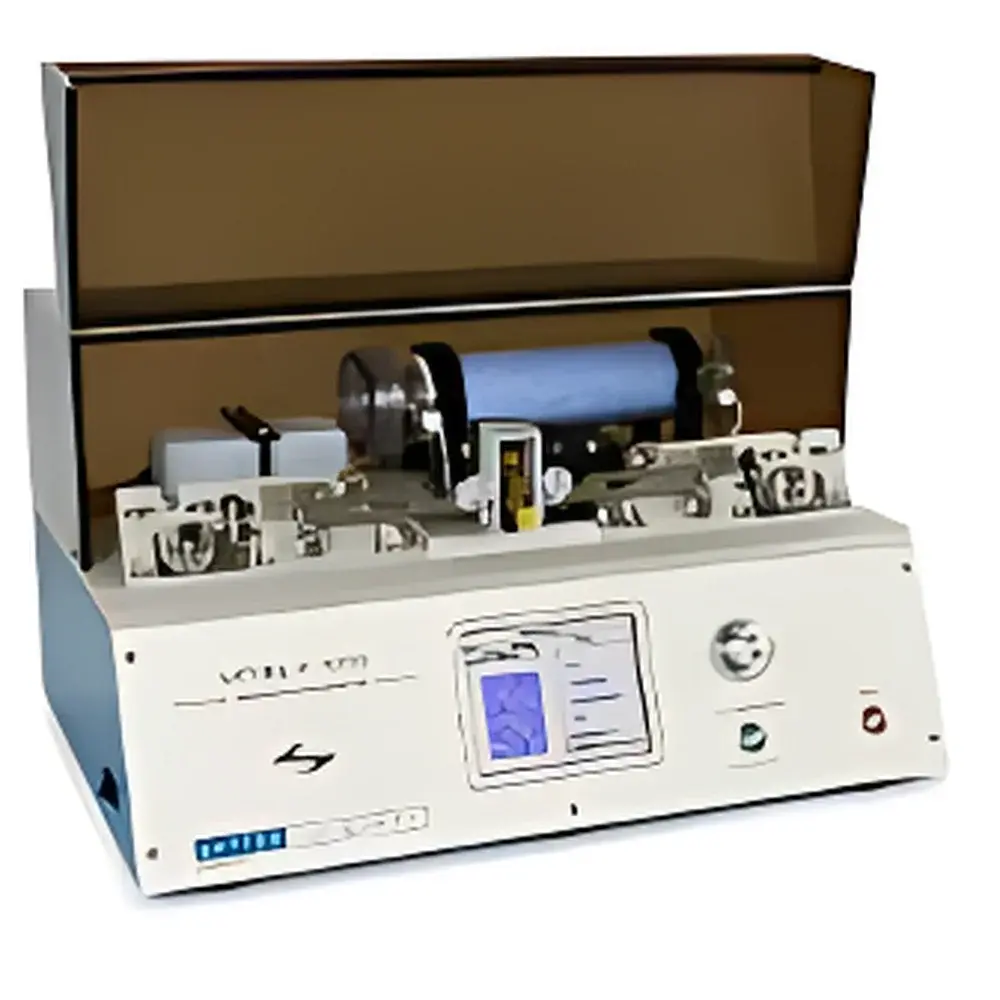
Sutter P-1000 Flaming/Brown-Type Micropipette Puller
| Brand | Sutter |
|---|---|
| Origin | USA |
| Model | P-1000 |
| Dimensions | 53 cm × 36 cm × 30 cm |
| Weight | 18.59 kg |
| Power Supply | 115/230 V, 50/60 Hz |
| Certification | CE |
| Included | User Manual, Sutter Pipette Cookbook (hard copy), FB255B filament, glass sample kit |
Overview
The Sutter P-1000 is a high-precision, microprocessor-controlled Flaming/Brown-type micropipette puller engineered for reproducible fabrication of glass capillaries used in electrophysiology, microinjection, patch clamping, and single-cell manipulation. It operates on the principle of controlled resistive heating—using a platinum-iridium filament to heat the center of a glass capillary while applying precisely timed axial tension and cooling profiles. This dual-parameter thermal-mechanical process enables consistent taper geometry, tip diameter control (sub-micron resolution), and symmetrical double-pull output per cycle. Designed for laboratory environments requiring stringent protocol adherence and traceable instrument performance, the P-1000 integrates deterministic thermal management with real-time diagnostic feedback to minimize operator-dependent variability.
Key Features
- Full-color capacitive touchscreen interface with intuitive navigation and contextual help overlays
- Integrated Sutter Pipette Cookbook—pre-validated, application-specific pull programs categorized by glass type (e.g., borosilicate, quartz), outer diameter (1.0–1.5 mm), wall thickness, and target application (e.g., whole-cell patch, intracellular recording, pronuclear injection)
- Dual heating modes: Preheat mode stabilizes jaw temperature prior to pull initiation; Safe-Heat mode enforces upper thermal limits to prevent filament degradation or capillary annealing
- Advanced program editor supporting line duplication, block copy/paste, iterative row repetition, and user-defined annotations for SOP documentation
- Real-time diagnostics: filament resistance monitoring, pressure transducer validation, jaw thermistor calibration check, and capillary loading status verification
- Onboard memory stores the two most recent pull results—including pull parameters, timestamp, and thermal profile snapshots—for rapid comparison and troubleshooting
- Configurable ramp testing utility with adjustable dwell times and slope gradients; test profiles can be saved as reference templates
- Dual-output symmetry: Each pull cycle yields two identical, mirror-symmetric pipettes—critical for paired-electrode experiments and bilateral microinjection protocols
- Dedicated compressed-air supply port with integrated pressure regulator and optional inline moisture trap for consistent pneumatic actuation
Sample Compatibility & Compliance
The P-1000 accommodates standard borosilicate (e.g., BF150-86-10, GC150TF-10), aluminosilicate, and fused quartz capillaries ranging from 1.0 mm to 1.5 mm outer diameter. It supports both filament-based heating (FB255B included) and optional flame-based configurations via accessory kits. All operational firmware and parameter logging comply with GLP-aligned data integrity requirements: timestamps are hardware-synchronized, program edits are non-destructive, and no configuration changes occur without explicit user confirmation. The system bears CE marking per Directive 2014/30/EU (EMC) and 2014/35/EU (LVD), and its electrical architecture meets IEC 61010-1 safety standards for laboratory equipment. While not FDA-cleared as a medical device, it is routinely deployed in ISO 17025-accredited labs performing method development under ASTM E2915 and USP guidelines for analytical instrument qualification.
Software & Data Management
No external PC or proprietary software is required for operation—the P-1000 runs entirely on embedded Linux with deterministic real-time kernel scheduling. All pull programs, diagnostic logs, and ramp test archives are stored internally on encrypted flash memory with write-cycle protection. Export functionality supports USB mass-storage mode: users may retrieve CSV-formatted pull metadata (including temperature setpoints, pull speed, delay intervals, and jaw position traces) for integration into LIMS or statistical process control platforms. Audit trails record every parameter modification, user login event (via optional password lock), and firmware update—supporting 21 CFR Part 11 compliance when paired with institutional electronic signature policies. Firmware updates are delivered as signed binary packages verified via SHA-256 checksum prior to installation.
Applications
- Electrophysiology: Fabrication of low-resistance patch pipettes (1–5 MΩ) and sharp intracellular electrodes with sub-0.2 µm tip openings
- Developmental biology: High-yield production of injection pipettes for zebrafish, Drosophila, and Xenopus embryonic microinjection
- Neuroscience: Consistent tapering of theta-tube and concentric capillaries for iontophoresis and dual-barrel recording
- Single-cell genomics: Pulling ultra-fine pipettes (<0.5 µm) for cytoplasmic aspiration and nuclear isolation
- Microfluidics interface: Generating tapered capillaries for nanoliter-scale fluidic interconnects and probe coupling
- Custom sensor fabrication: Preparing pulled optical fiber tips for near-field scanning and fluorescence collection
FAQ
Does the P-1000 support custom glass types not listed in the Cookbook?
Yes—users may manually define thermal profiles using raw parameter fields (heat duration, pull speed, delay, pressure), validated against reference capillaries using the ramp test function.
Can pull programs be exported or shared between instruments?
Yes—programs are stored as human-readable JSON files via USB export and can be imported onto other P-1000 units running firmware v2.3 or later.
Is filament replacement a field-serviceable procedure?
Yes—FB255B filament installation requires only a hex key and takes under 90 seconds; alignment is auto-calibrated during the first post-replacement warm-up cycle.
What maintenance is required to ensure long-term thermal accuracy?
Annual verification of jaw thermistor calibration using NIST-traceable dry-block calibrators is recommended; Sutter provides a documented verification protocol in Appendix D of the service manual.
How does the P-1000 handle variations in ambient humidity or lab temperature?
The internal thermal model dynamically compensates for ambient drift using real-time jaw thermistor feedback and adaptive PID loop tuning—no manual recalibration is needed across 15–32 °C operating range.



