
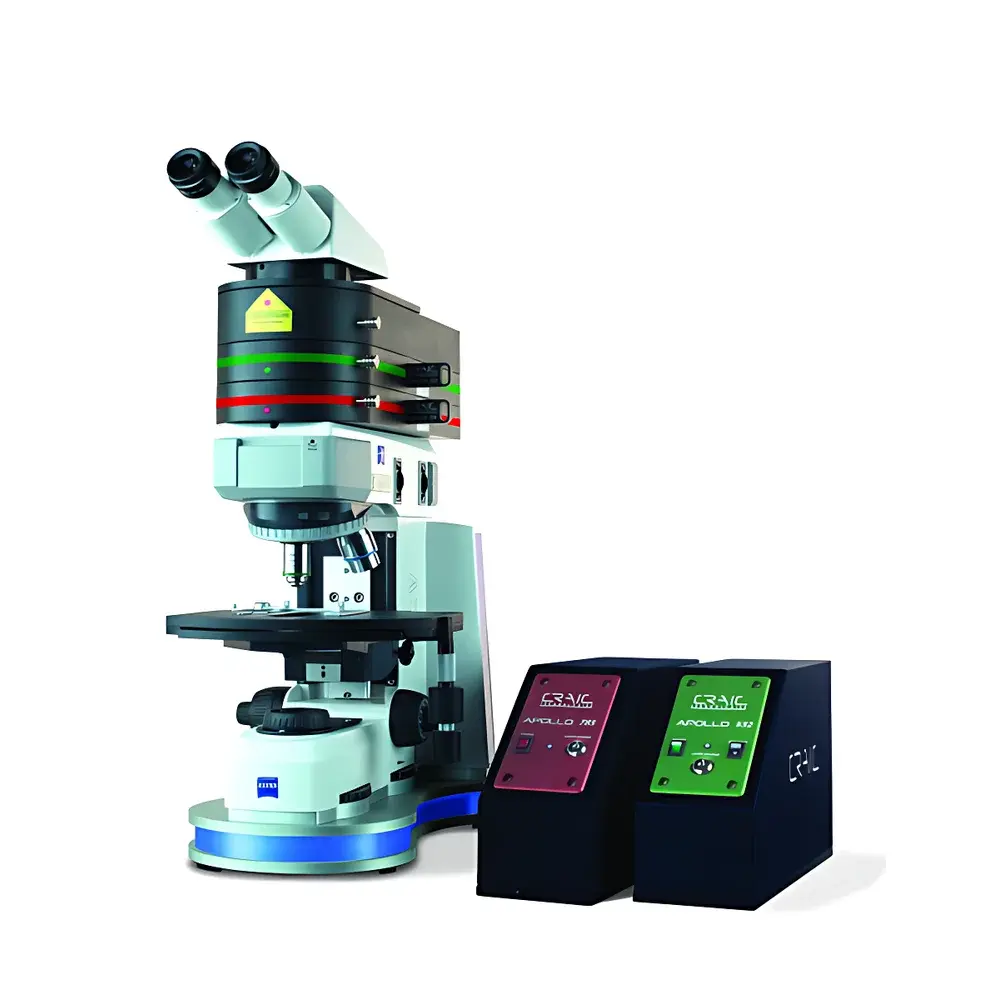
CRAIC Apollo™ Micro-Raman Spectrometer
| Brand | CRAIC |
|---|---|
| Origin | USA |
| Manufacturer Type | Authorized Distributor |
| Origin Category | Imported |
| Model | Apollo™ |
| Instrument Type | Grating-Based Raman Spectrometer |
| Spectral Range | 120–3000 cm⁻¹ |
| Spectral Resolution | 6 cm⁻¹ |
| Spatial Resolution | 1 µm |
| Minimum Wavenumber | 6 cm⁻¹ |
| Spectral Reproducibility | ≤ ±0.2 cm⁻¹ |
| Laser Wavelengths | 405, 473, 488, 532, 638, 660, 785, 830 nm |
| Laser Linewidth | < 0.02 nm |
| Output Power | 50–100 mW per laser |
| Detector | TE-Cooled CCD |
| A/D Resolution | 16-bit |
| Dynamic Range | 2500:1 |
| Integration Time | 8 ms – 10 min |
| Electrical Interface | USB 2.0 |
| Input Voltage | 110–220 VAC |
| Sampling Area | 14 µm |
| Spectral Surface Imaging™ Capability | Yes |
Overview
The CRAIC Apollo™ Micro-Raman Spectrometer is a high-precision, modular confocal Raman imaging system engineered for non-destructive, label-free chemical characterization at the microscale. Based on spontaneous Raman scattering principles, it couples spatially resolved excitation with high-throughput grating-based spectral dispersion to deliver quantitative vibrational fingerprinting of heterogeneous samples. Unlike conventional benchtop Raman systems, the Apollo™ integrates directly with optical microscopes—enabling diffraction-limited spatial resolution down to 1 µm—and supports multi-laser excitation (up to three wavelengths simultaneously) to optimize signal-to-noise ratio, minimize fluorescence interference, and access resonance-enhanced Raman modes across diverse material classes. Its fully solid-state architecture eliminates moving parts in both the spectrometer and laser delivery path, ensuring long-term mechanical stability, thermal robustness, and operational repeatability critical for GLP-compliant laboratories and regulated QC environments.
Key Features
- Modular, stackable laser platform supporting simultaneous operation of up to three discrete excitation wavelengths (405, 473, 488, 532, 638, 660, 785, or 830 nm), each with <0.02 nm linewidth and 50–100 mW output power
- Confocal optical design with sub-micron spatial resolution (1 µm) and precise z-axis depth profiling capability
- High-efficiency transmission grating spectrometer covering 120–3000 cm⁻¹ with calibrated resolution of 6 cm⁻¹ (FWHM)
- TE-cooled back-illuminated CCD detector with 16-bit digitization, 2500:1 dynamic range, and integration times adjustable from 8 ms to 10 minutes
- Optical interface compatible with major upright and inverted research-grade microscopes—including Zeiss, Leica, Nikon, and Olympus platforms—as well as CRAIC’s UV-Vis-NIR microspectrophotometers
- Integrated Spectral Surface Imaging™ software suite enabling automated acquisition, registration, and visualization of hyperspectral Raman data cubes (x, y, wavenumber) with 3D surface reconstruction
- Rigorous factory calibration traceable to NIST standards; spectral reproducibility maintained at ≤ ±0.2 cm⁻¹ over extended measurement sessions
- Compact, vibration-insensitive chassis designed for benchtop deployment in cleanrooms, semiconductor fabs, and academic core facilities
Sample Compatibility & Compliance
The Apollo™ accommodates a broad spectrum of solid and thin-film samples without requirement for conductive coating or vacuum environment. It routinely characterizes semiconductors (Si, GaN, SiC), 2D materials (graphene, MoS₂), pharmaceutical polymorphs, biological tissues (fixed/frozen sections), MEMS/NEMS devices, display pixels (OLED, QLED), forensic trace evidence, and energetic materials. All hardware and firmware comply with IEC 61000-6-3 (EMC emission limits) and IEC 61010-1 (safety requirements for laboratory equipment). Data acquisition workflows support audit-trail generation and electronic signature compliance per FDA 21 CFR Part 11 when deployed with validated software configurations. Instrument performance adheres to ISO 8573-1 for compressed air cleanliness (where applicable) and ASTM E1840 for Raman spectral calibration verification.
Software & Data Management
Control and analysis are performed via CRAIC’s proprietary Apollo™ Acquisition Suite, a Windows-based application built on a deterministic real-time kernel for synchronized stage movement, laser switching, and detector readout. The software includes embedded spectral preprocessing (cosmic ray removal, baseline correction using asymmetric least squares), multivariate analysis tools (PCA, cluster analysis), and spectral library matching against commercial (e.g., RRUFF, ICDD) and user-defined databases. Raw spectra are stored in HDF5 format with embedded metadata (laser wavelength, power, objective magnification, grating groove density, calibration coefficients), ensuring FAIR (Findable, Accessible, Interoperable, Reusable) data principles. Export options include CSV, JCAMP-DX, and vendor-neutral .spc formats compatible with third-party chemometric platforms such as MATLAB, Python (SciPy/NumPy), and Unscrambler X.
Applications
- Pharmaceutical development: Polymorph identification, crystallinity mapping, API-excipient interaction analysis, and counterfeit drug screening per USP
- Semiconductor process control: Strain mapping in SiGe heterostructures, dopant activation assessment, gate oxide integrity verification
- Materials science: Phase distribution in battery cathodes (NMC, LFP), defect density quantification in CVD graphene, interfacial chemistry in perovskite solar cells
- Life sciences: Label-free histopathology of unstained tissue sections, lipid/protein conformational changes in single cells, amyloid fibril morphology in neurodegenerative disease models
- Forensics & security: Identification of explosives precursors (e.g., ammonium nitrate, PETN), illicit drug signatures, and pigment composition in questioned documents
- Microelectronics: Failure analysis of solder joints, contamination detection on wafer surfaces, stress evaluation in TSV (through-silicon via) structures
FAQ
Can the Apollo™ be integrated with my existing microscope?
Yes—the system uses standardized C-mount and infinity-corrected optical interfaces compatible with all major OEM microscope platforms. Mechanical and optical alignment kits are provided for rapid installation.
Is spectral calibration traceable to national standards?
Yes—each instrument ships with a NIST-traceable calibration certificate based on neon and argon emission lines, with optional annual recalibration services available.
Does the system support automated mapping of large sample areas?
Yes—motorized XYZ stages (optional) integrate seamlessly with the software to enable programmable grid-based Raman mapping at user-defined step sizes and dwell times.
What level of technical support is included post-purchase?
CRAIC provides lifetime remote diagnostics, firmware updates, and application engineering support. On-site service contracts and certified operator training programs are available globally.
How is data integrity ensured during long-duration experiments?
The system implements hardware-level timestamping, cyclic redundancy checks (CRC) on all spectral frames, and automatic recovery from USB communication interruptions—ensuring uninterrupted acquisition over multi-hour sessions.





