
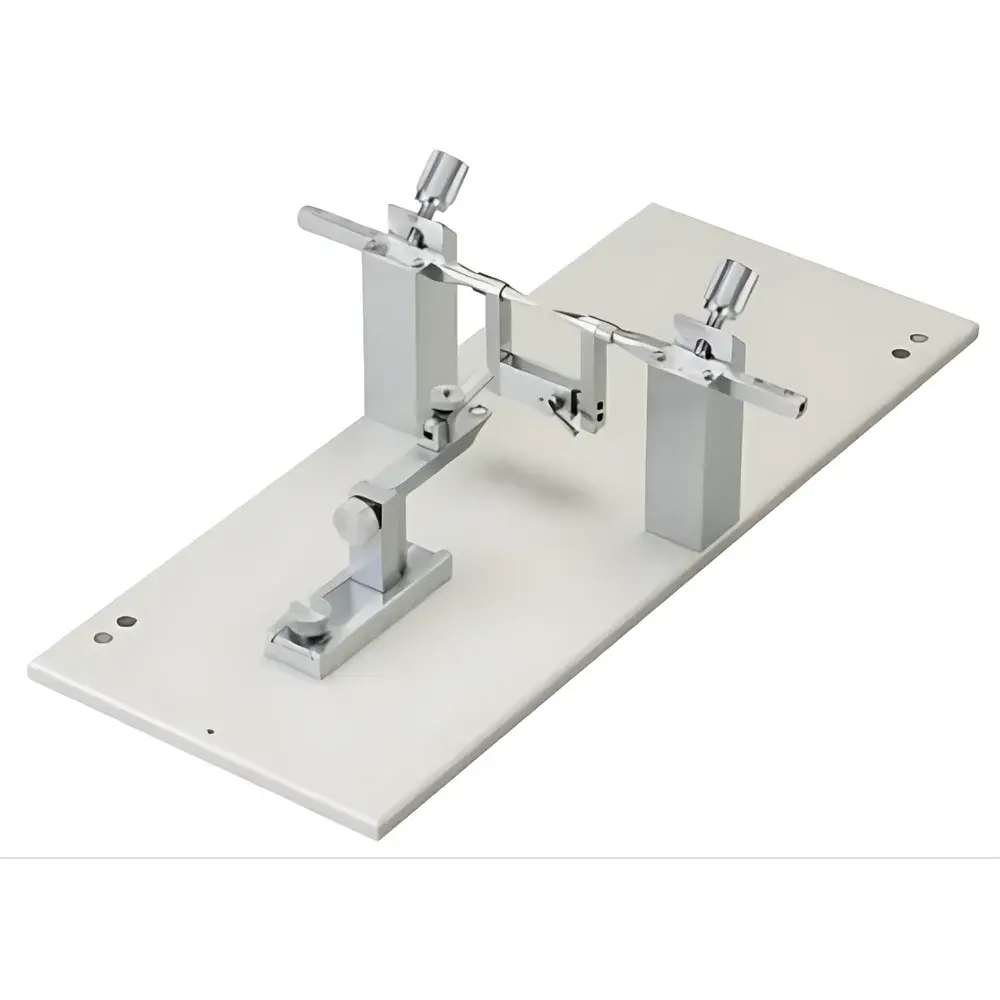
NARISHIGE SR-AM Magnetic Head Holder Assembly
| Brand | NARISHIGE |
|---|---|
| Origin | Japan |
| Model | SR-AM Magnetic Head Holder |
| Compatibility | Designed for SR-series base plates |
| Mounting Interface | Magnetic coupling with SR-series stereotaxic frames |
| Includes | EB-3B mouse ear bars (pair), EB-5N auxiliary ear bars, hex key, mounting knob |
| Dimensions | 300 × 190 × 88 mm |
| Weight | 1.2 kg |
Overview
The NARISHIGE SR-AM Magnetic Head Holder Assembly is a precision-engineered component designed for integration into the SR-series stereotaxic instrument platform. It functions as a modular, magnetically coupled head fixation system that enables rapid, repeatable, and stable positioning of rodent subjects—primarily mice—during neurosurgical, electrophysiological, or microinjection procedures. Unlike conventional screw-based or clamp-style holders, the SR-AM utilizes high-strength rare-earth magnets to secure the head holder directly onto the SR-series base plate, eliminating mechanical play and reducing setup time without compromising rigidity. Its design adheres to established biomechanical constraints for murine craniotomy and intracranial targeting, supporting reproducible alignment relative to bregma and lambda landmarks under stereotaxic coordinate systems (e.g., Paxinos & Franklin atlas). The assembly serves as a critical interface between subject immobilization and manipulator-mounted tools—including micropipettes, electrodes, or optical fibers—ensuring minimal drift during extended experimental sessions.
Key Features
- Magnetic coupling architecture for tool-free, sub-millimeter repeatable mounting on SR-series base plates
- Integrated compatibility with NARISHIGE’s MHW-A tilt adapter, enabling fine angular adjustment (±15°) of the entire head holder assembly for oblique trajectory access
- Standardized mounting geometry compliant with SR-series stereotaxic frame rails and accessory dovetail interfaces
- Included EB-3B bilateral ear bars engineered for consistent tympanic membrane contact and minimal cranial deformation in adult C57BL/6 and BALB/c mice (20–30 g)
- Supplied EB-5N auxiliary ear bars provide enhanced stability for juvenile or low-weight subjects (<18 g) or when using non-standard skull geometries
- Hex-key-adjustable mounting knob allows calibrated torque application (0.3–0.5 N·m recommended) to prevent over-tightening and preserve magnetic interface integrity
- Aluminum alloy construction with anodized finish ensures dimensional stability across temperature fluctuations (20–25°C typical lab range) and resistance to repeated sterilization cycles (70% ethanol wipe-down only)
Sample Compatibility & Compliance
The SR-AM Head Holder is validated for use with live, anesthetized mice undergoing terminal or survival surgical protocols approved under institutional animal care and use committee (IACUC) guidelines. It supports standard stereotaxic coordinates referenced to bregma and lambda, aligning with widely adopted atlases including the Mouse Brain Library (MBL) and Allen Brain Atlas. The device does not incorporate electronic components or consumables; therefore, it falls outside regulatory scope for FDA 21 CFR Part 11 or ISO 13485 certification. However, its mechanical design conforms to ISO 14155:2020 principles for non-invasive research instrumentation used in preclinical studies. Documentation includes traceable manufacturing origin (Japan), material certifications (JIS H 4000 aluminum alloy), and biocompatibility data for all contacting surfaces per ISO 10993-5 (cytotoxicity testing).
Software & Data Management
As a purely mechanical stereotaxic accessory, the SR-AM Head Holder requires no embedded firmware, driver installation, or software integration. Coordinate registration and targeting calculations are performed externally using third-party planning tools (e.g., Stereotaxic Planner v3.2, NeuroInfo Suite) or manual atlas-based referencing. All physical adjustments—ear bar depth, incisor bar height, and pitch/yaw orientation—are recorded manually in laboratory notebooks or electronic lab notebooks (ELNs) compliant with GLP audit requirements. When used in conjunction with digital manipulators (e.g., MN-400, MO-10), positional metadata may be exported via RS-232 or USB-serial protocols, though the SR-AM itself contributes no data stream.
Applications
- Single-cell electrophysiology: Stable head fixation enables high-fidelity patch-clamp recordings from cortical or hippocampal neurons over multi-hour durations
- Viral vector delivery: Precise angular control via MHW-A adapter facilitates injection into deep midbrain nuclei (e.g., VTA, SNc) with minimal tissue displacement
- In vivo two-photon imaging: Rigid coupling minimizes motion artifacts during chronic cranial window experiments
- Optogenetic fiber implantation: Enables reproducible placement of 200-µm core optical fibers into target regions with ≤50 µm targeting error
- Behavioral neuroscience surgery: Supports bilateral electrode or cannula implantation with inter-hemispheric symmetry verification using digital calipers
FAQ
Can the SR-AM be used with rats?
No—the SR-AM is dimensionally optimized for mice (max skull width ≤12 mm). For rat applications, NARISHIGE recommends the SR-10R or SR-15R head holders with corresponding ear bar sets.
Is autoclaving supported?
No. Autoclaving is prohibited due to thermal degradation of magnetic properties and anodized surface integrity. Clean only with 70% ethanol or isopropyl alcohol followed by air drying.
What is the maximum recommended torque for the mounting knob?
0.45 N·m. Exceeding this value risks deformation of the magnetic coupling interface and loss of positional repeatability.
Does the SR-AM include calibration documentation?
Yes—each unit ships with a Certificate of Conformance listing batch number, manufacturing date, and dimensional verification report against JIS B 7502 geometric tolerance standards.
How often should the magnetic interface be inspected?
Prior to each experimental session: visually inspect for ferrous debris, verify smooth engagement/disengagement, and confirm absence of lateral wobble when fully seated on the SR base plate.



