
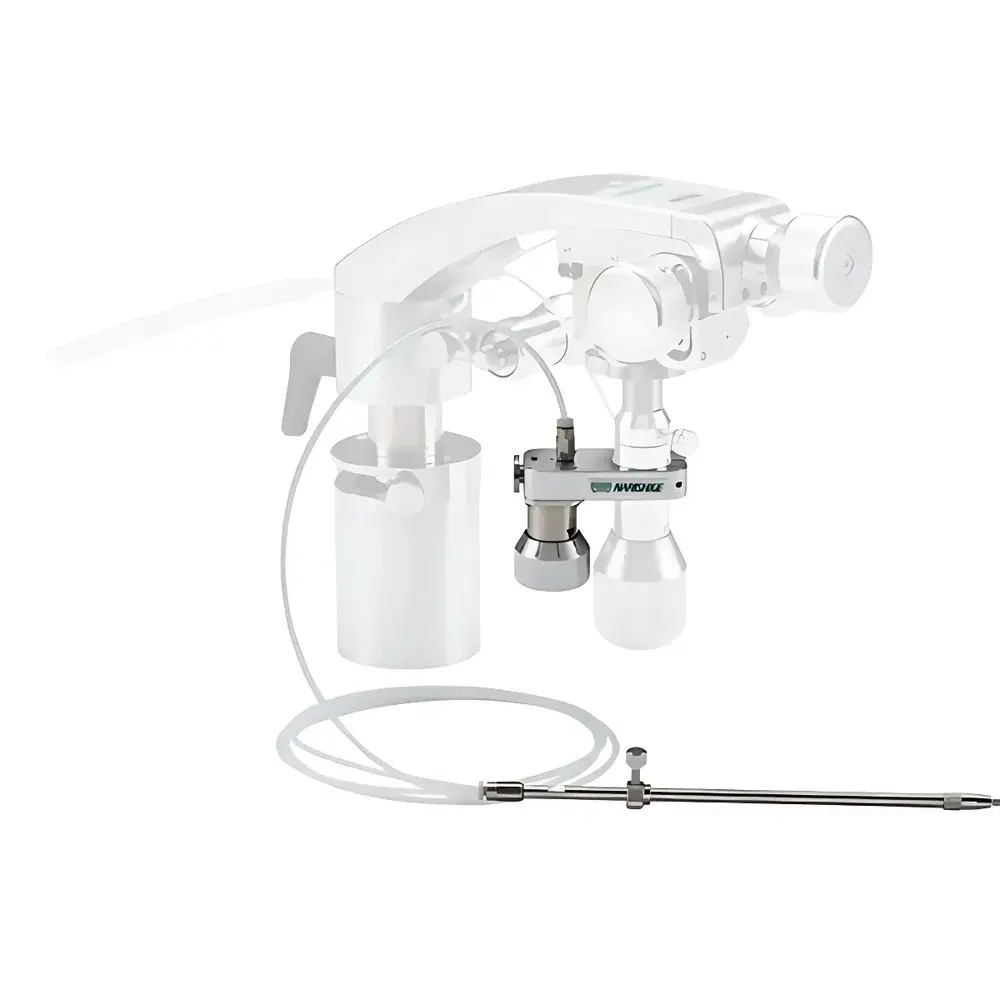
NARISHIGE IM-HD1T Pneumatic Microinjector
| Brand | NARISHIGE |
|---|---|
| Origin | Japan |
| Model | IM-HD1T |
| Dimensions | 24 × 55 × 54 mm (W×D×H) |
| Weight | 58 g |
| Construction | Stainless steel housing with ergonomic form factor |
| Actuation | Pneumatic (external air supply required) |
| Control mode | Manual trigger + optional external TTL/relay interface for automated integration |
| Compatible syringes | Standard 10 µL–100 µL glass or plastic microsyringes (e.g., Drummond Nanoject, Hamilton 7000 series) |
| Accessories included | HI-9 injector holder, CT-4 polyimide tubing (0.28 mm ID), CT-1-1.5 fused silica capillary tubing (1.5 m length), HIO1PKO1 silicone O-rings, hex wrench |
Overview
The NARISHIGE IM-HD1T Pneumatic Microinjector is a compact, high-precision fluid delivery instrument engineered for reproducible nanoliter-to-microliter scale injections in life science research environments. Unlike solenoid- or stepper motor–driven dispensers, the IM-HD1T employs regulated compressed air to actuate a precision-machined stainless steel plunger mechanism, enabling smooth, pulse-free displacement of viscous or low-surface-tension fluids—including aqueous buffers, dyes, fluorescent tracers, viral vectors, and cytoplasmic injection media—into single cells, embryos, or microfluidic channels. Its design adheres to core principles of pneumatic volumetric displacement: flow rate and delivered volume are governed by input pressure (typically 0.05–0.5 MPa), dwell time, and syringe internal geometry—parameters that remain highly stable across repeated cycles when operating conditions are controlled. The device is not a standalone pump but functions as a calibrated mechanical interface between an external pressure source (e.g., regulated nitrogen or clean dry air line) and a mounted microsyringe, making it inherently compatible with existing lab infrastructure and vacuum-compatible setups.
Key Features
- Ultra-compact footprint (24 × 55 × 54 mm) and lightweight construction (58 g) enable seamless integration onto micromanipulator stages, inverted microscopes, or custom-built injection rigs without compromising stability.
- Stainless steel body with corrosion-resistant surface finish ensures long-term reliability in humid or chemically aggressive environments typical of cell culture and electrophysiology labs.
- Manual trigger operation with tactile feedback allows intuitive, real-time control during delicate intracellular injections; optional TTL or relay input enables synchronization with microscope shutter systems, camera acquisition, or programmable logic controllers (PLCs).
- Integrated pressure regulation interface supports fine-tuning of actuation force—critical for minimizing membrane rupture during oocyte or zebrafish embryo microinjection.
- Modular accessory compatibility includes HI-9 universal syringe holder (with adjustable tilt and rotation), CT-4 polyimide tubing for low-compliance fluid paths, and CT-1-1.5 fused silica capillaries (1.5 m length, 10 µm ID) optimized for minimal dead volume and high-resolution delivery.
- Ergonomic trigger geometry reduces operator fatigue during extended manual injection sessions, supporting GLP-aligned experimental repeatability across users.
Sample Compatibility & Compliance
The IM-HD1T is routinely deployed in applications requiring strict adherence to biological sample integrity and procedural traceability. It supports injection into mammalian cells (HEK293, CHO), primary neurons, Xenopus oocytes, Drosophila embryos, and C. elegans gonads. While the device itself carries no CE/UKCA marking or FDA 510(k) clearance—as it is classified as a laboratory tool rather than a medical device—it is widely used in ISO 13485-certified R&D facilities developing IVF reagents, CRISPR-Cas9 delivery protocols, and single-cell omics workflows. When operated with sterile-filtered air sources and autoclavable accessories (e.g., HI-9 holder with removable parts), the system meets basic aseptic handling requirements per USP and ISO 14644-1 Class 5 cleanroom practices. All supplied tubing and O-rings (HIO1PKO1 silicone set) comply with USP Class VI biocompatibility standards.
Software & Data Management
The IM-HD1T operates as a hardware-level injection actuator and does not include embedded firmware or onboard data logging. However, its TTL/relay interface permits deterministic triggering from third-party platforms such as MetaMorph, μManager, or LabVIEW-based automation suites. When integrated into a validated workflow, timestamped injection events can be logged alongside microscope image metadata, enabling full audit trails for regulatory submissions under FDA 21 CFR Part 11 (when paired with appropriate electronic signature and audit trail modules). NARISHIGE provides detailed I/O pinout schematics and timing diagrams in the technical manual to support protocol validation and IQ/OQ documentation.
Applications
- Single-cell transfection and CRISPR ribonucleoprotein (RNP) delivery into suspension or adherent cultures.
- Intracytoplasmic sperm injection (ICSI) training and preclinical gamete manipulation.
- Microinjection of morpholinos or mRNA into zebrafish or Xenopus embryos for developmental biology studies.
- Calibration and validation of microfluidic droplet generators and picoliter-scale reaction chambers.
- Controlled deposition of conductive inks or bioinks in bioprinting R&D where shear-sensitive biomolecules must retain activity.
FAQ
What syringe types are compatible with the IM-HD1T?
Standard 10 µL–100 µL glass or plastic microsyringes with Luer-lock or fixed-tip configurations (e.g., Drummond Wiretrol, Hamilton 7000 series) mount securely using the HI-9 holder.
Is an external air compressor required?
Yes—the IM-HD1T requires a clean, oil-free, pressure-regulated air or nitrogen source (0.05–0.5 MPa); typical lab-grade regulators with dual-gauge readouts are sufficient.
Can the IM-HD1T be used in a biosafety cabinet?
Yes—its compact size, lack of electrical components near the injection head, and compatibility with sterilizable accessories make it suitable for BSC use when connected via flexible tubing routed outside the cabinet.
Does NARISHIGE provide calibration certificates?
No—calibration is user-performed using gravimetric or fluorometric methods per ISO 8655-5; NARISHIGE supplies dimensional tolerances and recommended pressure–volume curves in the operation manual.
How is maintenance performed?
Routine cleaning involves flushing the CT-4 tubing with ethanol and replacing silicone O-rings (HIO1PKO1 kit) every 6–12 months depending on usage frequency and fluid chemistry.





