
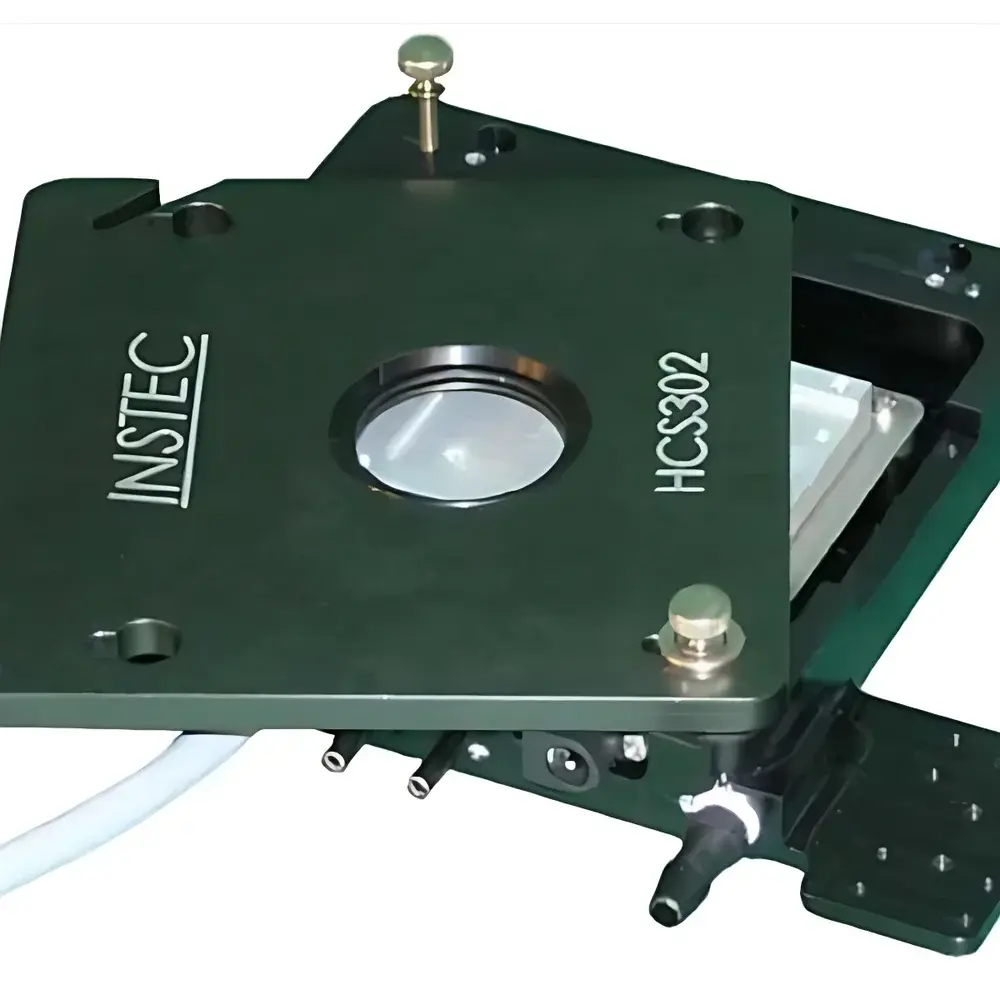
Instec HSC302 High-Performance Cryo-Hot Stage System
| Brand | Instec |
|---|---|
| Origin | USA |
| Model | HSC302 |
| Temperature Range | −190 °C to +400 °C |
| Temperature Accuracy | ±0.1 °C (at 100 °C, 400 °C, and below ambient) |
| Temperature Stability | ±0.1 °C (at 100 °C) |
| Max Ramp Rate | ±100 °C/min |
| Min Ramp Rate | ±0.1 °C/h |
| Minimum Working Distance | >5.6 mm (objective), >10.0 mm (condenser) |
| Sample Size | 38 × 50 mm |
| Transmitted Light Aperture Options | 2, 5, 8, or 10 mm |
| Controller | STC200 (RS232 interface, 230 V input) |
| Accessories | XY Positioner (XY-A-01), Long Working Distance Polarizing Condenser (LWDC1, WD = 20 mm), 2 L LN₂ Cooling System (LN2-P2UF2), Circulating Water Pump (WP230C) |
Overview
The Instec HSC302 High-Performance Cryo-Hot Stage System is an engineered solution for in situ thermal microscopy under precise, dynamic temperature control. Designed for integration with upright and inverted optical microscopes—including polarized light, fluorescence, and differential interference contrast (DIC) platforms—the HSC302 enables real-time observation of phase transitions, crystallization kinetics, thermal expansion, polymorphic transformations, and stress-induced birefringence across an exceptionally broad thermal envelope. Its operational range spans from cryogenic conditions (−190 °C, achievable via liquid nitrogen immersion) to high-temperature regimes (up to +400 °C), making it suitable for materials science, pharmaceutical solid-state characterization, polymer rheology, geoscience mineral analysis, and semiconductor thin-film studies. The system employs a dual-mode heating/cooling architecture: resistive heating elements are coupled with a vacuum-jacketed cold finger and integrated 2 L liquid nitrogen reservoir (LN2-P2UF2), ensuring rapid thermal response without condensation or frost accumulation on optical surfaces. Temperature regulation is executed by the STC200 digital controller—a PID-based unit featuring RS232 serial communication, programmable ramp/soak profiles, and real-time data logging capabilities compliant with GLP documentation requirements.
Key Features
- Ultra-wide thermal operating range: −190 °C to +400 °C, validated at critical setpoints (e.g., ±0.1 °C accuracy at both 100 °C and 400 °C)
- High-stability thermal control: ±0.1 °C stability maintained over extended dwell periods at 100 °C, critical for equilibrium-phase studies
- Programmable thermal ramp rates: adjustable from ultra-slow (0.1 °C/h) for nucleation onset detection to rapid (100 °C/min) for kinetic screening
- Optimized optical access: long working distance (>5.6 mm objective clearance; >10.0 mm condenser clearance) accommodates high-NA and immersion objectives
- Modular aperture selection: interchangeable transmitted-light windows (2, 5, 8, or 10 mm diameter) enable field-of-view optimization without compromising thermal uniformity
- Integrated motion control: optional XY-A-01 precision translation stage (25 mm travel, 1 µm resolution) allows repeatable sample repositioning during thermal cycling
- Polarization-ready optics: LWDC1 long-working-distance polarizing condenser (WD = 20 mm) with detachable polarizer supports quantitative birefringence mapping
Sample Compatibility & Compliance
The HSC302 accepts standard microscope slides (up to 38 × 50 mm) and accommodates diverse specimen geometries—including powders, thin films, gels, single crystals, and encapsulated reactive samples—within its sealed, inert-gas-compatible chamber. All wetted components are constructed from low-outgassing stainless steel and high-purity alumina ceramics to prevent contamination and ensure compatibility with UHV pre-conditioning protocols. The system meets mechanical and electrical safety requirements per IEC 61010-1:2010 and carries CE marking for laboratory equipment. When operated with validated software protocols and audit-trail-enabled STC200 firmware (v2.4+), the HSC302 supports 21 CFR Part 11-compliant data acquisition workflows for regulated environments such as pharmaceutical development labs conducting ICH Q5E or USP thermal analysis.
Software & Data Management
The included STC200 control software provides native Windows-based interface for defining multi-segment temperature programs, synchronizing thermal events with external triggers (e.g., camera acquisition, spectroscopic readouts), and exporting timestamped temperature logs in CSV format. Raw data files retain metadata including controller firmware version, calibration certificate ID, and user-defined experiment tags—enabling full traceability per ISO/IEC 17025:2017 clause 7.5.2. Optional LabVIEW™ and Python API libraries permit integration into automated metrology platforms. All temperature profiles are stored with cryptographic hash verification to prevent post-acquisition tampering—a requirement for GLP audits and regulatory submissions.
Applications
- Polymorph screening and eutectic point determination in active pharmaceutical ingredients (APIs)
- In situ observation of liquid crystal phase transitions (nematic–smectic–isotropic) under controlled thermal gradients
- Thermal expansion coefficient (CTE) measurement of composite laminates via digital image correlation (DIC)
- Crystallization onset detection in supercooled metallic glasses using time-resolved polarized microscopy
- Dehydration/rehydration dynamics of clay minerals and zeolites under variable humidity-temperature coupling (with optional environmental module)
- Thermo-mechanical failure analysis of solder joints and die-attach materials in microelectronics packaging
FAQ
What vacuum level is required for optimal cryogenic performance?
The HSC302 operates effectively at ≤1 × 10⁻³ mbar; higher vacuum (<1 × 10⁻⁵ mbar) improves thermal isolation below −100 °C but is not mandatory for routine operation.
Can the STC200 controller log temperature data independently of a PC?
Yes—the STC200 features internal non-volatile memory capable of storing up to 10,000 data points (time, setpoint, actual temperature) without host connection.
Is the 2 L liquid nitrogen system compatible with automated refill infrastructure?
The LN2-P2UF2 accessory includes standardized ⅜″ VCR fittings and pressure-relief interlocks, enabling seamless integration with centralized LN₂ supply lines and level-monitoring SCADA systems.
Does the HSC302 support simultaneous electrical biasing of samples?
Electrical feedthroughs (±200 V, 100 mA max) are available as factory-installed options (code suffix “-E”); contact technical support for pinout schematics and shielding specifications.
How frequently must the system be recalibrated?
Instec recommends annual calibration against NIST-traceable reference standards (e.g., Fluke 724 with PRT probe); calibration certificates include uncertainty budgets per ISO/IEC 17025.



