
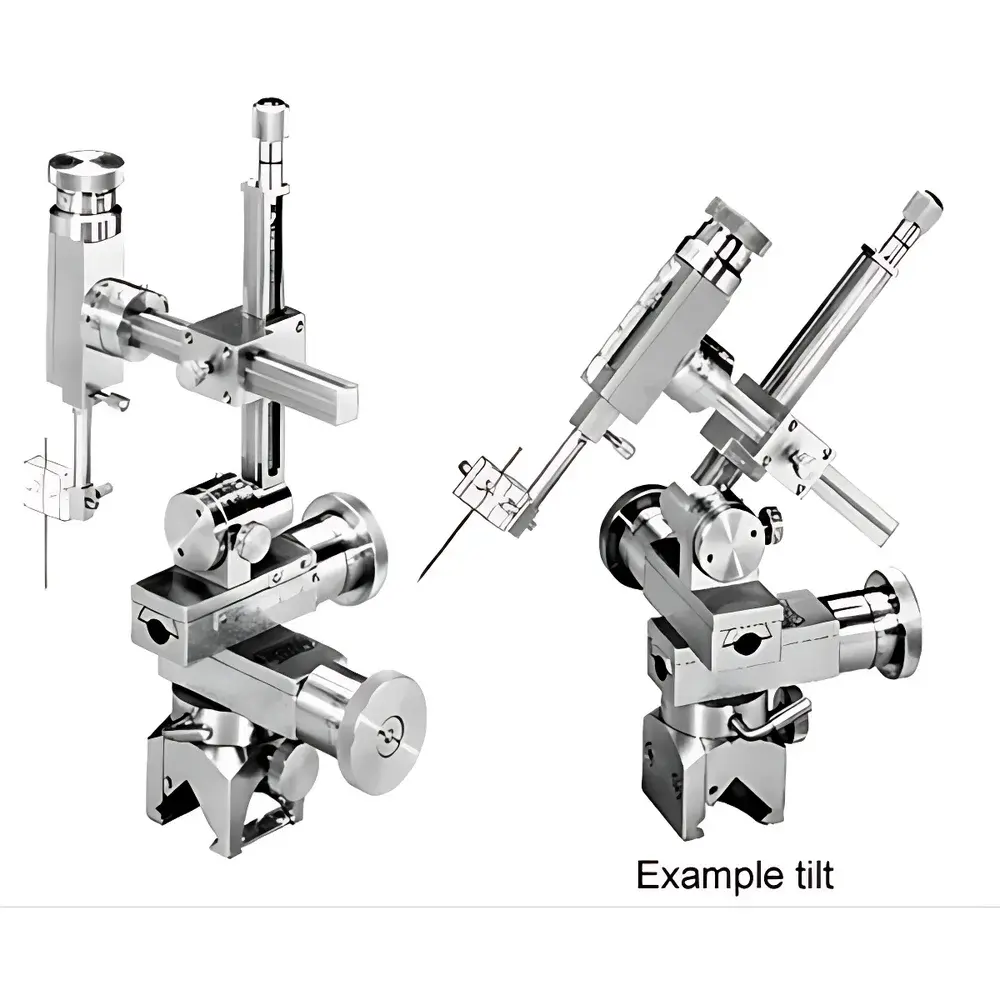
Narishige SM-11 Stereotaxic Microcontroller
| Brand | Narishige |
|---|---|
| Origin | Japan |
| Model | SM-11 |
| Gross Dimensions (W×D×H) | 150 × 104 × 225 mm |
| Weight | 1.75 kg |
| Coarse Z-Axis Travel | 60 mm |
| Fine Adjustment Range (X/Y/Z) | 30 mm each |
| Minimum Increment | 10 µm |
| Coarse Adjustment Step | 500 µm |
Overview
The Narishige SM-11 Stereotaxic Microcontroller is a precision mechanical positioning system engineered for high-fidelity spatial control in stereotactic neurosurgery, electrophysiology, microinjection, and optogenetic targeting. Unlike motorized or digitally controlled units, the SM-11 operates as a fully manual, ultra-stable micromanipulator optimized for integration with standard stereotaxic frames—specifically designed to mount directly onto the anterior-posterior (AP) crossbar. Its operational principle relies on dual-stage mechanical translation: coarse positioning via a long-travel Z-axis slider (60 mm range), complemented by independent fine-adjustment mechanisms on all three Cartesian axes (X, Y, Z), each delivering 30 mm of travel with a resolution of 10 µm per click. This hierarchical motion architecture ensures both broad workspace coverage and subcellular targeting accuracy without electronic drift, thermal noise, or software latency—critical for in vivo rodent brain mapping, single-cell injections, or chronic electrode implantation under microscopy.
Key Features
- Dual-resolution mechanical actuation: 500 µm coarse steps for rapid repositioning; 10 µm fine increments for sub-micron targeting fidelity
- Three-axis independent fine adjustment (X/Y/Z), each equipped with calibrated vernier dials and tactile feedback stops
- Integrated rotational joints on XY, XZ, and YZ planes enable precise angular alignment of mounted tools (e.g., glass pipettes, electrodes, optical fibers) relative to the stereotactic coordinate system
- Z-axis fine stage incorporates a sliding carriage mechanism that allows lateral approach parallel to the X-axis—essential for angled trajectories avoiding cortical vasculature or ventricular structures
- Compact footprint (150 × 104 × 225 mm) and low mass (1.75 kg) minimize frame vibration coupling and maximize stability on shared optical tables or surgical rigs
- Tool-mounting interface conforms to ISO 80300-compliant stereotaxic accessory standards; compatible with Narishige’s MO-10, IM-10, and other third-party manipulators and holders
- All structural components manufactured from anodized aluminum and hardened stainless steel to ensure dimensional stability, corrosion resistance, and compatibility with autoclaving and ethanol-based disinfection protocols
Sample Compatibility & Compliance
The SM-11 is routinely deployed in GLP-compliant preclinical neuroscience laboratories and IACUC-approved animal surgery suites. It supports standard 1.0–1.5 mm OD glass capillaries, tungsten or platinum-iridium microelectrodes (up to 200 µm shank diameter), fiber-optic cannulae, and microdialysis probes. Its mechanical design adheres to ISO 13485-aligned manufacturing practices and meets JIS B 7451 (Japanese Industrial Standard for Precision Positioning Devices). While not a medical device per FDA 21 CFR Part 820, its construction and traceability documentation support regulatory submissions for IND-enabling toxicology and biodistribution studies. The absence of electronics eliminates electromagnetic interference concerns during simultaneous EEG/LFP recording or MRI-compatible procedures.
Software & Data Management
As a purely mechanical instrument, the SM-11 requires no firmware, drivers, or proprietary software. All positional parameters are recorded manually or logged via external systems (e.g., LabChart, Spike2, or custom Python-based tracking scripts interfaced with digital calipers or encoder-equipped base plates). For audit-trail compliance in regulated environments, users integrate the SM-11 into SOP-driven workflows where position coordinates, tool orientation angles, and procedural timestamps are entered into ELN platforms such as LabArchives or Benchling. Optional accessories—including digital readout adapters (e.g., Mitutoyo Digimatic indicators) and motorized base mounts—can be added without compromising core mechanical integrity.
Applications
- Single-neuron intracellular or extracellular recordings in awake or anesthetized rodents
- Stereotactic delivery of AAV vectors, CRISPR-Cas9 constructs, or pharmacological agents into discrete nuclei (e.g., VTA, BLA, mPFC)
- Chronic implantation of tetrodes, silicon probes, or neuropixels arrays with <50 µm target deviation
- Angle-specific ablation or stimulation using focused ultrasound transducers or laser-coupled fibers
- Developmental neurobiology studies requiring reproducible targeting across littermates at P0–P14
- Validation of automated robotic stereotaxic systems—used as a gold-standard reference platform for error calibration
FAQ
Is the SM-11 compatible with non-Narishige stereotaxic frames?
Yes—it mounts universally to any AP crossbar with standard M4 or 6-32 threaded holes (adapters available upon request).
Can the fine-adjustment resolution be improved beyond 10 µm?
No—the 10 µm minimum increment is mechanically fixed by gear ratio and dial calibration; higher resolution requires supplemental optical or piezoelectric stages.
Does the SM-11 support vacuum or fluidic connections for pressure-controlled injection?
Not natively—but it interfaces seamlessly with Narishige’s IM-11 or World Precision Instruments’ Micro4 controllers via standardized mounting brackets.
What maintenance is required for long-term accuracy?
Annual recalibration of dial zero points using certified gauge blocks; lubrication of lead screws every 12 months with Dow Corning 111 silicone grease.
Is sterilization possible between subjects?
Yes—full disassembly permits autoclaving of aluminum/stainless components at 121°C, 15 psi for 20 minutes; avoid steam exposure to engraved scale markings.



