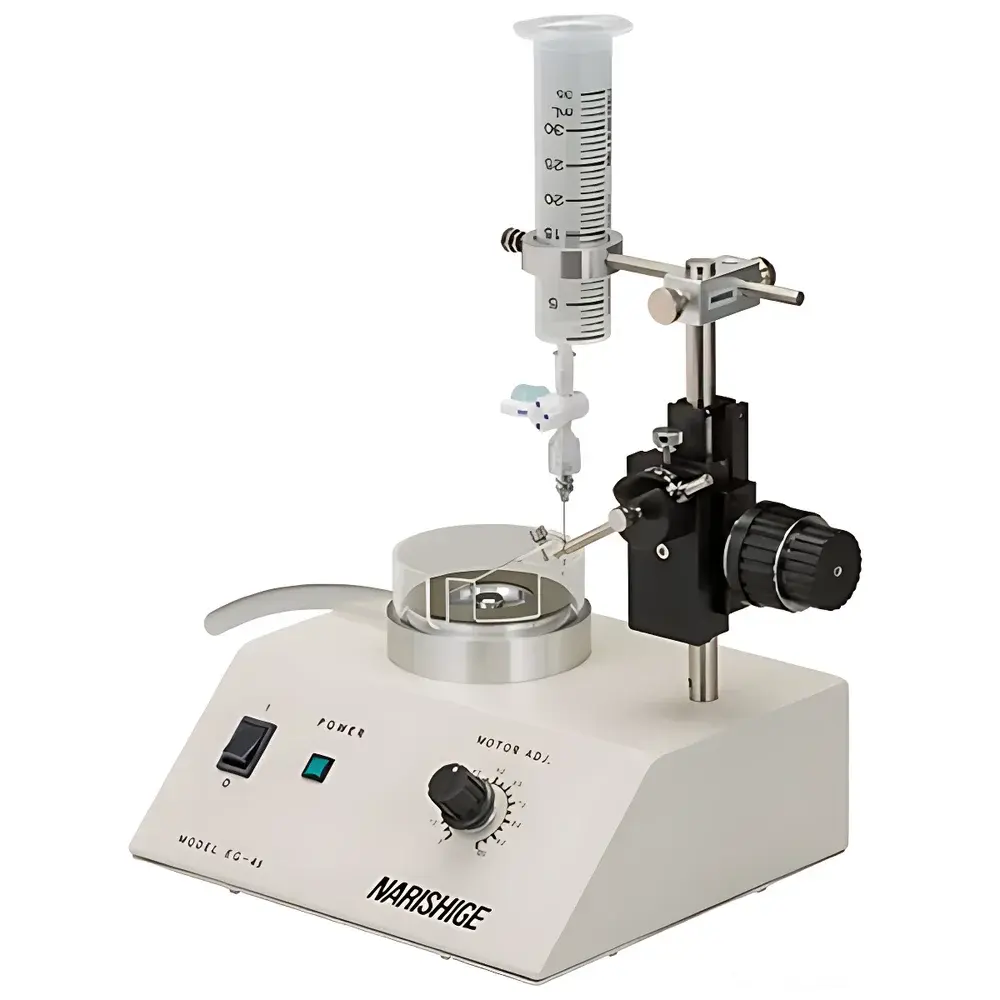
NARISHIGE EG-45 Microelectrode Grinder
| Brand | NARISHIGE |
|---|---|
| Origin | Japan |
| Model | EG-45 |
| Motor Speed | 150–2,100 rpm (diamond wheel stoppable at 150 rpm) |
| Vertical Manipulator Travel | ~47 mm |
| Capillary Diameter Range | Ø1.0–Ø1.5 mm |
| Operating Voltage | AC 100–240 V, 50/60 Hz |
| Power Consumption | 10 W |
| Dimensions (W×D×H) | 185 × 165 × 310 mm |
| Weight | 2.4 kg |
| Includes | Vertical Grinding Adapter, Dedicated Capillary Holder, Power Cord, Hex Wrench |
Overview
The NARISHIGE EG-45 Microelectrode Grinder is a precision-engineered instrument designed for the reproducible sharpening and bevelling of glass micropipettes used in intracellular electrophysiology, patch-clamp recording, microinjection, and single-cell manipulation. It operates on the principle of controlled abrasive grinding using a rotating diamond-coated wheel, with precise orthogonal positioning of the capillary relative to the wheel surface. Unlike manual or non-motorized grinders, the EG-45 employs a low-vibration, brushless DC motor that maintains rotational stability across its full speed range—critical for minimizing chatter-induced irregularities on the pipette tip geometry. Its rigid mechanical architecture ensures micron-level repeatability in tip angle, bevel symmetry, and outer diameter taper—parameters directly influencing seal formation, electrode resistance, and signal-to-noise ratio in high-fidelity recordings.
Key Features
- Stable low-noise motor drive delivering consistent 150–2,100 rpm operation; diamond wheel can be safely halted at minimum 150 rpm for fine-tuning and inspection.
- Coaxial coarse/fine vertical manipulator with ~47 mm total travel, enabling sub-micron depth control during grinding without repositioning.
- Dedicated capillary holder with integrated protractor scale (0°–90°) mounted on the fixed segment—allows accurate, repeatable bevel angle setting prior to grinding.
- Vertical grinding adapter with water-fed cooling channel prevents thermal deformation and debris accumulation at the grinding interface.
- Onboard water supply and drainage system minimizes clogging risk and simplifies maintenance; compatible with standard laboratory deionized water.
- Compact footprint (185 × 165 × 310 mm) and lightweight design (2.4 kg) facilitate integration into laminar flow hoods, electrophysiology rigs, or shared core facility benches.
Sample Compatibility & Compliance
The EG-45 is optimized for borosilicate and soda-lime glass capillaries with outer diameters between 1.0 mm and 1.5 mm—standard dimensions for pulled electrodes used in whole-cell and sharp-electrode configurations. Its mechanical design accommodates both straight and pre-pulled pipettes, provided the shank diameter falls within specification. The device complies with IEC 61010-1:2010 safety standards for laboratory electrical equipment. While not certified for medical device manufacturing, its construction and operational traceability support GLP-aligned workflows in academic and industrial neuroscience laboratories. All electrical components meet CE marking requirements for EMC and low-voltage directive compliance.
Software & Data Management
The EG-45 is a standalone electromechanical instrument with no embedded firmware, touchscreen interface, or digital connectivity. Its operation is fully manual and analog—intentionally eliminating software dependencies that may introduce calibration drift or cybersecurity vulnerabilities in regulated environments. Process parameters (e.g., rotation speed, immersion depth, angle setting) are recorded manually in lab notebooks or integrated into electronic lab notebook (ELN) systems such as LabArchives or Benchling. For audit readiness, users may document grinding conditions alongside electrode impedance measurements and subsequent patch success rates—a practice aligned with NIH and Wellcome Trust reporting guidelines for electrophysiology method validation.
Applications
- Preparation of low-resistance intracellular recording electrodes for in vivo and in vitro brain slice experiments.
- Bevelling of patch pipettes to improve gigaseal formation probability in voltage-clamp and current-clamp studies.
- Sharpening of injection pipettes for embryonic microinjection, CRISPR-Cas9 delivery, or dye loading in developmental biology.
- Routine maintenance of worn electrodes in long-term multi-day recordings where tip geometry degradation compromises data fidelity.
- Standardization of electrode fabrication protocols across multi-user core facilities—reducing inter-operator variability in neurophysiology training programs.
FAQ
Is the EG-45 compatible with quartz or metal-coated capillaries?
No—the EG-45 is engineered exclusively for standard soda-lime and borosilicate glass capillaries (Ø1.0–1.5 mm). Quartz capillaries require higher grinding force and specialized abrasives; metal-coated pipettes risk damaging the diamond wheel surface and compromising wheel flatness.
Can the EG-45 be used without a microscope?
Yes, though real-time visual monitoring via an upright or inverted microscope is strongly recommended to verify tip geometry and detect chipping or asymmetry before use in live tissue.
What type of water should be used in the cooling system?
Deionized (DI) water is required to prevent mineral deposition in the water channels and maintain consistent thermal management across extended operation cycles.
Does the EG-45 support automated protocol storage or programmable grinding sequences?
No—it is a manually operated mechanical grinder. Automation requires external integration via third-party motion controllers, which is not supported or validated by NARISHIGE.
Is the vertical grinding adapter interchangeable with other NARISHIGE holders?
The adapter is mechanically keyed and dimensionally matched only to the EG-45’s dedicated capillary holder; it is not cross-compatible with the PC-10, MF-9, or other NARISHIGE micromanipulator accessories.
Related Products