
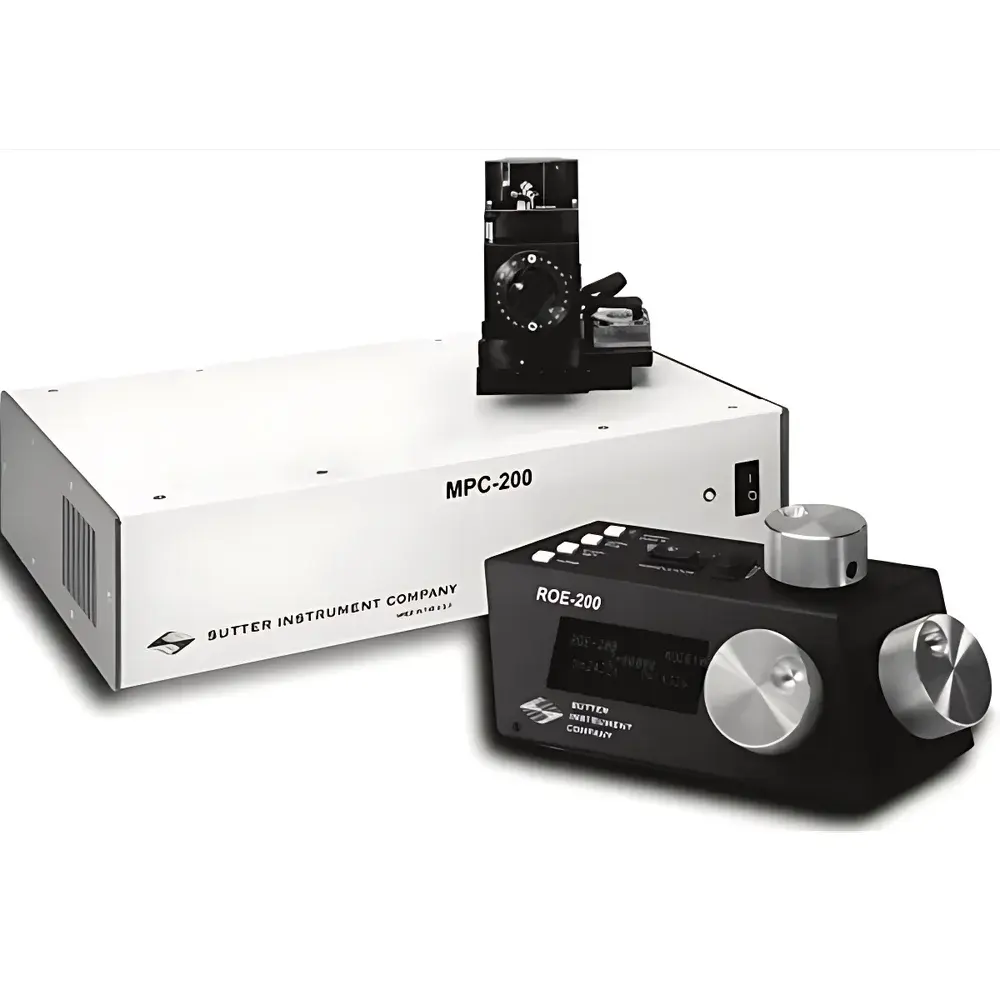
Sutter MPC-225 Micromanipulator
| Brand | Sutter |
|---|---|
| Origin | USA |
| Model | MPC-225 |
| Component Category | Optical Instrument Component |
| Actuation | Stepper Motor–Driven |
| Axes | 3 (X/Y/Z) + Optional 4th Diagonal Axis via ROE-225 |
| Travel Range per Axis | 25 mm |
| Motion Resolution | Adjustable via Dual-Range Position Knobs (Coarse/Fine, 10 µm fine increment) |
| Bearing System | Preloaded Ball-Bearing Slides |
| Compatibility | Mounting Interfaces for MP-285 Pipette Holders and Probes |
| Controller | Integrated Self-Diagnosing MP-225 Controller with ROE-225 Human-Machine Interface |
| Configuration | Factory-Assembled Right- or Left-Handed |
| Mounting | Standard ¼-20 or 10-32 threaded holes on Square Base Plate |
Overview
The Sutter MPC-225 Micromanipulator is a precision-engineered, stepper motor–driven mechanical positioning system designed for high-stability, repeatable manipulation of microelectrodes, patch pipettes, optical fibers, and other sub-millimeter probes in optical and electrophysiological laboratories. Built upon Sutter Instrument’s legacy of robust micromanipulation platforms—including the MP-285 and MPC-365—the MPC-225 delivers calibrated linear motion across three orthogonal axes (X, Y, Z), each offering 25 mm of travel with preloaded ball-bearing slides ensuring smooth, backlash-free translation. Its core architecture integrates miniature stepper motors coupled to integrated anti-backlash gearheads, enabling deterministic open-loop positioning without reliance on external encoders. The system is purpose-built for intracellular recording, patch-clamp experiments, and single-cell targeting under upright or inverted microscopy—where thermal drift mitigation, mechanical rigidity, and long-term positional retention are critical.
Key Features
- Three-axis modular design (X/Y/Z) with identical kinematic performance and interchangeable axis orientation (right- or left-handed configuration available ex-factory)
- 25 mm linear travel per axis, achieved via precision-ground lead screws and preloaded recirculating ball-bearing sliders for minimal hysteresis and high positional reproducibility
- Dual-range manual control: Coarse/fine position knobs provide rapid gross positioning and ultra-precise 10 µm incremental motion—optimized for both setup efficiency and subcellular targeting accuracy
- Taper-pin and hex-screw interconnection system enables rigid, tool-free axis stacking or reconfiguration into non-standard geometries (e.g., diagonal 4-axis setups when paired with ROE-225)
- Backward-compatible mounting interface accepts standard Sutter MP-285 pipette holders, electrode carriers, and probe adapters—ensuring seamless integration into existing optical rigs
- Self-identifying controller (MP-225 Control Unit) performs automatic hardware enumeration at power-up; no manual dip-switch configuration or firmware calibration required
- ROE-225 Remote Optical Encoder interface provides real-time 3D coordinate readout, user-defined home position storage, and one-button recall of up to two custom working positions (e.g., pipette exchange location and experimental target site)
Sample Compatibility & Compliance
The MPC-225 is routinely deployed in GLP-compliant electrophysiology suites and ISO 17025-accredited biophotonics labs where traceable positioning stability and mechanical interoperability are prerequisites. Its mechanical design conforms to standard optical breadboard and microscope stage mounting conventions—including compatibility with Sutter MT-series and MD-series platforms via ¼-20 or 10-32 threaded base plates. While the MPC-225 itself does not carry CE marking or FDA 510(k) clearance as a standalone device, its use in research-grade instrumentation aligns with ASTM E2919 (Standard Guide for Electrophysiological Recording Systems) and supports adherence to Good Laboratory Practice (GLP) documentation requirements through ROE-225’s position logging capability. All structural components are machined from anodized aluminum and stainless steel to ensure dimensional stability across ambient lab temperature fluctuations (20–25 °C).
Software & Data Management
The MPC-225 operates as a stand-alone hardware system with no host PC dependency. Positional data is managed exclusively through the ROE-225 human-machine interface, which displays real-time Cartesian coordinates (X/Y/Z) with 1 µm resolution and supports non-volatile storage of two user-defined coordinate sets. Though it lacks native USB/Ethernet connectivity or API-driven automation, the ROE-225’s button-triggered position recall function facilitates repeatable experimental workflows—particularly valuable during multi-hour patch-clamp sessions requiring consistent electrode repositioning. For labs requiring audit trails, position logs can be manually transcribed or captured via third-party camera-based tracking systems synchronized to ROE-225 display output. No proprietary drivers, operating system dependencies, or software licenses are required for basic operation.
Applications
- Intracellular and whole-cell patch-clamp recordings in acute brain slices, cultured neurons, and oocytes
- Targeted microinjection of dyes, tracers, or CRISPR-Cas9 complexes into individual cells under DIC or fluorescence guidance
- Precision alignment of optical fibers, photostimulation probes, or microfluidic tubing within multimodal imaging rigs
- Positioning of sharp electrodes for extracellular field potential mapping in vivo or in vitro
- Integration with Sutter’s L.M.P. laser-based photolysis systems for caged-compound uncaging experiments requiring submicron spatial registration
- Customizable 4-axis diagonal configurations (via ROE-225) for angled pipette approaches in dense tissue preparations or tilted-stage microscopy
FAQ
Is the MPC-225 compatible with Sutter MP-285 pipette holders and probe adapters?
Yes—the MPC-225 retains identical mounting interfaces and mechanical footprints, enabling direct interchangeability with all MP-285 accessories without modification.
Can the MPC-225 be operated without the ROE-225 interface?
No. The ROE-225 serves as the sole control and display unit; it is not optional and must be connected for all motion commands and position feedback.
What is the maximum payload capacity per axis?
The system is rated for ≤ 200 g per axis under static loading conditions; dynamic load limits decrease with acceleration—consult Sutter’s Application Note AN-MPC225-01 for torque vs. speed curves.
Does the MPC-225 support closed-loop feedback or encoder-based positioning?
No. It is an open-loop stepper motor system. Positional accuracy relies on mechanical repeatability and gearhead precision—not real-time position verification.
How is the MPC-225 mounted to a microscope stage or optical table?
Via its square base plate, which features standardized ¼-20 and 10-32 threaded holes; compatible with Sutter MT-1, MD-220, and most industry-standard kinematic mounts.



