
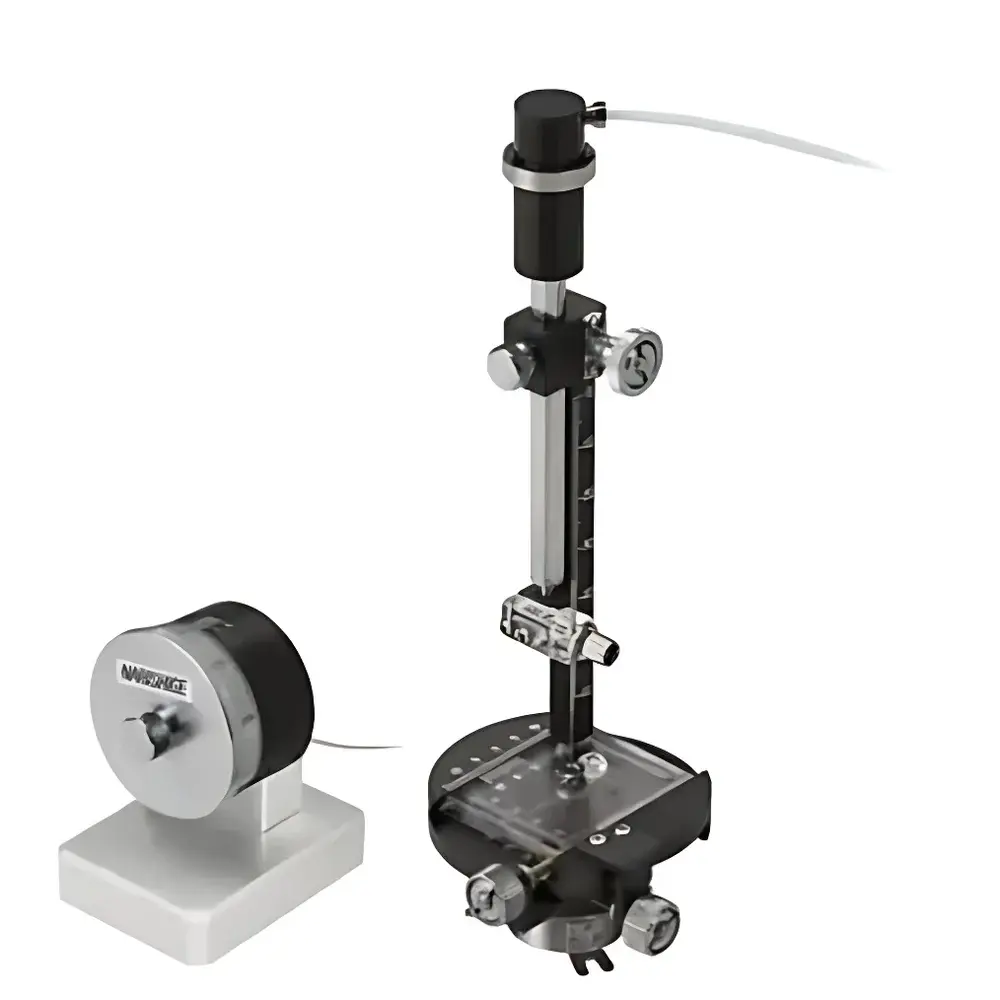
MO-95 Hydraulic Microdrive Controller by NARISHIGE
| Brand | NARISHIGE |
|---|---|
| Origin | Japan |
| Model | MO-95 |
| Construction | Acrylic XY stage, Stainless steel components |
| Drive Mechanism | Hydraulic (non-motorized, vibration-free) |
| Coarse Z Travel | 50 mm |
| Fine X/Y/Z Travel | 18 mm / 18 mm / 10 mm |
| Minimum Step Size | 2 µm (fine adjustment), 500 µm (coarse toggle) |
| Control Unit Dimensions | 65 × 88 × 93 mm, 630 g |
| Drive Unit Dimensions | 60 × 60 × 150 mm, 100 g |
| Hydraulic Tubing Length | 1.5 m |
| Compatible Accessories | MO-903E Chamber, Chamber Cap, Stainless Steel Guide Tube (Ø0.7 × 60 mm), Threaded Rods, Mounting Screws, Washers, Leak-proof Sealing Kit, Electrode Holder with Deep Groove |
| Application | Stereotactic electrophysiology in non-human primates (e.g., macaques) |
Overview
The MO-95 Hydraulic Microdrive Controller, engineered by NARISHIGE (Japan), is a precision stereotactic positioning system designed for chronic or acute intracranial electrophysiological experiments in medium-sized non-human primates—particularly macaques. Unlike motorized or piezoelectric microdrives, the MO-95 employs a manually operated hydraulic actuation mechanism that delivers smooth, vibration-free advancement of recording or stimulation electrodes into deep brain structures. Its core design principle centers on mechanical isolation: minimal transmission of operator-induced tremor or acoustic noise to the electrode tip, thereby preserving neural signal fidelity during insertion and stable long-term recording. The controller integrates with standard primate stereotactic frames via a rigid acrylic XY platform, enabling precise orthogonal alignment relative to bregma-lambda coordinates. Head fixation is achieved using conventional stereotactic ear bars and bite bars (not included), ensuring negligible displacement during fine adjustments—even under minor physiological motion such as respiration or pulse-related skull micro-movements.
Key Features
- Vibration-free hydraulic actuation eliminates electromagnetic interference and mechanical resonance, critical for low-noise extracellular recordings.
- Dual-stage motion control: coarse Z-axis travel (50 mm) for rapid electrode approach; fine X/Y/Z adjustment (18 mm × 18 mm × 10 mm) with tactile feedback and calibrated vernier scales.
- Sub-micron resolution capability: minimum incremental step of 2 µm in fine mode, verified via optical encoder-assisted calibration protocols per ISO 9001-certified manufacturing workflows.
- Modular acrylic XY stage offers full optical transparency for concurrent visual guidance, fluorescence imaging, or surgical microscope integration without obstruction.
- Hydraulic tubing (1.5 m length, medical-grade silicone) ensures flexible placement of the compact drive unit (100 g) away from the surgical field while maintaining pressure stability and zero backlash.
- Electrode holder with deep groove accommodates glass micropipettes, metal microelectrodes (e.g., tungsten, platinum-iridium), and silicon probes up to Ø0.7 mm diameter.
Sample Compatibility & Compliance
The MO-95 is validated for use in GLP-compliant neuroscience laboratories conducting non-human primate research under IACUC-approved protocols. It supports standard stereotactic coordinate systems (e.g., Paxinos & Huang for macaque brain atlas) and interfaces seamlessly with NARISHIGE’s MO-903E chamber system for chronic implantation studies. All metallic components—including the stainless steel guide tube (Ø0.7 × 60 mm) and threaded mounting hardware—are passivated per ASTM F86 and certified biocompatible for extended intracranial exposure. The device contains no electronic circuitry, eliminating RF emissions and simplifying compliance with ISO 14971 risk management requirements for Class I non-active surgical instrumentation.
Software & Data Management
As a purely mechanical-hydraulic system, the MO-95 requires no firmware, drivers, or software integration. All positional data are recorded manually in laboratory notebooks or imported into ELN platforms (e.g., LabArchives, Benchling) via standardized templates aligned with NIH BRAIN Initiative metadata standards. For traceability, each unit ships with a factory calibration certificate referencing NIST-traceable micrometer standards. Audit trails for positional settings may be maintained through synchronized video capture (e.g., using Thorlabs DCx cameras) overlaid with timestamped manual logs—fully compatible with FDA 21 CFR Part 11–aligned electronic record systems when paired with appropriate signature controls.
Applications
- Chronic single-unit and multi-unit extracellular recordings in basal ganglia, thalamus, hippocampus, and prefrontal cortex of awake, behaving macaques.
- Targeted microinjection of tracers, optogenetic vectors, or pharmacological agents with sub-millimeter targeting accuracy.
- Combined electrophysiology and two-photon imaging in head-fixed preparations requiring absolute mechanical stability over hours.
- Calibration and validation of automated microdrive systems prior to deployment in high-throughput screening paradigms.
- Training platform for stereotactic surgery techniques in primate neurophysiology core facilities.
FAQ
Is the MO-95 compatible with MRI or CT environments?
No—while non-ferromagnetic, its acrylic and stainless steel construction has not undergone ASTM F2503 MRI safety testing; it is intended for use outside magnetic fields.
Can the hydraulic system be sterilized for repeated surgical use?
The drive unit and control box are not autoclavable; however, all wetted components (guide tube, chamber cap, sealing kit) are ethylene oxide (EtO) and hydrogen peroxide plasma compatible per ISO 14937.
What maintenance is required to ensure long-term positional repeatability?
Annual recalibration using NARISHIGE’s MO-CAL-1 verification jig is recommended; hydraulic fluid (silicone oil, viscosity 100 cSt) should be replaced every 24 months to prevent viscosity drift.
Does the MO-95 support real-time position feedback?
No native digital feedback is provided; however, third-party linear variable differential transformers (LVDTs) or optical encoders can be mounted externally per user-defined mechanical interface specifications.
Is technical support available for protocol development in primate models?
Yes—NARISHIGE’s global applications team provides remote consultation and peer-reviewed method documentation for macaque stereotaxy, including coordinate transformation matrices and error budget analysis per target nucleus.
Related Products



