
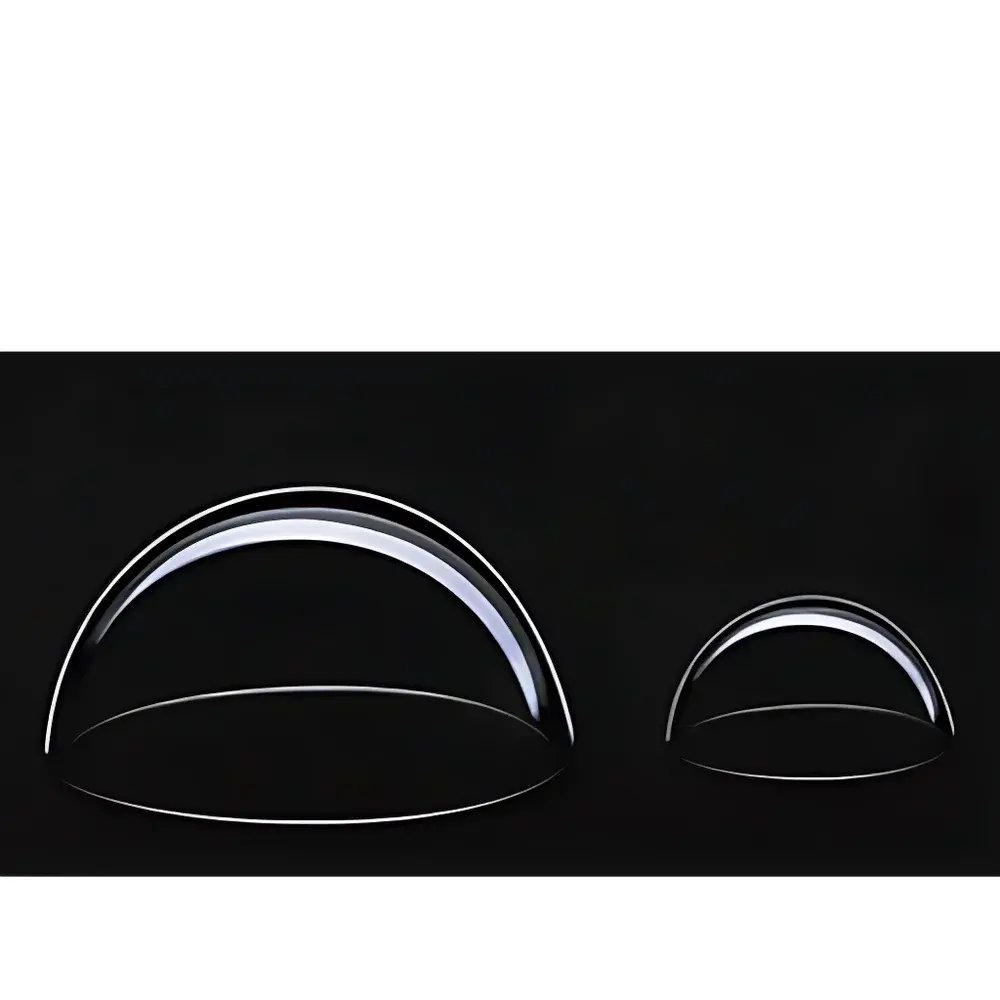
Meg1066 Fused Silica Hemispherical Dome Window
| Brand | MiXran |
|---|---|
| Model | Meg1066 |
| Material | High-Purity Fused Silica (SiO₂) |
| Transmission Range | 190–2500 nm |
| Surface Quality | 20–10 scratch-dig |
| Surface Flatness | λ/4 @ 633 nm (base flange side) |
| Coating | Optional AR coating (R<0.25% per surface, 240–700 nm or 1000–1600 nm) |
| Operating Temperature | –60 °C to +600 °C |
| Thermal Expansion Coefficient | 5.5 × 10⁻⁷ /°C |
| Density | 2.2 g/cm³ |
| Refractive Index | 1.458 @ 587.6 nm |
Overview
The Meg1066 Fused Silica Hemispherical Dome Window is a precision optical component engineered for demanding applications requiring broad spectral transmission, exceptional thermal stability, and high laser damage threshold. Constructed from synthetic fused silica with ultra-low hydroxyl content (<1 ppm), it exhibits near-zero fluorescence, minimal birefringence, and outstanding resistance to UV radiation degradation. Its hemispherical geometry provides uniform optical path length across the full field of view—critical for collimated beam exit/entry in vacuum-compatible laser housings, infrared sensor enclosures, and high-temperature process monitoring systems. Unlike plano-convex alternatives, the dome design eliminates focal shift under thermal gradient conditions and minimizes reflection-induced wavefront distortion at normal incidence.
Key Features
- Optical-grade fused silica substrate meeting ASTM F795 and ISO 10110-3 standards for homogeneity and striae control
- Hemispherical profile with precision-ground and polished outer surface (RMS roughness < 0.5 nm)
- Base flange side lapped to λ/4 flatness (measured at 633 nm HeNe wavelength) for reliable mechanical mounting and vacuum sealing
- Thermal shock resistance validated per MIL-STD-810G Method 503.5 (10 thermal cycles between –55 °C and +500 °C with no delamination or fracture)
- Available in four standard diameters (25 mm, 50 mm, 75 mm, 100 mm), each with proportional height and wall thickness optimized for structural integrity under differential pressure up to 1 bar (vacuum-rated)
- Optional broadband anti-reflection coatings deposited via ion-assisted e-beam evaporation; certified per ISO 9211-3 for adhesion, durability, and environmental stability
Sample Compatibility & Compliance
The Meg1066 dome is compatible with vacuum environments down to 1×10⁻⁷ mbar and inert gas purged enclosures. Its low outgassing rate (<1.0×10⁻¹² g/cm²·s for H₂O and CO₂, per ASTM E595) ensures suitability for ultra-high-vacuum (UHV) optical benches and space-qualified instrumentation. All units undergo batch-certified interferometric inspection and receive individual test reports documenting transmitted wavefront error (TWE), surface figure (Zernike coefficients up to n=12), and spectral transmittance curves (200–2500 nm). The component complies with RoHS 2015/863/EU and meets material traceability requirements per AS9100D for aerospace OEM integration.
Software & Data Management
While the Meg1066 is a passive optical element, its performance integration into larger systems benefits from standardized metrology data exchange. Each unit ships with a digital calibration certificate in PDF and XML format, containing NIST-traceable measurement metadata aligned with ISO/IEC 17025:2017 reporting requirements. Spectral transmittance datasets are provided in ASCII format compatible with Zemax OpticStudio, CODE V, and FRED optical design platforms. For GMP/GLP-regulated facilities, optional audit-ready documentation packages include raw interferogram exports, coating spectral scan logs, and environmental test chamber certification records.
Applications
- Laser system output windows for excimer (193 nm), Nd:YAG (1064 nm), and CO₂ (10.6 µm) sources
- Protective domes for FTIR spectrometer detectors and thermal imaging optics operating in corrosive industrial atmospheres
- Viewports in high-temperature reaction chambers (e.g., CVD, ALD, plasma etch tools) where quartz compatibility with halogen chemistries is essential
- UV-curable resin encapsulation molds requiring precise refractive index matching and low autofluorescence
- Calibration reference elements in radiometry labs accredited to ISO/IEC 17025 for spectral irradiance transfer standards
FAQ
Is the Meg1066 dome suitable for use with pulsed UV lasers?
Yes—its high LIDT (>15 J/cm² at 193 nm, 20 ns pulse width, 20 Hz repetition rate, measured per ISO 21254-2) makes it appropriate for excimer and frequency-quadrupled Nd:YAG systems.
Can custom AR coatings be specified beyond the standard bands?
Yes—custom multilayer designs for 157 nm (F₂), 13.5 nm (EUV), or dual-band (e.g., 355/1064 nm) are available upon request with minimum order quantity of 5 units.
What mounting interface options are supported?
Standard units feature a precision-ground cylindrical base with ±0.005 mm diameter tolerance; O-ring grooves (per ISO 3601-1) and threaded flange variants (CF-35, KF-40) are offered as build-to-order configurations.
Does the dome require periodic recalibration?
No—fused silica is a stable passive material; however, users operating in high-radiation or abrasive particulate environments are advised to perform annual visual and interferometric inspection per IEC 61223-3-5 protocols.



