
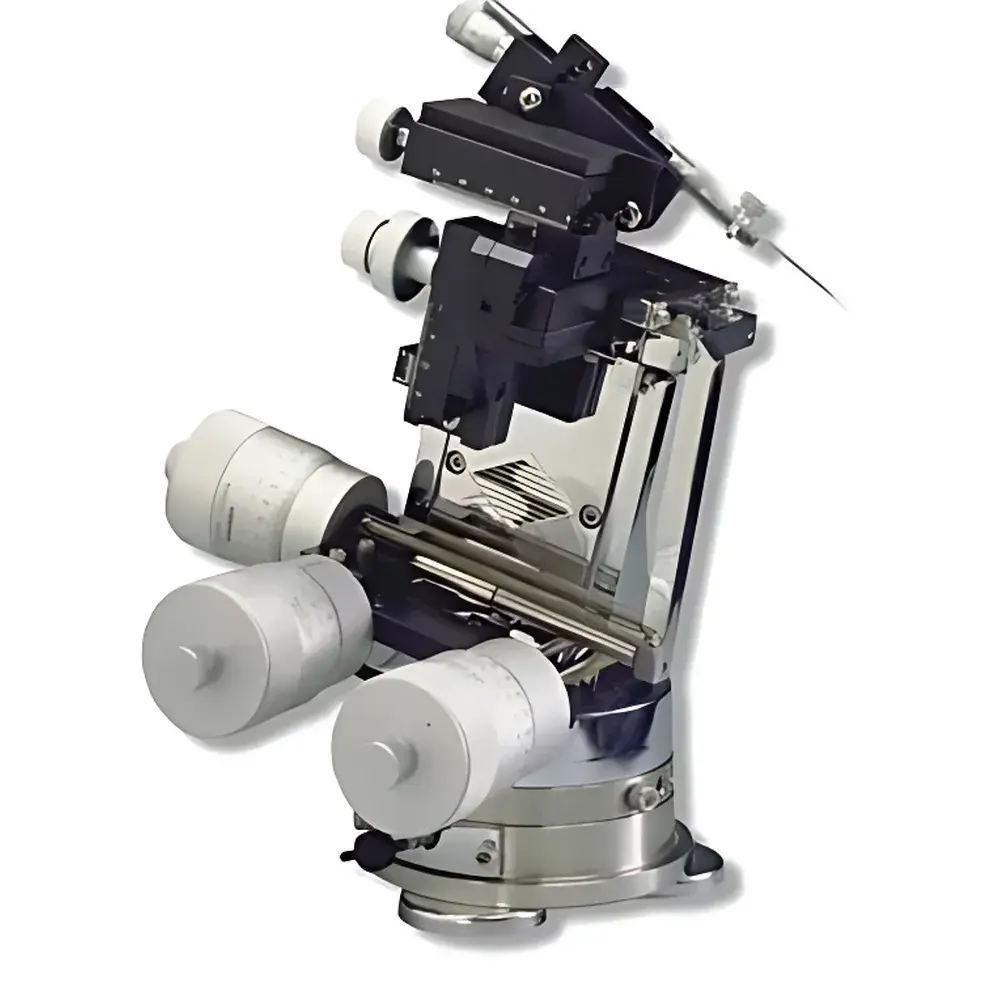
Sutter MP85 / MP285 / MP-33 Micromanipulator
| Brand | Sutter |
|---|---|
| Origin | USA |
| Model | MP85 / MP285 / MP-33 |
| Type | Electrochemical Sample Manipulator |
| Axes | 3–4 axis (manual or motorized) |
| Positioning Resolution | Down to 62.5 nm (MP-285/MP-225), 0.2 µm (MP-85 ultra-fine), 0.01 mm (MP-33 fine), 0.1 mm (coarse) |
| Drift | <10 nm/h (MP-285, 24°C), <1 µm/h (MPC-325-2/MPC-385-2) |
| Travel Range | Up to 25 mm (X/Y/Z/oblique), 1 inch (MP-285), 37 × 20 × 20 mm (MP-33 coarse) |
| Control Interface | RS-232 serial, software-driven (XenoWorks™ compatible) |
| Compliance | Designed for GLP/GMP-aligned electrophysiology and electrochemical microelectrode positioning |
Overview
The Sutter MP85, MP285, and MP-33 micromanipulators are precision-engineered electromechanical positioning systems designed for high-stability, sub-micron manipulation of microelectrodes, patch pipettes, stimulating electrodes, and other microscale probes in electrochemical, electrophysiological, and single-cell recording applications. These instruments operate on the principle of piezoelectric-assisted or stepper-motor-driven mechanical translation, enabling deterministic control over X, Y, Z, and optionally oblique (θ) axes with calibrated resolution and thermal drift compensation. The MP-285 and its variants (e.g., MP-225 in MPC-325-2) utilize closed-loop stepper motors with optical encoders for real-time positional feedback; the MP-85 integrates dual-resolution manual adjustment (coarse + ultra-fine); while the MP-33 serves as a cost-optimized, fully manual platform for routine microinjection or bath-applied stimulation protocols. All models are engineered for integration into Faraday-caged electrophysiology rigs and comply with electromagnetic compatibility (EMC) requirements per IEC 61326-1 for laboratory instrumentation.
Key Features
- Multi-tier resolution architecture: MP-285 offers 0.2 µm coarse and 0.04 µm fine positioning; MP-85 delivers 0.1 mm coarse, 0.01 mm fine, and 0.2 µm ultra-fine adjustment; MP-33 provides 0.1 mm coarse and 0.01 mm fine travel.
- Thermal stability: MP-285 achieves <10 nm/h positional drift at 24°C ambient; MPC-325-2 and MPC-385-2 maintain <1 µm/h drift over extended recordings—critical for long-duration voltage-clamp or amperometric experiments.
- Software-integrated motion control: RS-232 interface enables direct command via XenoWorks™, PatchMaster, or custom LabVIEW/Python scripts; supports absolute/relative coordinate modes, continuous or stepwise movement, and programmable “return-to-home” sequences.
- Modular expandability: MPC-385-2 and MPC-325-2 configurations integrate two synchronized MP-285 or MP-225 manipulators with an ROE-200 orientation encoder and MPC-200 controller—enabling dual-electrode independent positioning for paired whole-cell recordings or differential amperometry.
- Ergonomic mechanical design: All units feature hardened stainless-steel lead screws, low-backlash gear trains, and vibration-damped base plates; MP-285 includes dynamic speed scaling and real-time µm-position display on front-panel LCD.
Sample Compatibility & Compliance
These micromanipulators are validated for use with borosilicate, aluminosilicate, and quartz glass capillaries (OD 1.0–2.0 mm), metal microelectrodes (Pt/Ir, tungsten, stainless steel), and insulated coaxial probes used in cyclic voltammetry, fast-scan cyclic voltammetry (FSCV), and sharp-electrode intracellular recording. Mechanical tolerances accommodate standard 3.5 mm or 5.0 mm electrode holders (e.g., Sutter MO-103, Warner Instruments MHW-3). The systems conform to ISO 13485 design control principles for research-grade medical device accessories and support audit-ready documentation for GLP-compliant neuropharmacology or toxicology studies. While not FDA-cleared as a medical device, their performance metrics meet ASTM E2917-21 standards for positional repeatability in microscale laboratory instrumentation.
Software & Data Management
XenoWorks™ v6.x (included) provides native driver support for all three models, enabling scriptable trajectory generation, time-synchronized position logging (CSV export), and hardware-triggered motion events (TTL input/output). Positional metadata—including timestamp, axis coordinates, motion mode (step/continuous), and velocity—is embedded in exported electrophysiology data files (e.g., ABF, HDF5) when interfaced with Axon Digidata or HEKA PatchMaster acquisition systems. Audit trails record all parameter changes, user logins, and firmware updates—supporting 21 CFR Part 11 compliance when deployed with electronic signature-enabled LIMS environments. Firmware is field-upgradable via USB-to-serial adapter; configuration files (.xwp) are encrypted and version-controlled.
Applications
- Single-cell electrochemical detection: Precise positioning of carbon-fiber microelectrodes for real-time dopamine or serotonin monitoring in brain slices or cultured neurons.
- Dual-patch clamp experiments: Independent XYZ+θ control of two patch pipettes using MPC-385-2 to achieve simultaneous whole-cell recordings from synaptically coupled neurons.
- Micropipette-based iontophoresis: MP-33’s manual coarse/fine adjustment enables rapid repositioning during pharmacological challenge protocols without software dependency.
- Microelectrode array (MEA) calibration: Sub-micron alignment of reference electrodes relative to planar MEA substrates for impedance spectroscopy validation.
- Extracellular single-unit recording: Stable placement of tungsten or glass-coated platinum electrodes in vivo or in acute tissue preparations with minimal thermal drift artifact.
FAQ
What is the difference between MP-285 and MP-225 in MPC-325-2 vs. MPC-385-2?
The MP-225 is a lower-cost variant of the MP-285 with reduced maximum speed (1.0 mm/sec vs. 2.0 mm/sec) and slightly higher drift (<500 nm/h vs. <10 nm/h), but identical 62.5 nm/step resolution and RS-232 command set.
Can MP-85 be used for automated patch clamping?
No—MP-85 lacks motorized actuation and real-time position feedback; it is intended for manual coarse/fine adjustments during setup or low-throughput experiments where software control is unnecessary.
Is XenoWorks™ compatible with macOS or Linux?
XenoWorks™ is Windows-only (Windows 10/11, 64-bit); however, cross-platform control is achievable via Python pySerial libraries using documented ASCII command protocols.
Do these manipulators require external vibration isolation?
Yes—optimal sub-100 nm stability requires mounting on pneumatic or active vibration isolation tables (e.g., TMC MicroG or Kinetic Systems), especially for >10-minute recordings in noisy lab environments.
What maintenance is required for long-term accuracy?
Annual recalibration of optical encoders (MP-285/MP-225) and lubrication of lead screws (MP-33/MP-85) per Sutter Technical Bulletin TB-MAN-027; no user-serviceable components in stepper motor assemblies.
Related Products






