
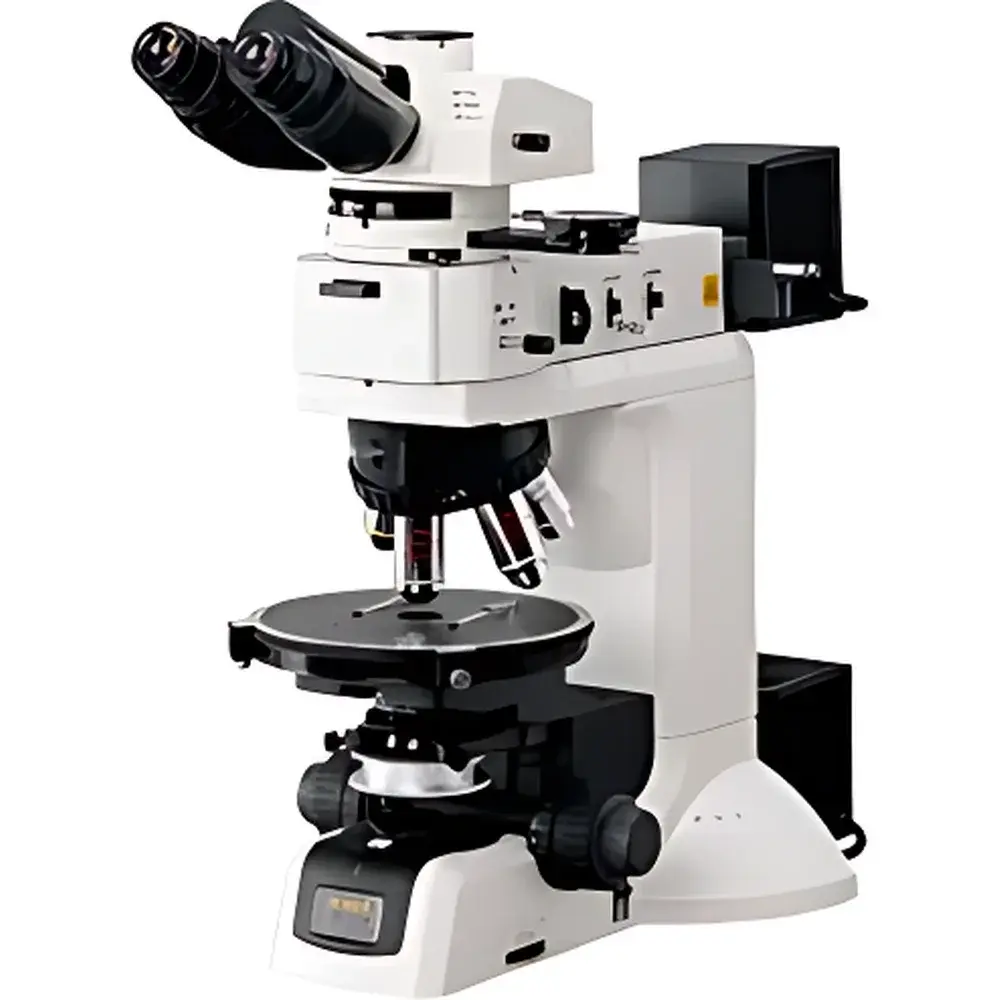
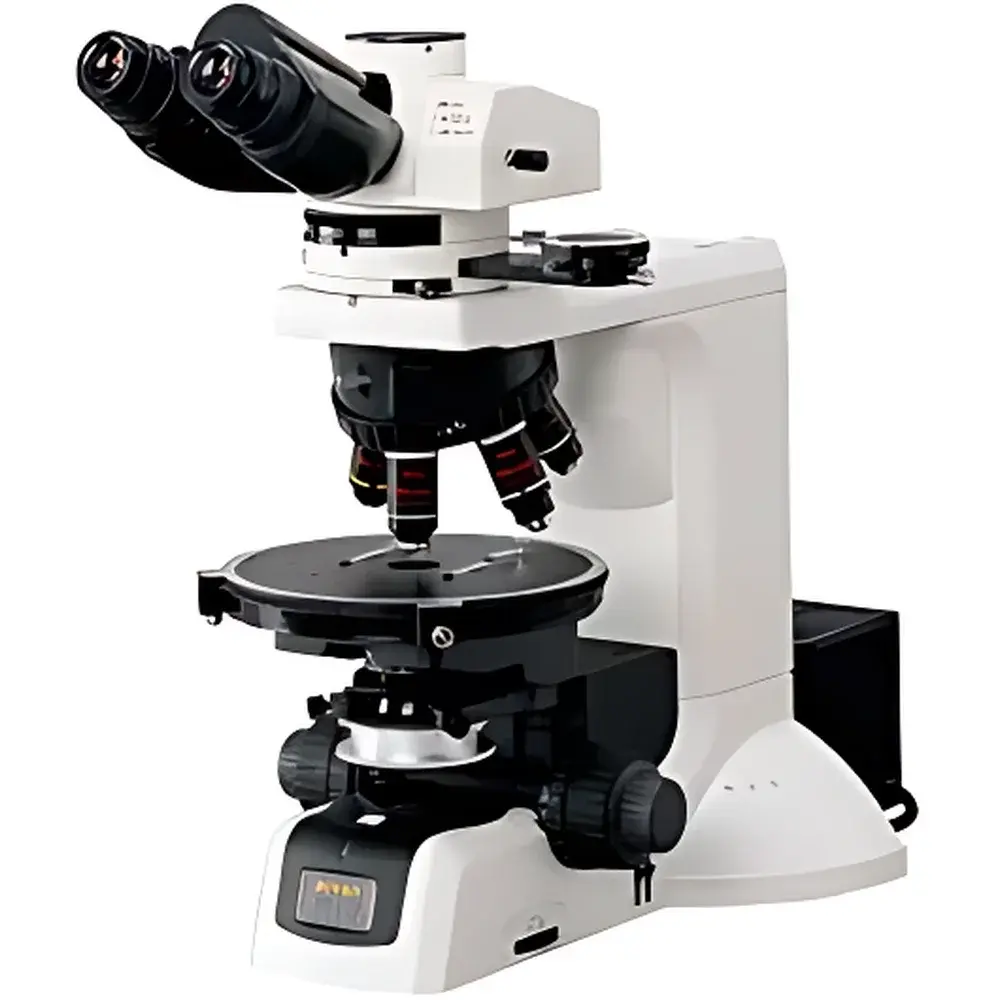
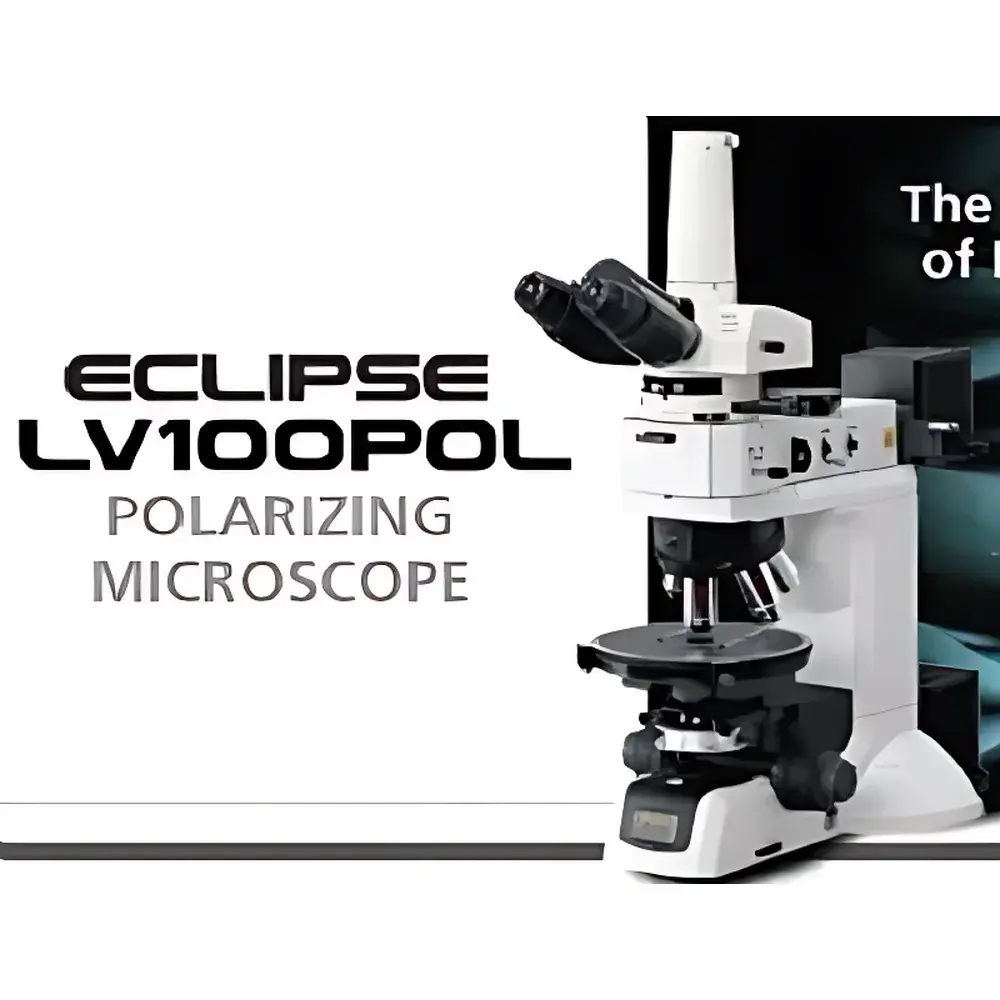
Nikon LV100POL Advanced Research Polarizing Microscope
| Brand | Nikon |
|---|---|
| Origin | Japan |
| Model | LV100POL |
| Optical System | CFI60 Infinity-Corrected |
| Illumination | 12 V / 50 W Halogen (Transmitted & Reflected) |
| Condenser | Stress-Free Achromatic, NA 0.9 |
| Stage | Precision 360° Rotatable Circular Stage with 1° Graduation and 45° Audible Click Stops |
| Objective Turret | Centerable Five-Position Nosepiece with DIN Slots |
| Analyzer | 360° Rotatable, 0.1° Graduation |
| Bertrand Lens | Built-in, Focusing and Centering Adjustable |
| Compensators | Standard λ/4 Gypsum and Mica Plates |
| Polarizer | Fixed in Condenser Mount with Angular Scale |
| Eyepieces | 10× CM Widefield (22 mm FOV) with Crosshair and Micrometer Scale |
| Focus Mechanism | Coaxial Coarse/Fine Drive |
| Weight | ~17 kg (Trinocular Configuration) |
| Power Consumption | 75 W (1.2 A) |
Overview
The Nikon LV100POL is an advanced research-grade polarizing microscope engineered for high-fidelity birefringence analysis across geoscience, petrology, polymer science, liquid crystal characterization, and pharmaceutical crystallinity assessment. It operates on the fundamental principles of polarization contrast microscopy—utilizing orthogonal linear polarizers (polarizer and analyzer), stress-free optical components, and precise retardation control to quantify anisotropic optical properties such as birefringence magnitude, optic axis orientation, and extinction angles. Its rigid mechanical architecture—engineered with doubled structural stiffness over prior generations—minimizes vibration-induced image drift during long-duration quantitative observations or time-lapse acquisition. The CFI60 infinity-corrected optical system delivers exceptional resolution and flatness across the full field of view, enabling accurate digital imaging and quantitative photometric measurement without peripheral distortion.
Key Features
- Enhanced mechanical stability: Doubled rigidity in base and stand design ensures minimal thermal drift and vibration transmission—critical for high-magnification interference figure acquisition and long-exposure polarized imaging.
- CFI60 optical platform: Combines high numerical aperture (up to NA 0.9 condenser) with extended working distance, supporting both cover-slip-corrected (CFI P Achromat) and cover-slip-free (CFI LU Plan Fluor EPI P) specimen configurations.
- Uniform illumination system: Proprietary Nikon Köhler-style compound lens (fly’s eye) collector maximizes luminous efficiency from the 12 V / 50 W halogen source—delivering brighter, more homogeneous illumination than conventional 100 W systems, with reduced thermal load on specimens.
- Precision polarizing optics: Fixed polarizer mounted at condenser base with angular scale; 360° rotatable analyzer with 0.1° vernier readout; built-in centerable and focus-adjustable Bertrand lens for undistorted conoscopic observation and interference pattern capture.
- Modular stage and turret: 360° graduated circular stage with audible 45° detents and fine-positioning auxiliary X–Y mechanical stage (35 × 25 mm travel, 0.1 mm scale); centerable five-objective nosepiece with DIN-standard slots compatible with third-party compensators and analyzers.
- Dual-mode illumination capability: Seamless transition between transmitted-light polarized imaging and reflected-light polarized observation via LV-UEPI epi-illuminator—enabling birefringence analysis of opaque, polished, or metallurgically prepared samples without reconfiguration.
Sample Compatibility & Compliance
The LV100POL accommodates standard 24 × 50 mm and 46 × 28 mm thin sections, as well as bulk mineral mounts, polymer films, liquid crystal cells, and pharmaceutical tablet cross-sections. Its stress-free objective and condenser optics comply with ISO 10934-1 (Microscopy — Nomenclature of components for polarizing microscopes) and support ASTM D4123 (Standard Test Method for Birefringence of Plastics). All optical glass elements in the CFI LU Plan Fluor EPI P series are lead- and arsenic-free, conforming to RoHS Directive 2011/65/EU. The system supports GLP-compliant documentation workflows when integrated with Nikon NIS-Elements software, including audit-trail-enabled parameter logging per FDA 21 CFR Part 11 requirements.
Software & Data Management
When paired with Nikon NIS-Elements AR (Advanced Research) software, the LV100POL enables automated acquisition of interference figures, real-time birefringence quantification via retardation calibration curves, and multi-channel polarization state mapping. Software-controlled motorized analyzer rotation, stage positioning, and filter wheel integration allow for reproducible sequential imaging protocols. Image metadata—including polarizer/analyzer angles, exposure time, magnification, and compensator type—is embedded in TIFF and ND2 formats. Exported datasets are compatible with MATLAB, Python (via OpenCV and scikit-image), and commercial crystallographic analysis tools such as CrysTBox and JADE.
Applications
- Geological petrography: Quantitative identification of mineral assemblages, optical sign determination, and twinning analysis in thin sections.
- Polymer morphology: Mapping crystallinity distribution, spherulite size, and molecular orientation in extruded films and injection-molded parts.
- Liquid crystal device development: Characterization of director alignment, defect structures, and electro-optic switching behavior under controlled temperature and field conditions.
- Pharmaceutical solid-state analysis: Differentiation of polymorphic forms, hydrate/anhydrate states, and amorphous content in active pharmaceutical ingredients (APIs).
- Materials failure analysis: Detection of residual stress fields, grain boundary anisotropy, and phase transformations in heat-treated alloys and ceramics.
FAQ
What types of compensators are included with the LV100POL?
The system ships standard with a gypsum (λ/4) plate and a mica (λ) plate. Optional quartz wedge and Sénarmont compensators are supported via dedicated insertion slots in the intermediate tube.
Can the LV100POL perform differential interference contrast (DIC) imaging?
Yes—when equipped with the universal nosepiece option and Nikon DIC prism sets, the LV100POL supports quantitative DIC observation alongside polarized light modes.
Is the 50 W halogen source sufficient for high-NA oil-immersion objectives?
Yes—the optimized Köhler illumination path and high-efficiency collector deliver irradiance exceeding that of legacy 100 W systems at the specimen plane, even with 100× NA 1.25 oil objectives.
Does the microscope meet regulatory requirements for quality-controlled laboratories?
The LV100POL’s hardware design supports traceable calibration and repeatable measurement protocols. When used with NIS-Elements AR under validated SOPs, it fulfills key elements of ISO/IEC 17025 and USP for particulate and crystallinity testing.
How is stage stability ensured during high-magnification polarized observation?
The stage employs orthogonal steel roller bearing rails and precision-ground rotational bearings, achieving sub-arcminute wobble and >5 kg static load capacity—essential for stable interference figure acquisition at 1000× magnification.




