
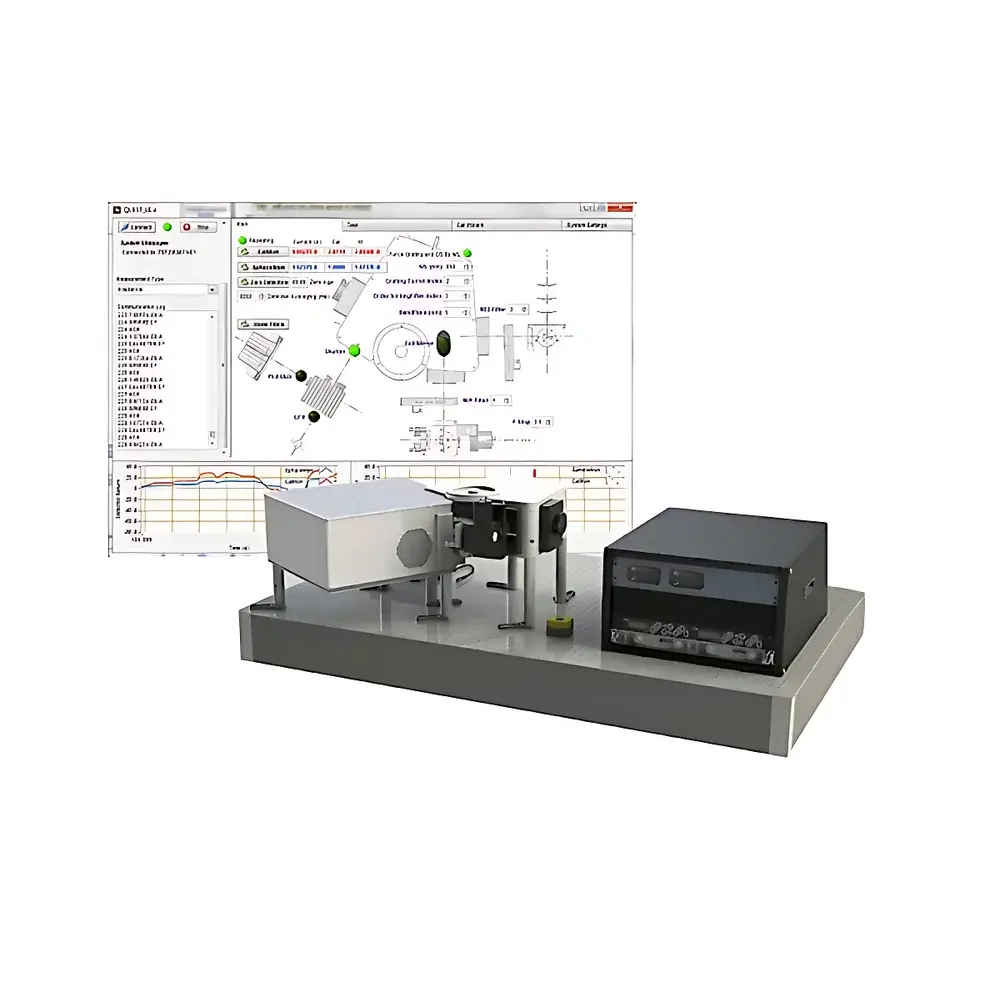
Labsphere QES Integrating Sphere Monochromatic Light Source
| Brand | Labsphere |
|---|---|
| Model | QES |
| Origin | USA |
| Type | Integrating Sphere-Based Monochromatic Light Source for Quantum Efficiency Testing |
| Measurement Mode | DC |
| Calibration Traceability | NIST-Traceable Spectral Irradiance and Radiance |
| Software Interface | SDK Available for Custom Test Sequence Development |
| Compliance Context | Designed to support ISO 15739, ISO 17850, and ASTM E2724-compliant QE characterization workflows |
| Key Applications | CMOS/CCD Image Sensor QE Mapping, Spectral Responsivity Validation, Pixel-Level Linearity Assessment, Module-Level Uniformity Analysis |
Overview
The Labsphere QES Integrating Sphere Monochromatic Light Source is a precision-engineered optical test instrument designed specifically for the quantitative spectral characterization of image sensors. It operates on the principle of controlled monochromatic illumination delivered via a high-stability broadband source coupled with a calibrated monochromator and integrated into a high-reflectance (≥99% BaSO₄-coated) integrating sphere. This architecture ensures spatially uniform, Lambertian emission across the output port—critical for eliminating angular dependence and enabling pixel-level quantum efficiency (QE) and spectral responsivity (SR) measurements without vignetting or field non-uniformity artifacts. The system delivers stable DC-mode irradiance over wavelength ranges spanning 350–1100 nm (standard configuration), covering the full silicon photodiode response region. Its NIST-traceable spectral irradiance and radiance calibration enables absolute QE determination in accordance with ISO 15739 (Digital Photography — Electronic Still Picture Imaging — Noise Measurements) and supports traceable validation under GLP/GMP-aligned sensor qualification protocols.
Key Features
- High-reflectance integrating sphere (≥99% reflectance at 400–1000 nm) with precisely engineered baffle geometry to minimize first-reflection non-uniformity
- Monochromator-coupled broadband source delivering discrete, narrowband (FWHM ≤ 5 nm) spectral outputs with <±0.2 nm wavelength repeatability
- DC-driven illumination mode optimized for low-noise, long-integration-time QE mapping—eliminating AC modulation artifacts common in pulsed systems
- NIST-traceable spectral irradiance calibration certificate provided per unit, including uncertainty budgets per wavelength point (k=2)
- Integrated thermal stabilization and feedback-controlled power regulation ensuring irradiance stability better than ±0.3% over 8-hour continuous operation
- Modular mechanical interface compatible with standard sensor probe stations (e.g., Cascade Microtech, MPI) and vacuum-compatible QE test chambers
Sample Compatibility & Compliance
The QES accommodates image sensor samples ranging from bare die (2×2 mm to 36×24 mm) to fully packaged modules (including lens-mounted configurations) via configurable aperture adapters and collimated beam options. It supports both front-side and back-side illuminated sensor architectures. All optical output metrics comply with the metrological requirements of ISO/IEC 17025-accredited laboratories. System design facilitates adherence to FDA 21 CFR Part 11 when paired with validated LabVIEW or Python-based control software featuring electronic audit trails, user access levels, and data integrity logging. Calibration documentation satisfies traceability requirements for ISO 9001:2015 and IATF 16949 quality management systems in automotive imaging supply chains.
Software & Data Management
A comprehensive SDK (C/C++, Python, and .NET APIs) is supplied for integration into custom test automation environments. The SDK provides low-level access to monochromator positioning, shutter control, power monitoring, and real-time irradiance readback via analog/digital I/O. Reference implementations include scripts for automated wavelength sweeps, multi-point uniformity mapping, and linearity ramp sequences compliant with ISO 17850 Annex B. Raw spectral irradiance data is exported in HDF5 format with embedded metadata (wavelength, FWHM, uncertainty, timestamp, calibration ID), ensuring interoperability with MATLAB, Python (NumPy/Pandas), and commercial metrology platforms such as Keysight PathWave or NI TestStand.
Applications
- Quantum efficiency mapping across full sensor active area—including corner-to-corner and row/column-specific analysis
- Spectral responsivity verification for RGB, NIR, and multispectral filter array (MFA) sensors
- Linearity assessment over 4–6 decades of exposure (from 10¹² to 10¹⁸ photons/cm²/s) using programmable neutral density staging
- Pixel defect identification via localized QE deviation analysis (ΔQE > 3σ from mean)
- Pre- and post-process validation of anti-reflective coating performance and microlens efficiency
- Reference standard deployment in inter-laboratory round-robin studies coordinated by JEDEC JC-70 or IEEE P2020 working groups
FAQ
Is the QES compatible with back-illuminated (BSI) sensors requiring near-infrared (NIR) illumination up to 1100 nm?
Yes—the standard tungsten-halogen source with quartz-transmission monochromator supports continuous output from 350 nm to 1100 nm; optional InGaAs-detected extended-range calibration packages are available for enhanced NIR accuracy.
Can the system be integrated into a Class 100 cleanroom environment?
All optical and mechanical components are constructed from non-outgassing, RoHS-compliant materials; optional stainless-steel housing and ESD-safe sphere coatings are available for semiconductor fab integration.
Does the NIST traceability cover both irradiance and radiance modes?
Yes—each unit ships with dual calibration certificates: one for collimated irradiance (W/m²/nm) at the output port plane, and another for directional radiance (W/sr·m²/nm) measured via calibrated imaging radiometer.
What level of spectral uniformity is guaranteed across the output aperture?
Spatial uniformity is specified as ±0.8% (1σ) over central 90% of the 50-mm output port, verified per ISO 13660 and reported in the factory acceptance test report.




