
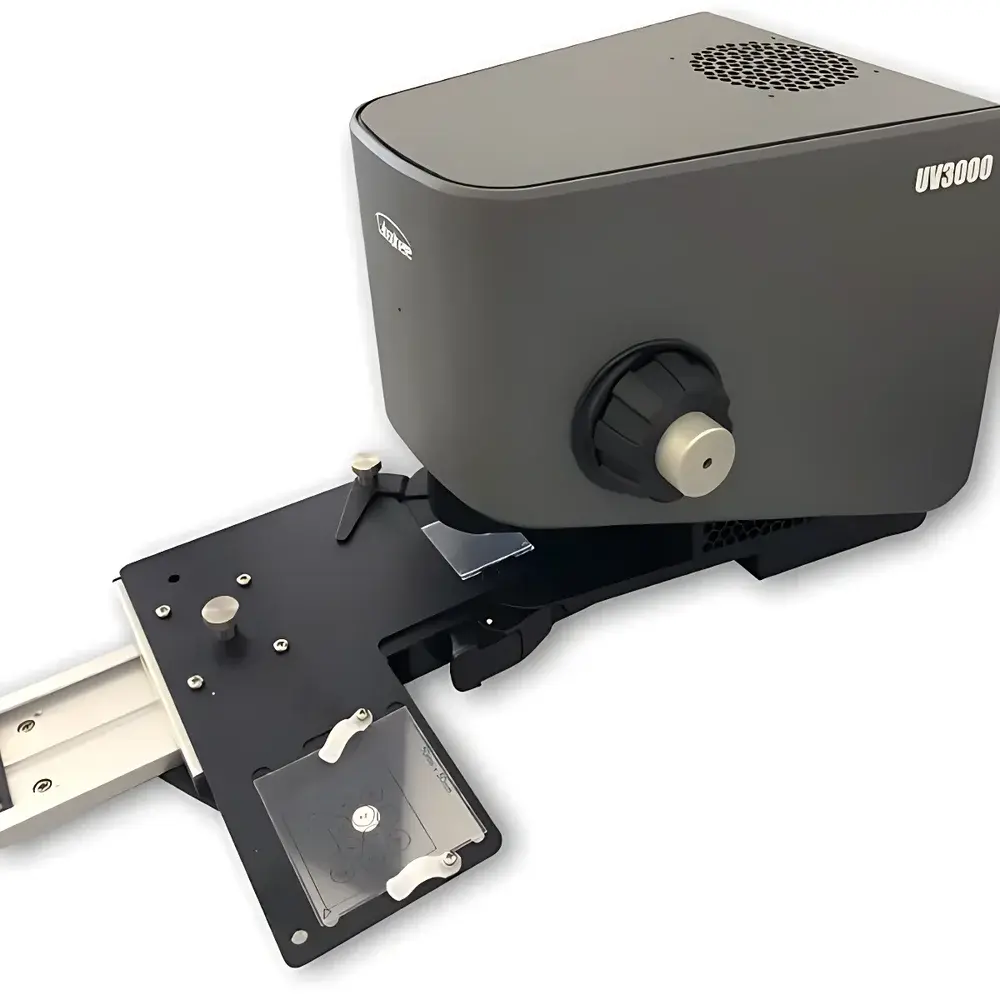
Labsphere UV3000S In Vitro SPF and HEVIS Photoprotection Analyzer
| Brand | Labsphere |
|---|---|
| Origin | USA |
| Model | UV 3000S |
| Wavelength Range | 290–500 nm |
| Wavelength Accuracy | ±1 nm |
| Wavelength Step | Adjustable (default 1 nm) |
| SPF Measurement Range | 0–50+ (in vitro) |
| Optical Density Dynamic Range | 3 AU |
| Compliance | ISO 24443:2021, ISO 24444:2019, COLIPA/CTFA In Vitro Guidelines, ASTM E2685 |
| Software Platform | .NET Framework®-based, Windows® 11 Compatible |
Overview
The Labsphere UV 3000S is a purpose-engineered in vitro photoprotection analyzer designed for quantitative spectral transmittance measurement of topical sunscreens and cosmetic formulations. It operates on the principle of double-beam UV–Vis spectrophotometry with integrated integrating sphere technology, enabling high-fidelity acquisition of absolute transmittance spectra across the biologically relevant 290–500 nm range—including UVB (290–320 nm), UVA (320–400 nm), and HEVIS (400–500 nm) bands. Unlike conventional single-beam systems, the UV 3000S employs real-time reference beam normalization to compensate for source drift, detector nonlinearity, and environmental fluctuations—ensuring traceable, reproducible SPF and UVA-PF (UVA Protection Factor) calculations per ISO 24443:2021 and ISO 24444:2019. Its optical architecture is optimized for low-stray-light performance and high photometric stability, critical for accurate determination of high-SPF products (≥SPF 50+) where absorbance values approach 3 AU.
Key Features
- Double-beam spectrophotometric engine with 150 mm diameter integrating sphere for uniform diffuse transmittance measurement
- Automated XYZ sample stage with motorized Z-height adjustment and repeatable 0.1 mm positioning accuracy
- Pre-aligned, NIST-traceable calibration suite including six certified bandpass standards (290, 305, 320, 340, 365, 400 nm) and neutral density filters
- Onboard performance verification protocol compliant with ISO/IEC 17025 requirements for instrument qualification
- Real-time spectral data acquisition at 1 nm resolution, with user-selectable step intervals (0.1–5 nm)
- Integrated HEVIS spectral weighting function (CIE S 026/E:2015) for quantitative visible light protection assessment
- GLP-compliant audit trail: full metadata logging (operator ID, timestamp, sample ID, instrument state, calibration history)
Sample Compatibility & Compliance
The UV 3000S accommodates standard 3.0 cm × 3.0 cm quartz or fused silica substrates coated with sunscreen films applied via defined spreader (e.g., 1.3 mg/cm² dose, 20 µm wet film thickness). Substrate options include synthetic skin mimics (e.g., PMMA plates), porcine ear skin, and reconstructed epidermis models—validated per OECD TG 439 and COLIPA Method 2011. All measurement protocols align with internationally harmonized regulatory frameworks: ISO 24443:2021 (in vitro SPF), ISO 24444:2019 (in vivo correlation), ASTM E2685 (instrument validation), and EU Commission Recommendation 2006/647/EC. Data output meets FDA 21 CFR Part 11 requirements for electronic records and signatures when deployed in validated environments.
Software & Data Management
The UV 3000S Control Suite is a Windows® 11-native application built on Microsoft .NET Framework®, featuring role-based access control, encrypted local database storage (SQL Server Compact), and automated report generation in PDF, CSV, and XML formats. Raw spectral data (.spc), processed SPF/UVA-PF values, and intermediate calculation matrices (e.g., weighted transmittance integrals, critical wavelength λc) are archived with SHA-256 checksums. The software supports batch processing of up to 96 samples per session, with configurable pass/fail thresholds against internal SOPs. Audit logs record every parameter change, report export, and calibration event—enabling full retrospective traceability required under GLP and GMP quality systems.
Applications
- Regulatory submission support for SPF 50+ labeling claims in EU, US, Australia, and ASEAN markets
- Formulation optimization: quantifying UV filter synergism, photostability degradation kinetics (via time-resolved transmittance), and film uniformity effects on UVA-PF
- HEVIS protection index (HPI) development for blue-light blocking cosmetics and medical device coatings
- Reference material certification and inter-laboratory comparison studies
- QC release testing of bulk actives and finished dosage forms under ISO 17025-accredited conditions
FAQ
Does the UV 3000S require annual factory recalibration?
No—its self-validation module enables daily performance checks using onboard standards; formal recalibration is recommended every 12 months or after major optical component service.
Can it measure SPF on human skin in vivo?
No—the UV 3000S is strictly an in vitro platform; in vivo SPF determination requires clinical protocols per ISO 24444 and is outside its scope.
Is the software compatible with LIMS integration?
Yes—via standardized RESTful API endpoints supporting HL7 and ASTM E1394 message structures for seamless laboratory information management system synchronization.
What substrate types are validated for UVA-PF reporting?
PMMA plates (ISO 24443 Annex A) and pigmented silicone substrates (ISO 24444 Annex B) are fully supported; raw spectral data allows post-hoc reprocessing if new substrate models emerge.
How does the system handle sample surface roughness artifacts?
The software applies Mie scattering correction algorithms derived from substrate-specific baseline transmittance modeling, minimizing bias in UVA-PF estimation caused by topographic heterogeneity.




