
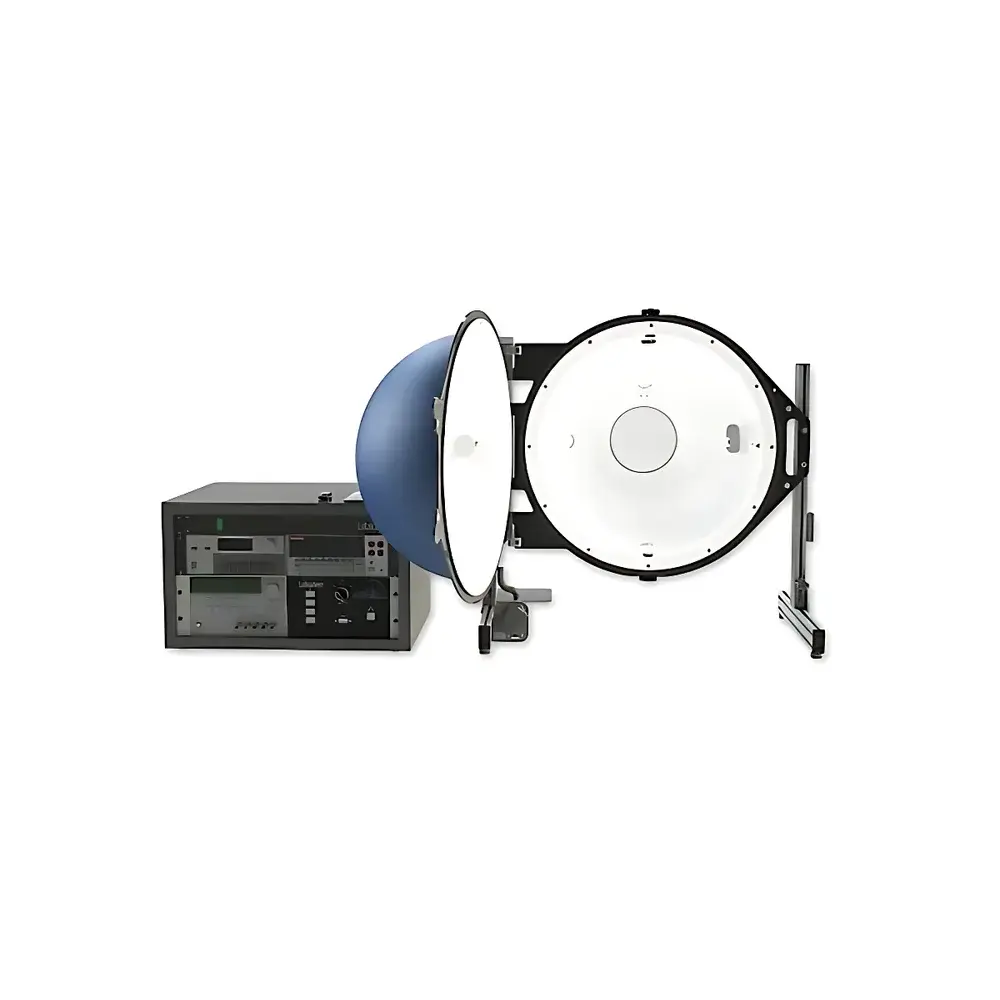
Labsphere Illumia Pro3 LED Optical, Thermal & Electrical Characterization System
| Brand | Labsphere |
|---|---|
| Origin | USA |
| Model | Illumia Pro3 |
| Sphere Diameter | 50 cm |
| Spectral Range (Calibrated) | 350–1000 nm |
| Wavelength Accuracy | ±0.3 nm |
| Integration Time | 40 µs – 5 s |
| Measurement Geometry | 2π |
| Coating | Spectralect® White Diffuse Reflectance Coating |
| Software | Integral™ v5.x (with Temperature, Current & Voltage Control, Real-Time LIVT Synchronization, and GLP-Compliant Data Logging) |
Overview
The Labsphere Illumia Pro3 is a fully integrated optical, thermal, and electrical characterization system engineered for precision measurement and standardized evaluation of high-power LEDs under controlled thermal and electrical conditions. Built around a 50-cm-diameter integrating sphere coated with Labsphere’s proprietary Spectralect® diffuse white material (reflectance >98% from 350–1000 nm), the system implements a rigorously defined 2π measurement geometry compliant with IES LM-85, CIE 127, and ANSI/IES RP-16 standards. Its core measurement principle relies on calibrated spectral radiometry coupled with synchronized current–voltage–temperature–luminous flux (LIVT) acquisition, enabling traceable determination of total spectral radiant flux (W), photometric luminous flux (lm), chromaticity coordinates (CIE 1931), dominant and peak wavelengths, CCT, CRI (Ra), and thermal roll-off behavior across operating junction temperatures. Unlike standalone spectroradiometers, the Illumia Pro3 embeds active thermal management—via integrated thermoelectric or liquid-cooled stage control—and programmable DC/pulsed current sourcing to replicate real-world drive conditions and quantify thermal resistance (Rth,j-s) and efficiency droop.
Key Features
- 50-cm integrating sphere with Spectralect® coating ensuring uniform spatial response and minimal angular dependency across 350–1000 nm
- High-fidelity, stray-light-corrected spectroradiometer with ±0.3 nm wavelength accuracy and 40 µs–5 s integration time range
- Full LM-85 compliance: supports single-pulse, continuous-pulse, and DC test modes with automated duty cycle and pulse width control
- Integrated thermal controller enabling precise junction temperature stabilization (–40°C to +150°C typical range, dependent on fixture)
- Programmable LED driver with four-quadrant operation, current resolution ≤0.1 mA, voltage resolution ≤1 mV
- Synchronized multi-parameter acquisition: simultaneous capture of spectral irradiance, forward voltage, forward current, and thermistor/RTD feedback
- Real-time LIV curve generation and dynamic thermal transient analysis (DTA) via Integral™ software
Sample Compatibility & Compliance
The Illumia Pro3 accommodates LED packages ranging from chip-on-board (COB) modules and mid-power SMDs to high-flux ceramic-based emitters (e.g., 1–50 W nominal power). Fixture adaptability includes standard MCPCB mounts, thermal interface options (e.g., indium foil, phase-change pads), and optional collimated beam ports for directional output assessment. All measurements adhere to ASTM E308 (computing photometric quantities from spectral data), ISO/CIE 11664 (colorimetry), and FDA-relevant documentation requirements for medical-grade lighting validation. Integral™ software supports 21 CFR Part 11-compliant audit trails, electronic signatures, and user-access-level permissions—enabling deployment in GMP/GLP-regulated R&D and production environments.
Software & Data Management
Integral™ v5.x provides a validated, menu-driven interface for test configuration, real-time visualization, and post-processing. Users define temperature ramps, current sweeps, and pulse profiles through intuitive wizards; all parameters are logged with timestamps, instrument metadata, and calibration certificate references. Raw spectral data is stored in vendor-neutral .jdx and .csv formats. Advanced analysis modules include thermal derating curves, efficiency vs. temperature (ηopt–Tj) modeling, chromaticity shift mapping (Δu’v’), and automated LM-85 report generation—including required tables for lumen maintenance, color shift, and thermal resistance. Data export supports integration with MATLAB, Python (via API), and enterprise LIMS platforms.
Applications
- R&D of high-power LED packages for automotive headlights, horticultural lighting, and UV-C disinfection systems
- Production line binning and reliability screening per JEDEC JESD22-A108 (temperature cycling) and TM-21 extrapolation
- Validation of thermal interface materials (TIMs) and heatsink performance under operational load
- Development of adaptive drivers with closed-loop thermal compensation algorithms
- Standards-compliant submission testing for ENERGY STAR, DesignLights Consortium (DLC), and IEC 62717
- Academic research in solid-state lighting physics, including carrier leakage and Auger recombination quantification
FAQ
Does the Illumia Pro3 support absolute spectral radiance calibration?
Yes—each system ships with NIST-traceable spectral irradiance calibration performed at three temperature points (25°C, 85°C, 125°C) using Labsphere’s primary-standard tungsten halogen source.
Can it measure pulsed LEDs with nanosecond-scale rise times?
The system supports pulse widths down to 100 µs with jitter <1 µs; sub-microsecond pulses require external triggering and are evaluated on a case-by-case basis with optional high-speed digitizer integration.
Is Integral™ software validated for regulated environments?
Integral™ v5.x includes IQ/OQ documentation, change control logs, and configurable audit trail settings meeting FDA 21 CFR Part 11 and EU Annex 11 requirements.
What sphere coatings are available beyond Spectralect®?
Custom coatings—including UV-enhanced barium sulfate (200–400 nm) and NIR-optimized polytetrafluoroethylene (PTFE)—are available as factory-installed options.
How is thermal contact resistance minimized during measurement?
The system includes calibrated thermal interface kits with known k-values, pressure-controlled mounting stages, and real-time thermistor placement verification protocols per JEDEC JESD51-14.



