
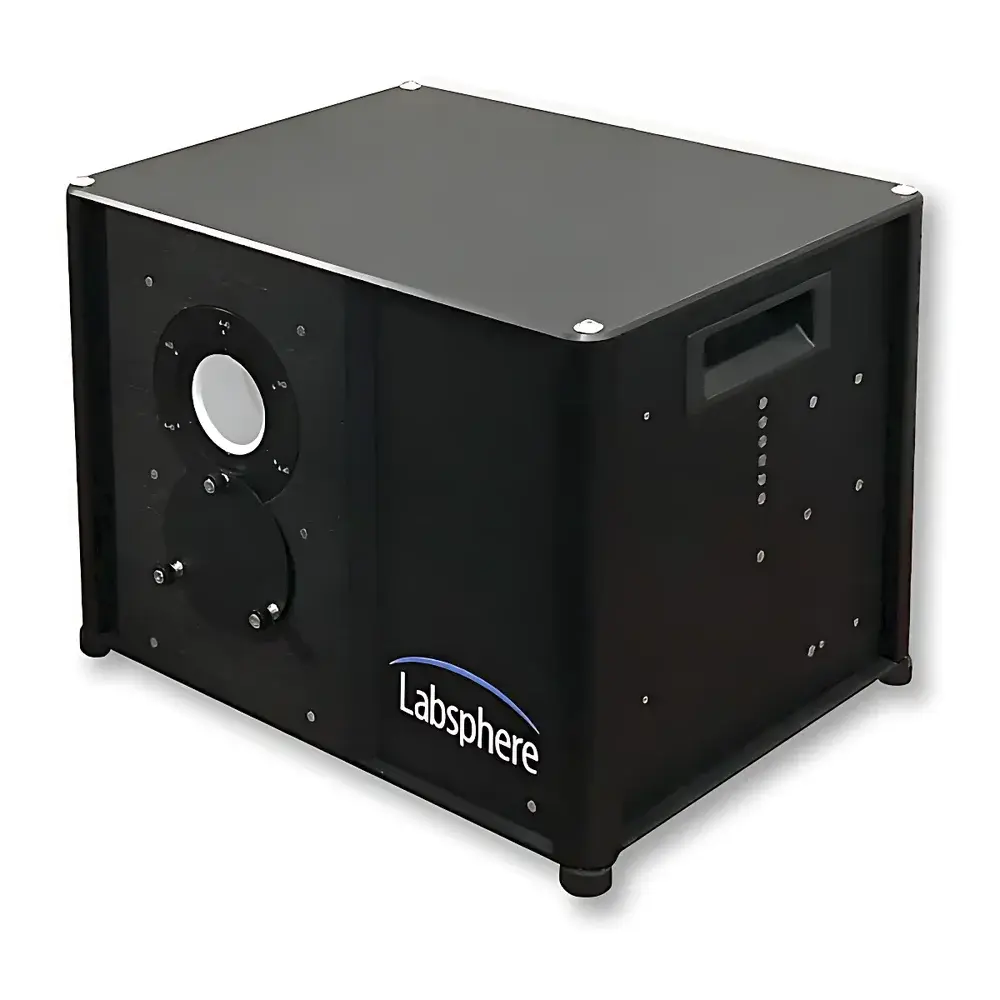
Labsphere Spectra-PT Adjustable Power Integrating Sphere Calibration Source
| Brand | Labsphere |
|---|---|
| Origin | USA |
| Model | Spectra-PT |
| Type | Integrating Sphere-Based Uniform Light Source for Photometric and Radiometric Calibration |
| Compliance | NIST-traceable calibration options available |
| Control Interface | Analog 0–10 V and digital RS-232/USB |
| Dynamic Range | >10⁶:1 (typical, dependent on detector and configuration) |
| Spectral Range | 350–1000 nm (standard halogen/tungsten-halogen lamp configuration) |
| Uniformity | ≥98% spatial uniformity over output port (per ISO 9050 and CIE S 023) |
| Stability | <0.2% RMS over 30 min (thermal + power supply stabilized) |
| Port Diameter | 4", 6", or 8" (configurable) |
| Lamp Life | ≥2000 h (rated at nominal voltage) |
Overview
The Labsphere Spectra-PT Adjustable Power Integrating Sphere Calibration Source is a precision-engineered, NIST-traceable uniform light source designed for photometric and radiometric calibration of imaging sensors, cameras, and optical detectors. Based on fundamental integrating sphere physics—where diffuse multiple reflections produce spatially uniform exitance—the Spectra-PT leverages a high-stability tungsten-halogen lamp coupled with a spectrally stable barium sulfate (BaSO₄)-coated sphere interior (reflectance >97% from 350–1000 nm). Its core function is to deliver repeatable, spatially homogeneous irradiance or radiance across its output port, enabling accurate flat-field correction, responsivity mapping, and spectral sensitivity characterization. Unlike fixed-output sources, the Spectra-PT integrates continuously variable DC power control, permitting precise intensity adjustment without spectral shift—critical for multi-level linearity testing and dynamic range validation per ISO 15739 (electronic still-picture imaging — noise measurements) and ASTM E308 (computing tristimulus values).
Key Features
- Adjustable optical power output via analog 0–10 V or digital RS-232/USB interface—enabling automated intensity sweeps and closed-loop system integration.
- Optimized BaSO₄-coated integrating sphere with ≥98% spatial uniformity (measured per CIE S 023 and ISO 9050 protocols) across standard 4″, 6″, or 8″ output ports.
- Thermally stabilized lamp housing and regulated DC power supply ensure <0.2% RMS temporal stability over 30 minutes—essential for low-noise metrology-grade measurements.
- Modular design supports optional accessories: calibrated reference detectors, spectral filters (e.g., narrowband VIS/NIR), and fiber-coupled configurations for remote illumination.
- Compliant with industry-standard calibration traceability frameworks; factory calibration certificates include uncertainty budgets aligned with ISO/IEC 17025 requirements.
Sample Compatibility & Compliance
The Spectra-PT is validated for use with CCD and CMOS image sensors, medical endoscopes, environmental light sensors, security cameras, and compact remote sensing platforms. Its broadband spectral output (350–1000 nm) supports both photopic (V(λ)) and radiometric applications—including luminance, illuminance, and spectral radiance measurements. The system meets mechanical and electrical safety requirements per UL 61010-1 and IEC 61010-1. When configured with optional NIST-traceable reference detectors, it supports GLP/GMP-compliant workflows requiring audit-ready calibration records and instrument qualification (IQ/OQ/PQ documentation packages available upon request). It is routinely deployed in laboratories adhering to ISO/IEC 17025, FDA 21 CFR Part 11 (with validated software add-ons), and automotive ADAS sensor verification standards (e.g., ISO 16505).
Software & Data Management
While the Spectra-PT operates as a standalone hardware source, it is fully compatible with third-party automation environments including LabVIEW, Python (PySerial, PyVISA), and MATLAB. Optional Labsphere LightMent™ software provides GUI-based power ramping, scheduled intensity profiles, real-time stability logging, and export of time-stamped irradiance datasets in CSV or HDF5 formats. All logged data includes metadata such as timestamp, setpoint voltage, ambient temperature, and serial-numbered calibration certificate references—supporting full traceability for ISO 17025 audits. Audit trail functionality (user login, parameter change history, calibration event logging) is available when integrated with enterprise LIMS or MES platforms.
Applications
- Flat-field correction and gain mapping of scientific and industrial cameras.
- Linearity and dynamic range characterization of photodetectors and imaging arrays per ISO 15739 and EMVA 1288.
- Correlated color temperature (CCT) and chromaticity uniformity testing for multi-spectral imaging systems.
- Validation of automatic exposure control (AEC) algorithms in automotive vision systems and surveillance hardware.
- Radiometric calibration of hyperspectral push-broom sensors used in Earth observation payloads.
- Performance verification of medical imaging optics, including rigid/flexible endoscopes per ISO 8600-3.
FAQ
Is the Spectra-PT suitable for absolute radiometric calibration?
Yes—when paired with a NIST-traceable reference detector mounted at the output port, the system enables absolute irradiance or radiance calibration with expanded uncertainties typically <3.5% (k=2) across the visible-NIR range.
Can the output spectrum be modified?
The base configuration uses a tungsten-halogen lamp (350–1000 nm). Optional bandpass, longpass, or neutral density filters can be installed to tailor spectral output; custom LED-based modules are available under separate model numbers (e.g., Spectra-LED series).
What maintenance is required?
Lamp replacement every ~2000 hours (monitored via internal hour meter); annual recalibration recommended for metrology-critical applications; sphere coating inspection advised every 2 years under continuous operation.
Does it support automated test sequences?
Yes—via RS-232 or USB, the Spectra-PT accepts SCPI-like commands for intensity setting, ramp rate control, and status polling, enabling seamless integration into ATE and camera test benches.
Is thermal drift compensated during long-duration tests?
The lamp housing incorporates passive thermal mass stabilization and active fan control; combined with regulated DC drive, this achieves <0.2% RMS stability over 30-minute intervals without external feedback loops.




