
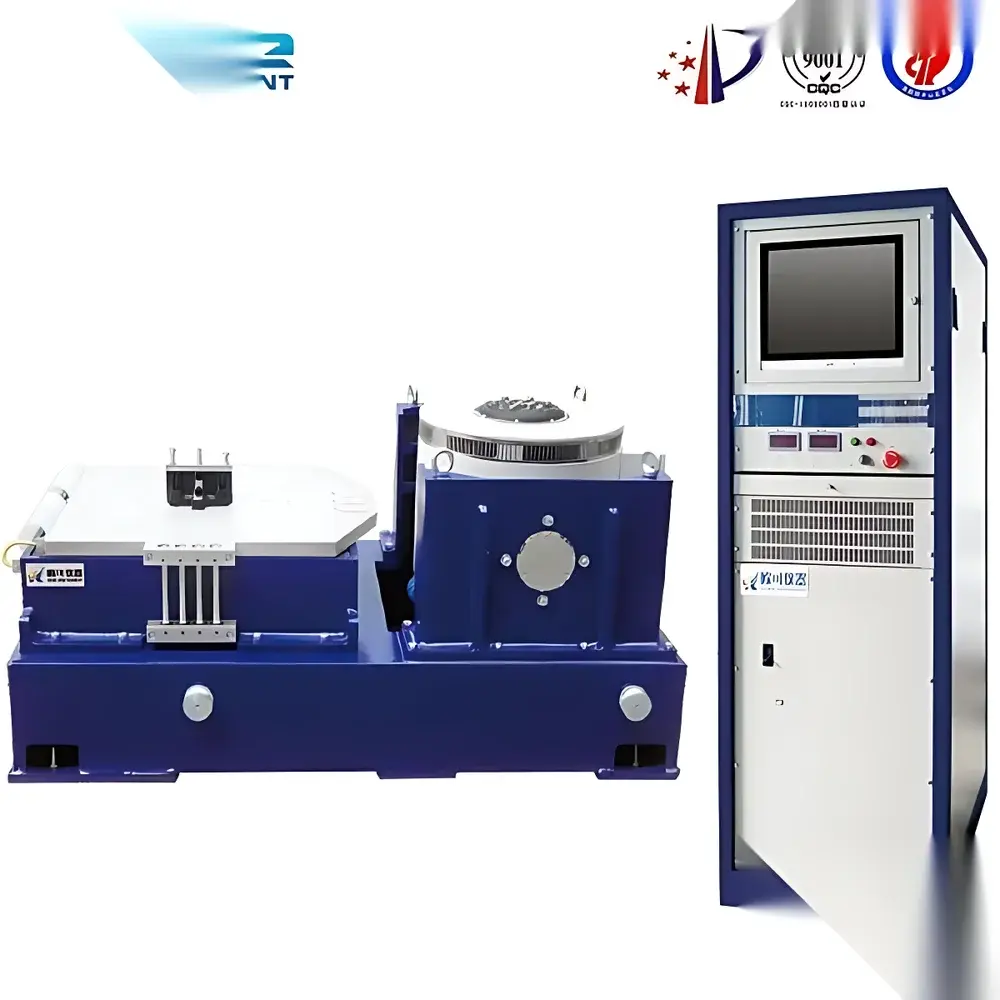
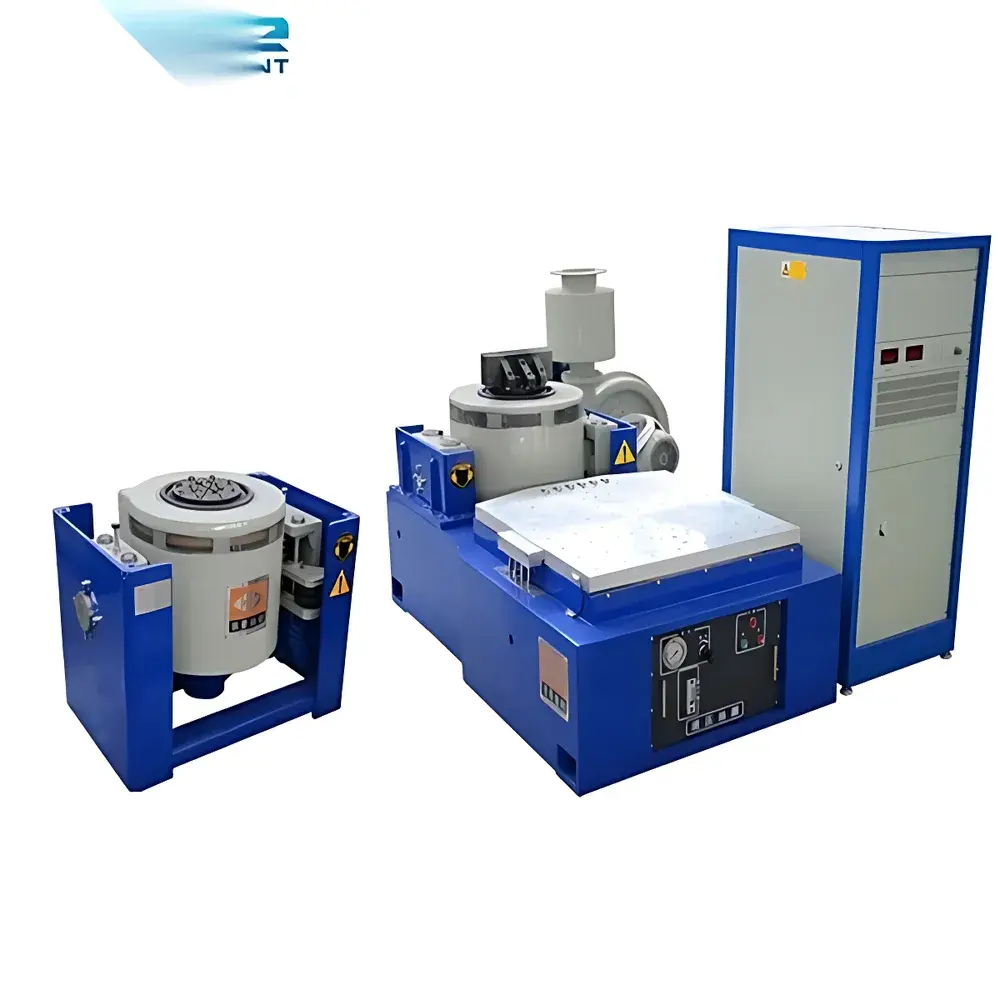
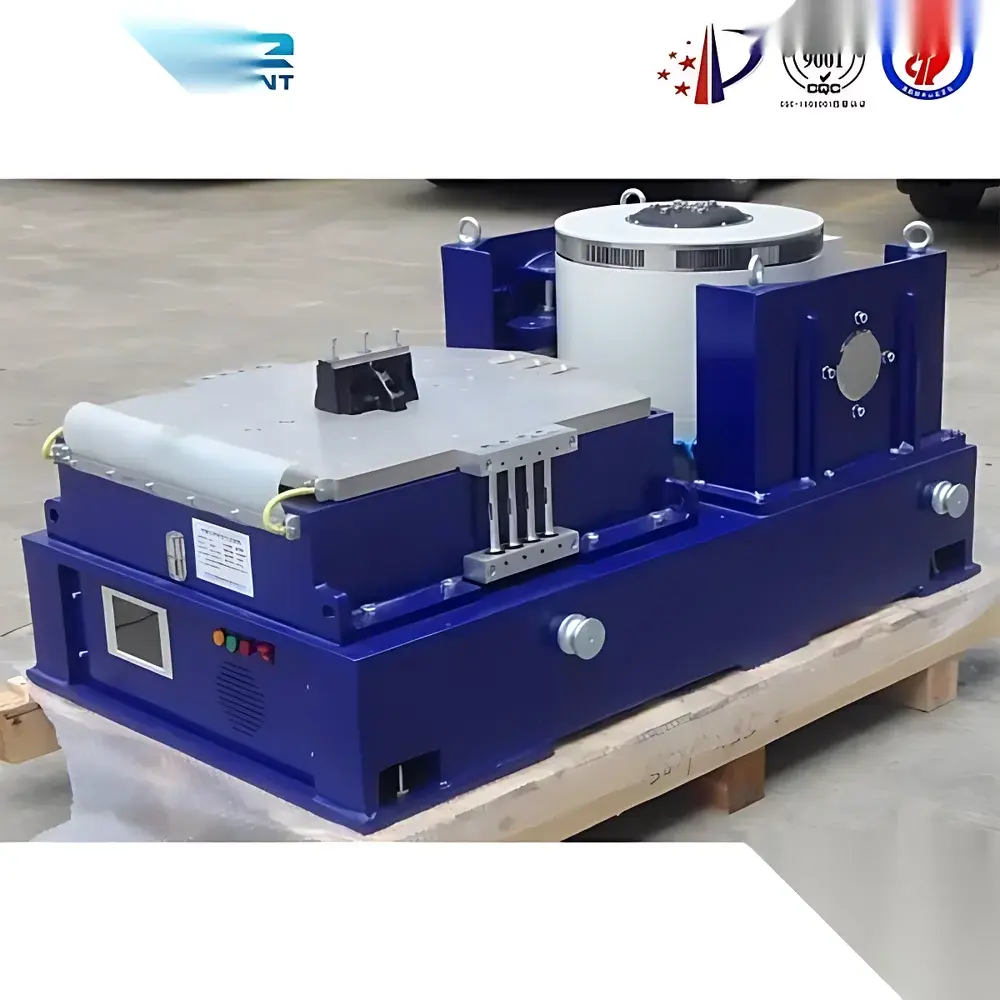
OK-ES-100 Three-Axis Random Vibration Testing System
| Brand | Other Brands |
|---|---|
| Origin | Imported |
| Manufacturer Type | Authorized Distributor |
| Price | USD 21,500 (FOB) |
| Max. Test Load | 100 kg |
| Frequency Range (Sweep & Fixed) | 5–70 Hz |
| Displacement Amplitude (No-Load) | 2–25 mm (Adjustable) |
| Vibration Mode | Orbital (Rotational) |
| Timer Range | 1–35,000 s |
| Table Surface Dimensions | 1000 × 1000 mm |
| Shaker Body Dimensions | 1000 × 1000 × 670 mm |
| Control Cabinet Dimensions | 420 × 300 × 750 mm |
| Power Rating | 1.5 kVA |
| Control Method | Programmable Logic Controller (PLC)-Based Sequencing |
| Display | Real-Time Time & Rotational Speed (RPM) |
| Operating Ambient Temperature | 0–45 °C |
| Compliance | ASTM D999, ASTM D4728, ISTA 3A/3E/3H, EN 1010-1, ANSI/UL 61010-1, ISO 13374-2 |
Overview
The OK-ES-100 Three-Axis Random Vibration Testing System is an electromechanically engineered shaker platform designed to replicate complex, multi-directional vibration profiles encountered during real-world logistics and transportation environments. Unlike uniaxial or dual-axis exciters, this system generates synchronized orbital (rotational) motion across three orthogonal axes—X, Y, and Z—enabling true 3D random vibration simulation in accordance with internationally recognized transport testing standards. Its core actuation architecture employs a balanced eccentric mass drive mechanism coupled with precision-machined bearing assemblies and high-torque servo-controlled motors, ensuring minimal phase lag and consistent energy transfer across the specified 5–70 Hz bandwidth. The system is calibrated for deterministic waveform reproduction and statistical stationarity in power spectral density (PSD) profiles, supporting both time-domain waveform replay and synthesized Gaussian random vibration spectra. It serves as a primary qualification tool for packaging integrity validation, electronic component ruggedness assessment, and mechanical fastener reliability screening under dynamic loading conditions.
Key Features
- Orbital vibration mode delivering simultaneous excitation in all three spatial axes without mechanical coupling artifacts
- Programmable PLC-based controller enabling repeatable test sequencing, dwell timing, and stepwise frequency sweeps
- Robust structural frame with reinforced baseplate and isolated cabinet mounting to minimize floor-transmitted interference
- High-load capacity design supporting up to 100 kg payload while maintaining amplitude linearity and phase coherence under off-center loading
- Real-time digital display of elapsed test duration and rotational speed (RPM), traceable via internal timestamping
- Integrated hardware-level safety interlocks including over-temperature cutoff, emergency stop circuitry, and mechanical limit switch protection
- Electromagnetic compatibility (EMC) optimized design meeting IEC 61000-6-2/6-4 immunity and emission requirements
Sample Compatibility & Compliance
The OK-ES-100 accommodates rigid and semi-rigid packaged units—including corrugated shipping containers, palletized loads, instrument enclosures, and automotive ECUs—on its 1000 × 1000 mm stainless-steel table surface. Fixturing options include T-slot rails, vacuum hold-down ports, and custom adapter plates for non-standard geometries. The system complies with multiple international transport simulation standards: ASTM D999 (vibration testing of shipping containers), ASTM D4728 (random vibration testing of unitized loads), ISTA 3A (general simulation for parcel delivery), ISTA 3E (engineered systems for consolidated shipments), and ISTA 3H (flat-panel display transport). It also satisfies regulatory prerequisites for CE marking under Machinery Directive 2006/42/EC and Low Voltage Directive 2014/35/EU, with documentation supporting GLP-compliant test record generation per ISO/IEC 17025:2017 Annex A.
Software & Data Management
While the base configuration utilizes embedded PLC logic for standalone operation, optional Ethernet-enabled firmware allows integration with host PC-based data acquisition platforms (e.g., LabVIEW, MATLAB, or custom Python scripts via Modbus TCP). All test parameters—including start/stop timestamps, executed frequency bands, displacement setpoints, and runtime anomalies—are logged internally with millisecond-resolution timestamps and retained in non-volatile memory for post-test audit. Audit trails comply with FDA 21 CFR Part 11 requirements when paired with validated user access controls and electronic signature modules. Export formats include CSV and XML for traceability in quality management systems (QMS) such as TrackWise or MasterControl.
Applications
- Validation of distribution packaging performance against shock and vibration-induced damage mechanisms
- Pre-shipment qualification of medical devices per ISO 11607-2 and FDA guidance on transit stability
- Reliability screening of printed circuit board assemblies (PCBAs) subjected to road transport spectra
- Structural fatigue analysis of consumer electronics housings and internal mounting brackets
- Verification of battery pack mechanical integrity under maritime container stacking and vessel roll-pitch-yaw dynamics
- Supporting Design for Logistics (DfL) initiatives by correlating lab-based vibration exposure with field failure modes
FAQ
Does the OK-ES-100 support true Gaussian random vibration synthesis?
Yes—it accepts user-defined PSD profiles imported via USB or network interface and executes closed-loop control using acceleration feedback from optional triaxial accelerometers.
Can the system be integrated into an existing environmental test chamber?
The shaker body and control cabinet are designed for external mounting; chamber integration requires coordination of thermal isolation, cable feedthroughs, and vibration decoupling per ISO 10816-3 guidelines.
Is calibration certification included with shipment?
A factory calibration report traceable to NIST standards is provided; ISO/IEC 17025-accredited third-party calibration is available as an add-on service.
What maintenance intervals are recommended for long-term operational stability?
Lubrication of drive bearings every 1,000 operating hours and annual verification of motor encoder alignment and amplifier gain stability are advised.
How is compliance with ISTA 3-series protocols verified during testing?
Test profiles are preloaded per ISTA specification tables; real-time spectrum analysis confirms PSD tolerance band adherence within ±1.5 dB across the 5–70 Hz range.



