
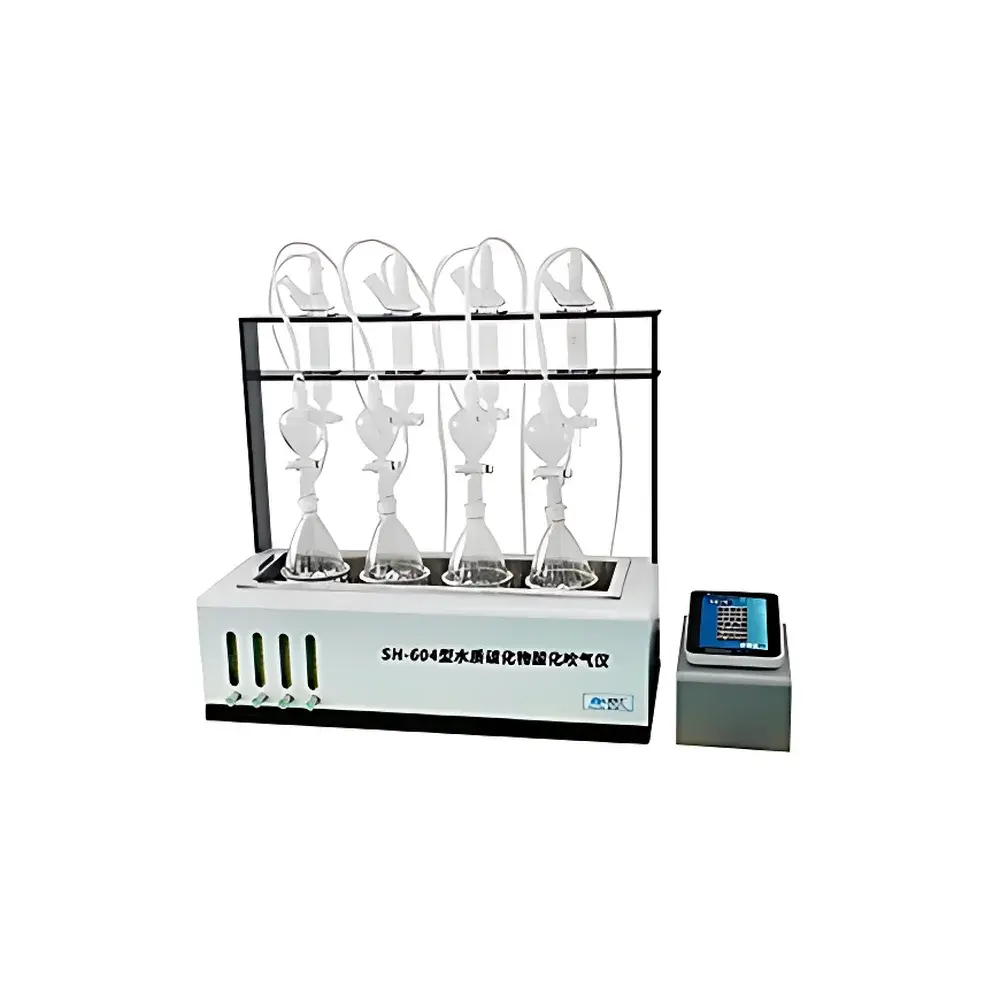
Shengaohua SH-604(V11) Acidification and Gas-Stripping System for Sulfide Analysis
| Brand | Shengaohua |
|---|---|
| Origin | Jiangsu, China |
| Manufacturer Type | Direct Manufacturer |
| Country of Origin | China |
| Model | SH-604(V11) |
| Instrument Type | Laboratory Benchtop System |
| Display | 7-inch Color Touchscreen (Chinese UI) |
| Bath Material | Food-Grade 304 Stainless Steel |
| Temperature Range | Ambient to 99.9 °C |
| Temperature Control Accuracy | ±1 °C |
| Heating Power | 1000 W |
| Heating Method | Constant-Temperature Water Bath |
| Power Supply | AC (220 ± 22) V, 50 Hz |
| N₂ Inlet Pressure | 0.1 MPa |
| Individual Channel Flow Range | 0–0.6 L/min (Rotameter) |
| Total Flow Range | 0–3 L/min (Rotameter) |
Overview
The Shengaohua SH-604(V11) Acidification and Gas-Stripping System is a purpose-built laboratory instrument engineered for the quantitative determination of sulfide (S²⁻) in aqueous environmental matrices—including surface water, groundwater, domestic wastewater, and industrial effluents—according to standardized wet-chemical analytical protocols. It operates on the principle of acidification-driven liberation of hydrogen sulfide (H₂S) gas from sample solutions under controlled thermal and pneumatic conditions, followed by selective trapping or direct spectrophotometric quantification. The system implements a parallel multi-channel gas-stripping architecture where each sample vessel is subjected to independent, precisely metered nitrogen sparging within a thermostatically regulated water bath. This design ensures high reproducibility across replicates and eliminates cross-contamination risks inherent in shared-gas-path configurations. Its engineering aligns with core requirements of Chinese national standards GB/T 16489–1996 (Methylene Blue Spectrophotometry), HJ/T 60–2000 (Iodometric Titration), and HJ 833–2017 (Soil and Sediment Analysis via Methylene Blue method with water-bath heating), making it suitable for accredited environmental testing laboratories operating under CNAS or provincial EPB quality assurance frameworks.
Key Features
- Modular, channel-isolated gas distribution system with individual rotameter-controlled nitrogen flow (0–0.6 L/min per channel) and total flow monitoring (0–3 L/min), enabling precise method optimization for varying sample volumes and matrix viscosities.
- Food-grade 304 stainless steel water bath with uniform thermal conductivity, corrosion resistance, and compliance with ISO 8573-1 (compressed air purity) and USP material compatibility guidelines for analytical instrumentation.
- 7-inch high-resolution color touchscreen interface with intuitive Chinese-language menu navigation, real-time temperature/flow/timer feedback, and non-volatile parameter storage for method recall.
- Independent programmable timers per channel (0–999 min), integrated audible alarm (5-second duration), and automatic power cutoff upon timer expiration—critical for unattended operation during overnight or extended extraction cycles.
- Overflow-prevention liquid containment design with raised rim and sloped base geometry, minimizing risk of bath contamination and ensuring operational safety during volatile acid additions (e.g., phosphoric or hydrochloric acid).
- Robust benchtop architecture with front-access service panel, EMI-shielded power module, and CE-compliant electrical isolation meeting IEC 61010-1:2010 safety requirements for laboratory equipment.
Sample Compatibility & Compliance
The SH-604(V11) accommodates standard 100–500 mL volumetric flasks, gas-washing bottles, or custom trapping vessels compatible with ASTM D4129–18 (Standard Test Method for Total Sulfur in Water by Oxidative Combustion and Ion Chromatography) sample preparation workflows. Its thermal stability and inert bath construction support analyses involving acidic reagents (pH <2), sulfide-rich sludge digests, and saline wastewater samples up to 35 g/L TDS without degradation of performance. The system satisfies functional equivalency criteria outlined in ISO/IEC 17025:2017 Clause 6.4.3 (Equipment Verification) when paired with certified reference materials (CRMs) such as NIST SRM 2783 (Sulfide in Freshwater) and validated against interlaboratory comparison programs (e.g., FAPAS® Environmental Water Proficiency Testing Scheme).
Software & Data Management
While the SH-604(V11) operates as a standalone hardware platform without embedded PC connectivity, its touchscreen interface logs all critical operational parameters—including setpoint temperature, actual bath temperature, elapsed time, and flow status—for manual transcription into laboratory notebooks or LIMS-compatible electronic records. For GLP/GMP-aligned environments, users may integrate the instrument into audit-trail workflows using external digital loggers (e.g., DeltaTRAK FlashLink® or Omega OM-CP-HITEMP140) that record timestamped temperature profiles compliant with FDA 21 CFR Part 11 Annex 11 data integrity principles. All firmware updates and calibration certificates are traceable via Shengaohua’s manufacturer-issued serial-number-based documentation package.
Applications
- Regulatory compliance testing for municipal wastewater discharge permits (e.g., China’s GB 8978–1996, EU Urban Wastewater Treatment Directive 91/271/EEC Annex I B).
- Environmental impact assessment (EIA) field-lab analysis of riverine and estuarine sulfide speciation under anaerobic sediment conditions.
- Process monitoring in biogas desulfurization units, pulp-and-paper mill effluent streams, and petroleum refinery wastewater treatment plants.
- Research applications in geochemical sulfur cycling studies, including sulfate-reducing bacterial activity quantification in microcosm experiments.
- Method validation and recovery studies using spiked CRMs for QA/QC adherence in third-party environmental testing labs.
FAQ
What standards does the SH-604(V11) directly support?
It is designed and verified for use with GB/T 16489–1996, HJ/T 60–2000, and HJ 833–2017, covering both water and solid-phase (soil/sediment) sulfide analysis via methylene blue and iodometric methods.
Can the instrument be used with alternative carrier gases?
Yes—while optimized for nitrogen (N₂), argon or synthetic air may be substituted provided inlet pressure remains at 0.1 MPa and flow rates are recalibrated per channel using certified rotameters.
Is the water bath volume adjustable or configurable?
No—the bath is fixed-capacity (approx. 12 L) with pre-engineered immersion depth for standard 250 mL reaction flasks; custom inserts are available upon request for non-standard vessel geometries.
Does the system include built-in data export capability?
No—it lacks USB/RS-232/Ethernet interfaces; however, its deterministic timing and stable thermal control enable high-fidelity manual data capture suitable for ISO/IEC 17025-compliant reporting.
What maintenance intervals are recommended for long-term reliability?
Daily visual inspection of rotameter float movement and bath water clarity; quarterly descaling with 5% citric acid solution; annual verification of temperature sensor accuracy against NIST-traceable thermometers per ISO/IEC 17025 Clause 6.5.2.







